Showing posts with label swart. Show all posts

Saturday, February 14, 2015

Metal oxidation states in the oxygen-evolving complex: A computational challenge

V. Krewald, M. Retegan, N. Cox, J. Messinger, W. Lubitz, S. DeBeer, F. Neese and D.A. Pantazis,
Chemical Science 2015, early-view (Open-Access)
Contributed by Marcel Swart

The determination of oxidation states of metals in biological systems is not an easy task and can lead to surprises or controversies. This was for instance shown last year when an unusual molybdenum(III) oxidation state in the nitrogenase enzyme was reported [1], or the year before [2] for a Sc-capped iron-oxygen complex where the crystal structure shows a iron(III) oxidation state unlike the expected iron(IV) state based on solution data [3].
The situation is infinitely more complex when more than one metal ion is present, as is the case in the oxygen evolving complex (OEC) of photosystem II that is studied here through a combination of computational chemistry and spectroscopy. The OEC contains 4 manganese and 1 calcium as the active species to convert water into oxygen. Many studies have been performed on the five stages along the catalytic cycle, often with contradictory conclusions about the geometry, electronic structure, oxidation and protonation states involved.
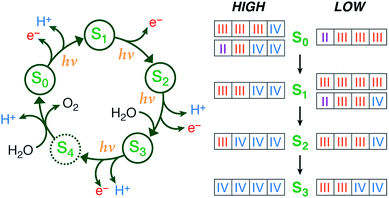

Summary of the catalytic cycle with the five stages (reproduced with permission from Chem. Sci., 2015, Advance Article, DOI: 10.1039/C4SC03720K; Published by The Royal Society of Chemistry) 

A breakthrough was a recent atomic resolution crystal structure [4] that largely confirmed the theoretical predictions by Siegbahn [5] about the geometrical positioning of the manganese ions and the oxygens. Still, a detailed understanding of the oxidation states was lacking, which is being explored in the paper by Pantazis and co-workers through a combination of a variety of experimental and theoretical techniques.
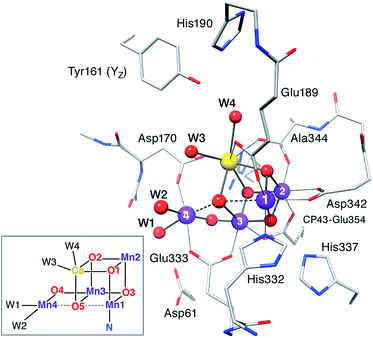

Typical model system used in the calculations (reproduced with permission from Chem. Sci., 2015, Advance Article, DOI: 10.1039/C4SC03720K; Published by The Royal Society of Chemistry) 

It is this combination of both theory and experiment, and the systematic exploration of protonation states, open- vs. closed cubane structure, distribution of +3/+4 oxidation states over the different manganese ions that makes this a complete and convincing story for the assignment of high-valent (HV) oxidation states along the catalytic cycle.
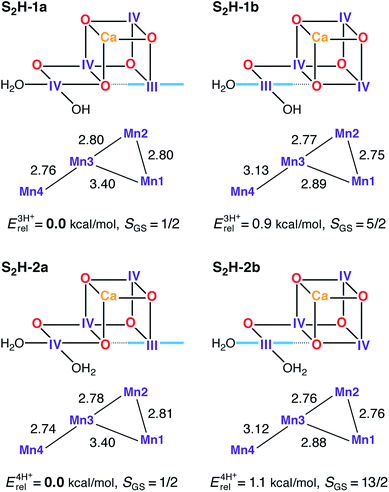

One example of the different possible distributions of oxidation states (III or IV) and spin states (1/2, 5/2 or 13/2), for state 2 models (reproduced with permission from Chem. Sci., 2015, Advance Article, DOI: 10.1039/C4SC03720K; Published by The Royal Society of Chemistry) 

The HV assignments made are consistent with the experimental data obtained so far, including a very recent “radiation-damage-free” crystal structure [6], for the first three stages of the catalytic cycle (S1-S3). What remains to be explored is how the enzyme produces the dioxygen molecule in the S4 stage and returns back to the resting state S0. Without any doubt, further unexpected findings will be coming along for this intriguing catalytic cycle.

[1] Chem. Sci. 2014, 5, 3096-3103, DOI: 10.1039/C4SC00337C 
[2] Chem. Commun. 2013, 49, 6650-6652, DOI: 10.1039/c3cc42200c
[3] Nature Chem. 2010, 2, 756-759, DOI: 10.1038/nchem.731
[4] Nature 2011, 473, 55-60, DOI: 10.1038/nature09913
[5] Acc. Chem. Res. 2009, 42, 1871-1880, DOI: 10.1021/ar900117k
[6] Nature 2015, 517, 99-103, DOI: 10.1038/nature13991

Creative Commons License
This work is licensed under a Creative Commons Attribution 3.0 Unported License. 

Saturday, January 4, 2014

Electron correlation, zero-point vibrational and temperature effects in Nuclear Magnetic Resonance spectroscopy

A.M. Teale, O.B. Lutnæs, T. Helgaker, D.J. Tozer, J. Gauss, Journal of Chemical Physics 2013, 138, 024111 (Pay-wall) and
J. Kaminský, M. Buděšínský, S. Taubert, P. Bouřa, M. Straka, Physical Chemistry Chemical Physics 2013, 15, 9223-9230 (Open Access)
Contributed by Marcel Swart

Last year has seen two important contributions in the field of determination of NMR chemical shifts by theoretical chemistry. More and more it is recognized that the computational prediction of 1H and 13C chemical shifts is a useful tool for natural product, mechanistic, and synthetic organic chemistry.[1] There are however doubts about how accurate these results are, and if any chemically relevant conclusions can be drawn from them.

The first paper[2] compares the chemical shifts as obtained by both density functional theory and wavefunction theory (RHF, CCSD, CCSD(T), extrapolated) for a total of 28 molecules (for which previously already rotational g-tensors and magnetizabilities were computed[3]). The authors also included zero-point vibrational effects on the computed chemical shieldings, and used extrapolation techniques to estimate uncertainties related to basis-set incompleteness[4]. First, the authors established an accurate benchmark set of data, for which the accuracy was established by comparison with experimental data (including zero-point vibrational corrections). They found good agreement between CCSD(T)/aug-cc-pCVQZ and experiment (empirical equilibrium values), with a mean-absolute-error of 2.9 ppm for the chemical shieldings. Afterwards, these reference data were used to compare how well a variety of density functionals was able to reproduce them, with a sobering conclusion: "None of the existing approximate functionals provide an accuracy competitive with that provided by CCSD or CCSD(T) theory".[2] The best performing functional (as shown before) was KT2 with a mean-absolute-error compared to the CCSD(T) data (both with the same aug-cc-pCVQZ basis set) of 10.2 ppm.

The second paper[5] has a completely different approach, and deals with the characterization of fullerenes. For this purpose, computational chemistry might be used, but one again should be sure about the methods used. The authors used quantum vibrational averaging, a dielectric continuum model for the solvent (CPCM, 1,1,2-trichloroethane), classical (MM3) and first-principle (BP86/def-SVP) molecular dynamics simulations, and did experiments. These authors used a different set of density functionals, and found the best results for wB97X-D/IGLO-III (a root-mean-square deviation compared to experiment of only 0.4 ppm). However, surprisingly, in the analysis of the dynamical part they used either BP86 or BHandHLYP for the NMR chemical shifts, even though these showed larger RMSD values of respectively 1.7 and 0.8 ppm. Moreover, big differences were found in the chemical shifts from the snapshots of the 1 ns classical MD, and those of the 1.2 ps first-principles MD. For the five different atom types these differences were found in the range 1.8-7.9 ppm.[6]

References and notes
[1] M.W. Lodewyk, M.R. Siebert, D.J. Tantillo, Chem. Rev. 2012, 112, 1839-1862 [DOI 10.1021/cr200106v]
[2] A.M. Teale, O.B. Lutnæs, T. Helgaker, D.J. Tozer, J. Gauss, J. Chem. Phys. 2013, 138, 024111 [DOI 10.1063/1.4773016]
[3] O. B. Lutnæs, A. M. Teale, T. Helgaker, D. J. Tozer, K. Ruud, J. Gauss, J. Chem. Phys. 2009, 131, 144104 [DOI 10.1063/1.3242081]
[4] These formulas have been developed for energies; hence, their use for the direct extrapolation of molecular properties is less well founded, and indeed can not be used with a two-point extrapolation for prediction of the basis set limiting value.
[5] J. Kaminský, M. Buděšínský, S. Taubert, P. Bouřa, M. Straka, Phys. Chem. Chem. Phys. 2013, 15, 9223-9230 [DOI 10.1039/C3CP50657F]
[6] Strangely enough, while the CPCM solvent model only had a modest effect on the chemical shifts of 0.2-0.3 ppm, the authors showed that first-principles MD (FPMD) simulations including solvent effects (COSMO) led to drastically different results for the chemical shifts of snapshots (0.1-4.1 ppm) from those from FPMD without them.

Creative Commons License
This work is licensed under a Creative Commons Attribution 3.0 Unported License. 

Tuesday, November 27, 2012

Polyoxometalates are cationic, not anionic

N.V. Izarova, N. Vankova, A. Banerjee, G.B. Jameson, T. Heine, F. Schinle, O. Hampe, U. Kortz, Angewandte Chemie International Edition 2010, 49, 7807-7811 (Paywall)
Contributed by Marcel Swart

Polyoxometalates are clusters of metals connected together through oxygens, and can be giant molecules such as {(MoVI)MoVI5O21}12(MoV2O4)30]12- (also known as Mo132) as shown by Bo and Miró in Dalton Transactions recently[1]. These clusters bear a total anionic charge, for instance -12 in the aforementioned example. However, this is not the complete picture.

Ulrich Kortz (Univ. Bremen) visited Girona a couple of months ago and reported an interesting example of how theory can be useful. His group was working on a "A Noble-Metalate Bowl", and when trying to reproduce the 51V NMR spectrum computationally, it was impossible to get good agreement. By introducing Na/K cations they did get more and more reasonable results, and only obtained good agreement after having introduced 7 potassiums (or alternatively 6 potassiums and 1 sodium).


At first, the experimental people did not believe the calculations, because they had their mind set on the fact that polyoxometalates carry a large negative charge, and not a positive one. However, after doing electrospray mass spectrometry, indeed they observed mainly two peaks:

1) a singly charged molecular cation {K7[Pd7V6O24(OH)2]}+ (with seven potassiums)
2) a singly charged molecular cation {Na1K6[Pd7V6O24(OH)2]}+ (with six potassiums)

Therefore, contrary to popular belief, polyoxometalates are cationic!

[1] C. Bo, P. Miró, Dalton Trans. 2012, 41, 9984-9988

Creative Commons License
This work is licensed under a Creative Commons Attribution 3.0 Unported License. 

Monday, April 2, 2012

Exchange-Enhanced Open-Shell States: Hund's rule for Bioinorganic Species Applied to H-Abstraction

D. Janardanan, D. Usharani, S. Shaik Angewandte Chemie International Edition 2012, 51, 4421-4425 (Paywall)

In a Perspective in Nature Chemistry last year1 Sason Shaik and co-workers described bond activation by metal-oxo enzymes and synthetic reagents. In it, they argued that Hund's rule of maximum multiplicity (valid for atoms) has an analogue for reactions and kinetics of (bio)inorganic species: the exchange-enhanced reactivity (EER). Pathways that increase the number of unpaired and spin-identical electrons on a metal center will be favored by exchange interactions, and hence are favored over pathways that keep the same number (or less) of exchange interactions.

In this recent paper in Angewandte Chemie International Edition Shaik and co-workers apply their EER principle on H-abstraction reactions, and show how dramatic axial ligand effects can be explained by it. The systems under study are [(Cz)(X)MnVO] (Cz: corrolazinato3-, X=None, F-, CN-) complexes (see Figure below), which probably have a singlet ground state (X=None) or a triplet ground state (X=F-, CN-).


More important than the ground state of the reactant is however the spin state of the transition states (TSs). The hydrogen abstraction involves a proton-coupled electron transfer (PCET): the migrating H· radical transfers its radical to the d-block of the metal, while at the same time the proton makes the O-H bond. For the singlet state, one obtains at the TS an open-shell singlet with an alpha electron on the metal and a beta electron on the substrate. In the exchange-enhanced triplet state, there are now three alpha electrons on the metal (with favorable exchange interactions) that gives the dramatic decrease in barrier (from 32 kcal·mol-1 for the singlet to 23.0 kcal·mol-1 for the triplet).

The axial ligand effect has two origins: the exchange interactions become stronger (11.1, 12.4 and 12.9 kcal·mol-1 for the three complexes) while at the same time the d-orbitals become closer in energy (smaller excitation energy).

References

(1) S. Shaik, H. Chen, D. Janardanan, "Exchange-enhanced reactivity in bond activation by metal-oxo enzymes and synthetic reagents", Nature Chem. 2011, 3, 19-27, DOI: 10.1038/NChem.943

Creative Commons License
This work is licensed under a Creative Commons Attribution 3.0 Unported License.