Wednesday, April 11, 2012

Conformations and Fluorescence of Encapsulated Stilbene

D. Tzeli, G. Theodorakopoulos, I. D. Petsalakis, D. Ajami, J. Rebek Journal of the American Chemical Society 2012, 134, 4346-4354 (Paywall)
Contributed by Steven Bachrach.
Reposted from Computational Organic Chemistry with permission

Petsalakis and Rebek have explored the fluorescence of stilbene inside a couple of different kinds of capsules. trans-Stilbene exhibits weak fluorescence in solution, but when placed inside a small capsule, the fluorescence disappears almost entirely, while in a large capsule, the fluorescence returns to normal. They examined stilbene inside two different capsules using a variety of DFT and ONIOM techniques.

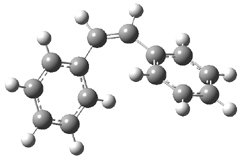
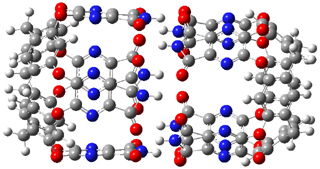
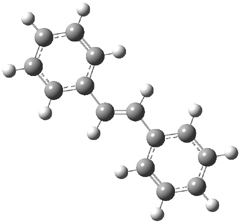
The optimized geometries of trans- and cis-stilbene optimized at CAM-B3LYP/6-31G(d,p) are displayed in Figure 1. As expected, the trans conformer is planar and the cis conformer is twisted to avoid clashes between the phenyl rings. The optimized structure of the 1.1 capsule is also shown in Figure 1. All of these structures are fairly insensitive to computational method. (They have also looked at an even larger capsule, but I have omitted displaying its structure here.)


(a)
(b)

(c)

(d)

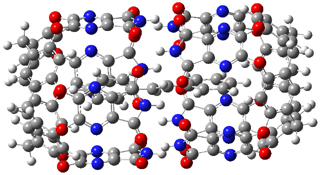
Figure 1. CAM-B3LYP/6-31G(d,p) optimized structures of (a) trans-stilbene, (b) cis-stilbene , (c) the 1.1 capsule, and (d) trans-stilbene inside the 1.1 capsule.

The structure of trans- stilbene inside the 1.1 capsule is shown in Figure 1. Of particular note is that the stilbene is no longer planar. (This twisting is perhaps better observed by an end-on view, which the reader can obtain by clicking on the picture and then manipulating the full 3-D structure using the Jmol applet.) The different computational methods give slightly different encapsulated structures, and vary a bit in their binding energies, but the twisting of the stilbene is reproduced by each method. Though not shown here, trans-stilbene in the larger capsule is again a nearly planar structure.

The structure of the S1 state of trans-stilbene in the large capsule is the same as for free trans-stilbene. However, the geometry of the S1 state in the smaller 1.1 capsule is twisted and corresponds to the conical intersection geometry.

The absorption spectra and the emission spectra were computed for the free and encapsulated structures. The absorption and emission spectra for free stilbene and stilbene in the larger capsule are nearly identical, corresponding to the experimental observation of similar fluorescence behavior. The absorption spectra of stilbene in the 1.1 capsule has a small blue shift of 8 nm due to the twisted geometry. But the major result is that the S1 state of stilbene inside the 1.1 capsule distorts to the conical intersection, allowing for radiationless return to the ground state. This means that there would be no fluorescence, and that is exactly what is observed.

Creative Commons License
This work is licensed under a Creative Commons Attribution-NoDerivs 3.0 Unported License.

Wednesday, April 4, 2012

Quadruple bonding in C2 and analogous eight-valence electron species

Sason Shaik, David Danovich, Wei Wu, Peifeng Su, Henry S. Rzepa, Philippe C. Hiberty, Nature Chemistry 2012, 4, 195 (Paywall)
Contributed by Steven Bachrach.
Reposted from Computational Organic Chemistry with permission

Inspired by a blog post of Henry Rzepa (see here) Shaik and co-workers examined the C2 species with an eye towards the nature of the bond between the two carbon atoms. Using both a valence bond approach and a full CI approach, they end up at the same place: there is a quadruple bond here!

The argument rests largely on a definition of of an in situ bond energy. For the VB approach, this requires choosing as a reference a non-bonding interaction between the atoms with regards to a pair of electrons. For the CI approach, the bond energy is half the energy of the singlet-triplet gap. So, for C2, the VB/6-31G* estimate of the bond energy of the putative fourth bond is 14.3 kcal mol-1. For the full CI/6-31G* computations of the singlet-triplet gap, the bond energy estimate is 14.8 kcal mol-1, and using the experimental value of the gap, the estimate is 13.2 kcal mol-1. Not a strong bond, but certainly meaningful!

In the VB approach, the fourth bond is a weighted sum of the antibonding 2σu and bonding 3σg orbitals – a combination that gives rise to small constructive overlap between the two C atoms. In the CI model, the wavefunction is dominated by the first two configurations; the first configuration, with a coefficient of C0=0.828 has 2σu doubly occupied and the second coefficient, with CD=0.324, has the 3σg orbital doubly occupied. Considering that 3σg is a bonding orbital, the significant contribution of this configuration gives rise to the fourth bond.


Creative Commons License
This work is licensed under a Creative Commons Attribution-NoDerivs 3.0 Unported License.

Monday, April 2, 2012

Exchange-Enhanced Open-Shell States: Hund's rule for Bioinorganic Species Applied to H-Abstraction

D. Janardanan, D. Usharani, S. Shaik Angewandte Chemie International Edition 2012, 51, 4421-4425 (Paywall)

In a Perspective in Nature Chemistry last year1 Sason Shaik and co-workers described bond activation by metal-oxo enzymes and synthetic reagents. In it, they argued that Hund's rule of maximum multiplicity (valid for atoms) has an analogue for reactions and kinetics of (bio)inorganic species: the exchange-enhanced reactivity (EER). Pathways that increase the number of unpaired and spin-identical electrons on a metal center will be favored by exchange interactions, and hence are favored over pathways that keep the same number (or less) of exchange interactions.

In this recent paper in Angewandte Chemie International Edition Shaik and co-workers apply their EER principle on H-abstraction reactions, and show how dramatic axial ligand effects can be explained by it. The systems under study are [(Cz)(X)MnVO] (Cz: corrolazinato3-, X=None, F-, CN-) complexes (see Figure below), which probably have a singlet ground state (X=None) or a triplet ground state (X=F-, CN-).


More important than the ground state of the reactant is however the spin state of the transition states (TSs). The hydrogen abstraction involves a proton-coupled electron transfer (PCET): the migrating H· radical transfers its radical to the d-block of the metal, while at the same time the proton makes the O-H bond. For the singlet state, one obtains at the TS an open-shell singlet with an alpha electron on the metal and a beta electron on the substrate. In the exchange-enhanced triplet state, there are now three alpha electrons on the metal (with favorable exchange interactions) that gives the dramatic decrease in barrier (from 32 kcal·mol-1 for the singlet to 23.0 kcal·mol-1 for the triplet).

The axial ligand effect has two origins: the exchange interactions become stronger (11.1, 12.4 and 12.9 kcal·mol-1 for the three complexes) while at the same time the d-orbitals become closer in energy (smaller excitation energy).

References

(1) S. Shaik, H. Chen, D. Janardanan, "Exchange-enhanced reactivity in bond activation by metal-oxo enzymes and synthetic reagents", Nature Chem. 2011, 3, 19-27, DOI: 10.1038/NChem.943

Creative Commons License
This work is licensed under a Creative Commons Attribution 3.0 Unported License. 

Editorial: First indication of impact

This figure shows a plot of cumulative views per month for the PLoS ONE paper "The Energy Computation Paradox and ab initio Protein Folding" by Faver et al.   Month 12 corresponds to March 2012, the month in which the paper was highlighted in Computational Chemistry Highlights.  During March the paper was viewed 345 times - a significant increase compared to the 86 views the previous month and second only to the first month where it was viewed 346 times.

 PLoS ONE is one of the few journals that publish such metrics so similar analyses are not possible for the other highlighted paper.  Never-the-less, the numbers are strong indication that Computational Chemistry Highlights is having an impact already.

Creative Commons License
This work is licensed under a Creative Commons Attribution 3.0 Unported License. 

Saturday, March 31, 2012

Finding Density Functionals with Machine Learning

John C. Snyder, Matthias Rupp, Katja Hansen, Klaus-Robert Müller, and Kieron Burke arXiv:1112.5441v1 2012 (Open Access)

The study uses standard machine learning (ML) techniques to construct a density-based (i.e. orbital-free) expression for the electronic kinetic energy $(T^{ML})$ for a model 1-dimensional system of up to four non-interacting electrons subject to a smooth potential.  Sub-kcal/mol accuracy can be achieved with fewer than 100 Gaussian training densities.

Numerical noise in the functional derivative of $T^{ML}$ is removed by a principal component analysis and while variational minimization of the energy fails to find a unique density "the search does not produce a unique minimum, it produces a range of similar but valid approximate densities, each with a small error."

While the application of the method does not require any physical intuition about the form of the functional, physically motivated potentials can be included in the method to improve results.  It will be very interesting indeed to see this and similar approaches being trained against highly accurate electronic structure data computed for for atoms and molecules, not just for the kinetic energy but for the exchange-correlation functional itself.

Acknowledgement: I thank Matteo Cavalleri for bringing this paper to my attention via twitter.


Creative Commons License
This work is licensed under a Creative Commons Attribution 3.0 Unported License.

Wednesday, March 28, 2012

Synthesis and Properties of [9]Cyclo-1,4-naphthylene: A π-Extended Carbon Nanoring

Akiko Yagi, Yasutomo Segawa, and Kenichiro Itami Journal of the America Chemical Society 2012, 134, 2962–2965 (Paywall)
Contributed by Steven Bachrach.
Reposted from Computational Organic Chemistry with permission

Itami continues to design novel macrocycles containing aromatic rings (see this post). This latest paper reports the synthesis of the first nanohoops containing naphthylenes, namely [9]cyclo-1,4-naphthylene 1. Since the macrocycle contains an odd number of naphthylene units, the lowest energy conformation is of C2 symmetry with one of the naphthylene rings in the plane of the macrocycle. This conformation gives rise to 27 peaks in the proton NMR, and while the value of the computed chemical shifts differ from the experimental ones by about 0.5 to 1 ppm, their relative ordering is in very nice agreement.

Itami also notes that 1 is chiral and computed the barrier for racemization of 19.9 kcal mol-1¸ through the transition state 2. This racemization process is compared with the racemization of 1,1’-binaphthyl.

Creative Commons License
This work is licensed under a Creative Commons Attribution-NoDerivs 3.0 Unported License.

Sunday, March 25, 2012

Linear Scaling Self-Consistent Field Calculations with Millions of Atoms in the Condensed Phase

Joost VandeVondele, Urban Borštnik, and Jürg Hutter Journal of Chemical Theory and Computation 2012, ASAP. (Paywall)

This paper presents orbital-based self-consistent field calculations on three-dimensional dihydrogen and water clusters containing up to two million atoms. The main new feature is the use of a mathematical technique called the matrix sign function to express the density matrix and the inverse overlap matrix. This is combined with more conventional linear techniques: a static mixing approach to solve the self-consistent equation, parallel sparse matrix multiplication, use of plane waves and Fast Fourier Transforms to compute the Coulomb energy, and use of energy functions that do not require Hartree-Fock exchange.

The method is implemented in the open source CP2K/Quickstep software package.

The LDA-DFT/minimial basis set energy of one million dihydrogen molecules is computed in 8 minutes of wall clock time using 46,656 cores of an Cray XT5. For comparison, an LDA-DFT/double zeta single point calculation on a 96,000-atom water cluster (736,000 basis functions) requires 16 h using  46,656 cores.  Results for NDDO and DFT tight binding energy functions are also presented.

It will be very interesting to see how this method performs with heterogeneous systems and GGA functionals.

Acknowledgement: Thanks to Noel O'Boyle and Michael Banck for alerting me to this article.

Creative Commons License
This work is licensed under a Creative Commons Attribution 3.0 Unported License.