Showing posts with label water. Show all posts

Wednesday, March 14, 2018

DeePCG: A Deep Neural Network Molecular Force Field


DeePCG: constructing coarse-grained models via deep neural networks. L Zhang, J Han, H Wang, R Car, Weinan E. arXiv:1802.08549v2 [physics.chem-ph]
Contributed by Jesper Madsen

The idea of “learning” a molecular force field (FF) using neural networks can be traced back to Blank et al. in 1995.[1] Modern variations (reviewed recently by Behler[2]), such as the DeePCG scheme[3] that I highlight here, seem to have two key innovations to set them apart from earlier work: network depth and atomic environment descriptors. The latter was the topic of my recent highlight and Zhang et al.[3] take advantage of similar ideas.
Figure 1: “Schematic plot of the neural network input for the environment of CG particle i, using water as an example. Red and white balls represent the oxygen and the hydrogen atoms of the microscopic system, respectively. Purple balls denote CG particles, which, in our example, are centered at the positions of the oxygens.)” from ref. [3]    
Zhang et al. simulate liquid water using ab initio molecular dynamics (AIMD) on the DFT/PBE0 level of theory in order to train a coarse-grained (CG) molecular water model. The training is done by a standard protocol used in CGing where mean forces are fitted by minimizing a loss-function (the natural choice is the residual sum of squares) over the sampled configurations. CGing liquid water is difficult because of the necessity of many-body contributions to interactions, especially so upon integrating out degrees-of-freedom. One would therefore expect that a FF capable of capturing such many-body effects to perform well, just as DeePCG does, and I think this is a very nice example of exactly how much can be gained by using faithful representations of atomic neighborhoods instead of radially symmetric pair potentials. Recall that traditional force-matching, while provably exact in the limit of the complete many-body expansion,[4] still shows non-negligible deviations from the target distributions for most simple liquids when standard approximations are used.

FF transferability, however, is likely where the current grand challenge is to be found. Zhang et al. remark that it would be convenient to have an accurate yet cheap (e.g., CG) model for describing phase transitions in water. They do not attempt this in the current preprint paper, but I suspect that it is not *that* easy to make a decent CG model that can correctly get subtle long-range correlations right at various densities, let alone different phases of water and ice, coexistences, interfaces, impurities (non-water moieties), etc. Machine-learnt potentials continuously demonstrate excellent accuracy over the parameterization space of states or configurations, but for transferability and extrapolations, we are still waiting to see how far they can get.

References

[1] Neural network models of potential energy surfaces. TB Blank, SD Brown, AW Calhoun, DJ Doren. J Chem Phys 103, 4129 (1995)
[2] Perspective: Machine learning potentials for atomistic simulations. J Behler. J Chem Phys 145, 170901 (2016)
[3] DeePCG: constructing coarse-grained models via deep neural networks. L Zhang, J Han, H Wang, R Car, Weinan E. arXiv:1802.08549v2 [physics.chem-ph]
[4] The multiscale coarse-graining method. I. A rigorous bridge between atomistic and coarse-grained models. WG Noid, J-W Chu, GS Ayton, V Krishna, S Izvekov, GA Voth, A Das, HC Andersen. J Chem Phys 128, 244114 (2008)

Saturday, February 14, 2015

Metal oxidation states in the oxygen-evolving complex: A computational challenge

V. Krewald, M. Retegan, N. Cox, J. Messinger, W. Lubitz, S. DeBeer, F. Neese and D.A. Pantazis,
Chemical Science 2015, early-view (Open-Access)
Contributed by Marcel Swart

The determination of oxidation states of metals in biological systems is not an easy task and can lead to surprises or controversies. This was for instance shown last year when an unusual molybdenum(III) oxidation state in the nitrogenase enzyme was reported [1], or the year before [2] for a Sc-capped iron-oxygen complex where the crystal structure shows a iron(III) oxidation state unlike the expected iron(IV) state based on solution data [3].
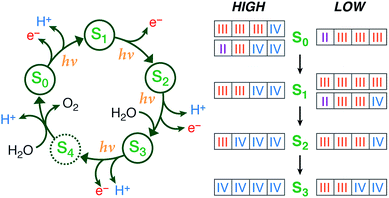
The situation is infinitely more complex when more than one metal ion is present, as is the case in the oxygen evolving complex (OEC) of photosystem II that is studied here through a combination of computational chemistry and spectroscopy. The OEC contains 4 manganese and 1 calcium as the active species to convert water into oxygen. Many studies have been performed on the five stages along the catalytic cycle, often with contradictory conclusions about the geometry, electronic structure, oxidation and protonation states involved.


Summary of the catalytic cycle with the five stages (reproduced with permission from Chem. Sci., 2015, Advance Article, DOI: 10.1039/C4SC03720K; Published by The Royal Society of Chemistry

A breakthrough was a recent atomic resolution crystal structure [4] that largely confirmed the theoretical predictions by Siegbahn [5] about the geometrical positioning of the manganese ions and the oxygens. Still, a detailed understanding of the oxidation states was lacking, which is being explored in the paper by Pantazis and co-workers through a combination of a variety of experimental and theoretical techniques.


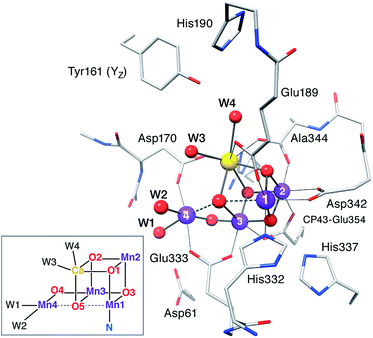
Typical model system used in the calculations (reproduced with permission from Chem. Sci., 2015, Advance Article, DOI: 10.1039/C4SC03720K; Published by The Royal Society of Chemistry

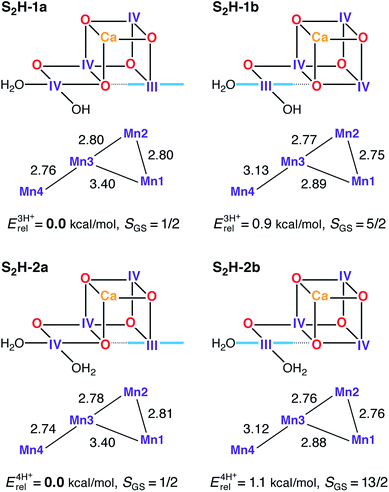
It is this combination of both theory and experiment, and the systematic exploration of protonation states, open- vs. closed cubane structure, distribution of +3/+4 oxidation states over the different manganese ions that makes this a complete and convincing story for the assignment of high-valent (HV) oxidation states along the catalytic cycle.


One example of the different possible distributions of oxidation states (III or IV) and spin states (1/2, 5/2 or 13/2), for state 2 models (reproduced with permission from Chem. Sci., 2015, Advance Article, DOI: 10.1039/C4SC03720K; Published by The Royal Society of Chemistry

The HV assignments made are consistent with the experimental data obtained so far, including a very recent “radiation-damage-free” crystal structure [6], for the first three stages of the catalytic cycle (S1-S3). What remains to be explored is how the enzyme produces the dioxygen molecule in the S4 stage and returns back to the resting state S0. Without any doubt, further unexpected findings will be coming along for this intriguing catalytic cycle.

[1] Chem. Sci. 2014, 5, 3096-3103, DOI: 10.1039/C4SC00337C 
[2] Chem. Commun. 2013, 49, 6650-6652, DOI: 10.1039/c3cc42200c
[3] Nature Chem. 2010, 2, 756-759, DOI: 10.1038/nchem.731
[4] Nature 2011, 473, 55-60, DOI: 10.1038/nature09913
[5] Acc. Chem. Res. 2009, 42, 1871-1880, DOI: 10.1021/ar900117k
[6] Nature 2015, 517, 99-103, DOI: 10.1038/nature13991

Creative Commons License
This work is licensed under a Creative Commons Attribution 3.0 Unported License

Thursday, January 16, 2014

Bulk Liquid Water at Ambient Temperature and Pressure from MP2 Theory

Mauro Del Ben, Mandes Schönherr, Jürg Hutter, and Joost VandeVondele. J. Phys. Chem. Lett. 2013, 4, 3753−3759. DOI: 10.1021/jz401931f
Contributed by François-Xavier Coudert.

Reprinted with permission from doi:10.1021/jz401931f
Copyright 2013 American Chemical Society.


Let's start with the obvious: molecular simulation of liquid water is a very challenging, yet very important, part of our field. While MP2 (second-order perturbation theory) gives a highly accurate description of water-water interactions in water clusters, it was so far too computationally expensive to perform decent-scale molecular dynamics and Monte Carlo simulations of bulk liquid water.

Well, no more. Using large HPC resources, in particular the European PRACE Research Infrastructure and the Swiss National Supercomputer Centre, Mauro Del Ben et al. report in J. Phys. Chem. Lett. the first “truly first-principles simulation of liquid water in the NpT ensemble”. They performed a isobaric-isothermal Monte Carlo simulation, at the MP2 level, of 64 water molecules in a periodic simulation cell, under ambient conditions. The resulting density and structure of the liquid water are quite good, and are contrasted in particular with the less-than-stellar densities yielded by DFT-based methods.

These results represent the latest step in a series of papers these past few years, harnessing the ever-growing power of HPC capabilities to test the validity of quantum chemical calculations for the description of bulk liquid water. Some of the earlier episodes can be read here: