Showing posts with label dispersion. Show all posts

Tuesday, June 26, 2018

Intramolecular London Dispersion Interaction Effects on Gas-Phase and Solid-State Structures of Diamondoid Dimers

Fokin, A. A.; Zhuk, T. S.; Blomeyer, S.; Pérez, C.; Chernish, L. V.; Pashenko, A. E.; Antony, J.; Vishnevskiy, Y. V.; Berger, R. J. F.; Grimme, S.; Logemann, C.; Schnell, M.; Mitzel, N. W.; Schreiner, P. R., J. Am. Chem. Soc. 2017, 139, 16696-16707
Contributed by Steven Bacharach
Reposted from Computational Organic Chemistry with permission

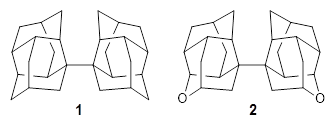
Schreiner and Grimme have examined a few compounds (see these previous posts) with long C-C bonds that are found in congested systems where dispersion greatly aids in stabilizing the stretched bond. Their new paper1 continues this theme by examining 1 (again) and 2, using computations, and x-ray crystallography and gas-phase rotational spectroscopy and electron diffraction to establish the long C-C bond.


The distance of the long central bond in 1 is 1.647 Å (x-ray) and 1.630 Å (electron diffraction). Similarly, this distance in 2 is 1.642 Å (x-ray) and 1.632 Å (ED). These experiments discount any role for crystal packing forces in leading to the long bond.

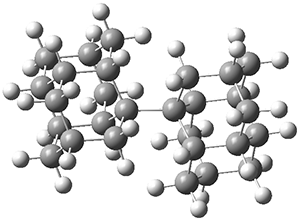
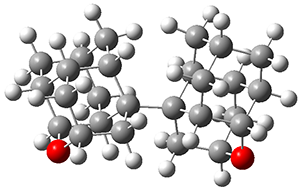
A very nice result from the computations is that most functionals that include some dispersion correction predict the C-C distance in the optimized structures with an error of no more than 0.01 Å. (PW6B95-D3/DEF2-QZVP structures are shown in Figure 1.) Not surprisingly, HF and B3LYP without a dispersion correction predict a bond that is too long.) MP2 predicts a distance that is too short, but SCS-MP2 does a very good job.


1

2
Figure 1. PW6B95-D3/DEF2-QZVP optimized structures of 1 and 2.


References

1) Fokin, A. A.; Zhuk, T. S.; Blomeyer, S.; Pérez, C.; Chernish, L. V.; Pashenko, A. E.; Antony, J.; Vishnevskiy, Y. V.; Berger, R. J. F.; Grimme, S.; Logemann, C.; Schnell, M.; Mitzel, N. W.; Schreiner, P. R., "Intramolecular London Dispersion Interaction Effects on Gas-Phase and Solid-State Structures of Diamondoid Dimers." J. Am. Chem. Soc. 2017139, 16696-16707, DOI: 10.1021/jacs.7b07884.


InChIs

1: InChI=1S/C28H38/c1-13-7-23-19-3-15-4-20(17(1)19)24(8-13)27(23,11-15)28-12-16-5-21-18-2-14(9-25(21)28)10-26(28)22(18)6-16/h13-26H,1-12H2
InChIKey=MMYAZLNWLGPULP-UHFFFAOYSA-N
2: InChI=1S/C26H34O2/c1-11-3-19-15-7-13-9-25(19,21(5-11)23(27-13)17(1)15)26-10-14-8-16-18-2-12(4-20(16)26)6-22(26)24(18)28-14/h11-24H,1-10H2
InChIKey=VPBJYHMTINJMAE-UHFFFAOYSA-N


'
This work is licensed under a Creative Commons Attribution-NoDerivs 3.0 Unported License.

Saturday, June 24, 2017

London Dispersion Enables the Shortest Intermolecular Hydrocarbon H···H Contact.

Rösel, S.; Quanz, H.; Logemann, C.; Becker, J.; Mossou, E.; Cañadillas-Delgado, L.; Caldeweyher, E.; Grimme, S.; Schreiner, P. R.,  J. Am. Chem. Soc. 2017, 139, 7428–7431
Contributed by Steven Bacharach
Reposted from Computational Organic Chemistry with permission

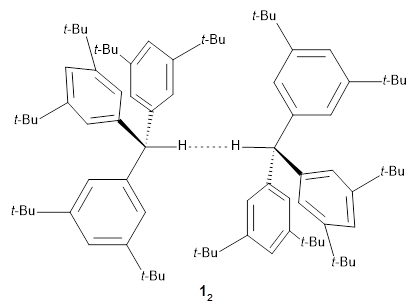
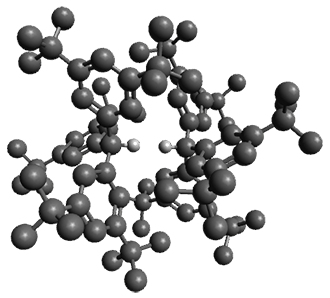
Following on previous work (see these posts on ladderane and hexaphenylethane), Schreiner, Grimme and co-workers have examined the structure of the all-meta tri(di-t-butylphenyl)methane dimer 12.1 In the study of hexaphenylethane,2 Schreiner and Grimme note that t-butyl groups stabilize highly congested structures through dispersion, identifying them as “dispersion energy donors”.3 The idea here is that the dimer of 1 will be stabilized by these many t-butyl groups. In fact, the neutron diffraction study of the crystal structure of 12 shows an extremely close approach of the two methane hydrogens of only 1.566 Å, the record holder for the closest approach of two formally non-bonding hydrogen atoms.


To understand the nature of this dimeric structure, they employed a variety of computational techniques. (Shown in Figure 1 is the B3LYPD3ATM(BJ)/def2-TZVPP optimized geometry of 12.) The HSE-3c (a DFT composite method) optimized crystal structure predicts the HH distance is 1.555 Å. The computed gas phase structure lengthens the distance to 1.634 Å, indicating a small, but essential, role for packing forces. Energy decomposition analysis of 12 at B3LYP-D3ATM(BJ)/def2-TZVPP indicates a dominant role for dispersion in holding the dimer together. While 12 is bound by about 8 kcal mol-1, the analogue of 12lacking all of the t-butyl groups (the dimer of triphenylmethane 22) is unbound by over 8 kcal mol-1. Topological electron density analysis does show a bond critical point between the two formally unbound hydrogen atoms, and the noncovalent interaction plot shows an attractive region between these two atoms.

Figure 1ATM(BJ)/def2-TZVPP optimized geometry of 12, with most of the hydrogens suppressed for clarity. (Selecting the molecule will launch Jmol with the full structure, including the hydrogens.)


References

1) Rösel, S.; Quanz, H.; Logemann, C.; Becker, J.; Mossou, E.; Cañadillas-Delgado, L.; Caldeweyher, E.; Grimme, S.; Schreiner, P. R., "London Dispersion Enables the Shortest Intermolecular Hydrocarbon H···H Contact." J. Am. Chem. Soc. 2017139, 7428–7431, DOI: 10.1021/jacs.7b01879.
2) Grimme, S.; Schreiner, P. R., "Steric Crowding Can Stabilize a Labile Molecule: Solving the Hexaphenylethane Riddle." Angew. Chem. Int. Ed. 2011, 50 (52), 12639-12642, DOI: 10.1002/anie.201103615.
3) Grimme, S.; Huenerbein, R.; Ehrlich, S., "On the Importance of the Dispersion Energy for the Thermodynamic Stability of Molecules." ChemPhysChem 2011, 12 (7), 1258-1261, DOI: 10.1002/cphc.201100127.


InChIs

1: InChI=1S/C43H64/c1-38(2,3)31-19-28(20-32(25-31)39(4,5)6)37(29-21-33(40(7,8)9)26-34(22-29)41(10,11)12)30-23-35(42(13,14)15)27-36(24-30)43(16,17)18/h19-27,37H,1-18H3
InChIKey=VFNQDWKFTWSJAU-UHFFFAOYSA-N

'
This work is licensed under a Creative Commons Attribution-NoDerivs 3.0 Unported License.

Wednesday, January 6, 2016

Attraction or Repulsion? London Dispersion Forces Control Azobenzene Switches

Schweighauser, L.; Strauss, M. A.; Bellotto, S.; Wegner, H. A. Angew. Chem. Int. Ed. 2015, 54, 13436-13439
Contributed by Steven Bachrach
Reposted from Computational Organic Chemistry with permission


The role of dispersion in organic chemistry has been slowly recognized as being quite critical in a variety of systems. I have blogged on this subject many times, discussing new methods for properly treating dispersion within quantum computations along with a variety of molecular systems where dispersion plays a critical role. Schreiner1 has recently published a very nice review of molecular systems where dispersion is a key component towards understanding structure and/or properties.

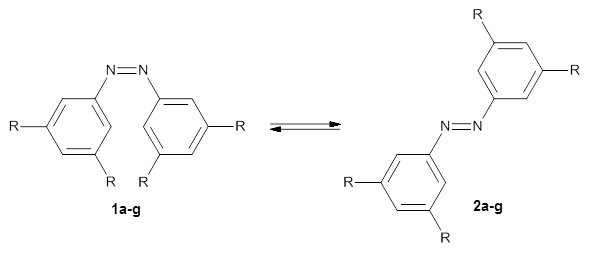
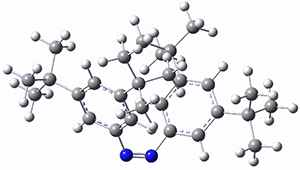
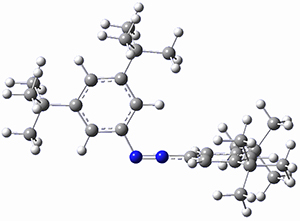
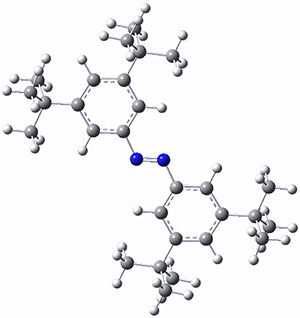
In a similar vein, Wegner and coworkers have examined the Z to E transition of azobenzene systems (1a-g 2a-g) using both experiment and computation.2 They excited the azobenzenes to the Z conformation and then monitored the rate for conversion to the E conformation. In addition they optimized the geometries of the two conformers and the transition state for their interconversion at both B3LYP/6-311G(d,p) and B3LYP-D3/6-311G(d,p). The optimized structure of the t-butyl-substituted system is shown in Figure 1.

a: R=H; b: R=tBu; c: R=Me; d: R=iPr; e: R=Cyclohexyl; f: R=Adamantyl; g: R=Ph

1b

1b-TS-2b

2b
Figure 1. B3LYP-D3/6-311G(d,p) optimized geometries of 1a, 2a, and the TS connecting them.

The experiment finds that the largest activation barriers are for the adamantly  1f  and  t-butyl 1b azobenzenes, while the lowest barriers are for the parent 1a and methylated 1c azobenzenes.

The trends in these barriers are not reproduced at B3LYP but are reproduced at B3LYP-D3. This suggests that dispersion is playing a role. In the Z conformations, the two phenyl groups are close together, and if appropriately substituted with bulky substituents, contrary to what might be traditionally thought, the steric bulk does not destabilize the Z form but actually serves to increase the dispersion stabilization between these groups. This leads to a higher barrier for conversion from the Z conformer to the Econformer with increasing steric bulk.


References

(1) Wagner, J. P.; Schreiner, P. R. "London Dispersion in Molecular Chemistry—Reconsidering Steric Effects,"Angew. Chem. Int. Ed. 2015, 54, 12274-12296, DOI: 10.1002/anie.201503476.
(2) Schweighauser, L.; Strauss, M. A.; Bellotto, S.; Wegner, H. A. "Attraction or Repulsion? London Dispersion Forces Control Azobenzene Switches," Angew. Chem. Int. Ed. 2015, 54, 13436-13439, DOI:10.1002/anie.201506126.


InChIs

1b: InChI=1S/C28H42N2/c1-25(2,3)19-13-20(26(4,5)6)16-23(15-19)29-30-24-17-21(27(7,8)9)14-22(18-24)28(10,11)12/h13-18H,1-12H3/b30-29-
InChIKey=SOCNVTNVHBWFKC-FLWNBWAVSA-N
2b: InChI=1S/C28H42N2/c1-25(2,3)19-13-20(26(4,5)6)16-23(15-19)29-30-24-17-21(27(7,8)9)14-22(18-24)28(10,11)12/h13-18H,1-12H3/b30-29+
InChIKey=SOCNVTNVHBWFKC-QVIHXGFCSA-N


This work is licensed under a Creative Commons Attribution-NoDerivs 3.0 Unported License.

Thursday, December 3, 2015

Small Atomic Orbital Basis Set First-Principles Quantum Chemical Methods for Large Molecular and Periodic Systems: A Critical Analysis of Error Sources

Sure, R.; Brandenburg, J. G.; Grimme, S. ChemistryOpen, EarlyView, DOI: 10.1002/open.201500192 (CC by-nc-nd)
Contributed by Grant Hill

The use of density functional theory (DFT) calculations to produce insights into the chemistry unveiled by experiment is widespread due to its relative ease-of-use and ability to explain many chemical phenomena of interest. In particular, the B3LYP hybrid functional [1] and the Pople-type 6-31G* basis set [2] are incredibly popular, with some referring to this as Default Favourite Theory (a play on DFT).[3] A recent review by Grimme and co-workers sets out a case against using this B3LYP/6-31G* model chemistry by careful examination of errors.

The review contends that the use of small basis sets such as 6-31G* leads to relatively large errors due to both basis set superposition error (BSSE) and basis set incompleteness error (BSIE). It's not entirely clear how to separate these two terms and as a result the review mostly focuses on the BSSE element, with some emphasis on intramolecular BSSE in addition to the more familiar intermolecular BSSE. The question of why B3LYP/6-31G* still performs well in a number of cases is then examined in terms of a fortuitous cancellation of errors between BSSE and London forces (dispersion energy). It is demonstrated that this cancellation cannot be relied upon in all cases and a convincing case is made for choosing different basis sets and methods. While the review mostly focuses on intermolecular interactions, there is some generalisation to other problems of interest.

A number of alternative methods for including dispersion in DFT calculations are reviewed, and final recommendations are made that can easily be incorporated into the workflow of a non-specialist, without a significant increase in computational cost. This includes the use of the def2-SVP basis set of Weigend, Ahlrichs and co-workers.[4] This review should make for interesting reading for anyone routinely using DFT methods in conjunction with double-zeta basis sets.

References:
[1]a) Stephens, P. J.; Devlin, F. J.; Chablowski, C. F.; Frisch, M. J. J. Phys. Chem. 1994, 98, 11623. b) Becke, A. D. J. Chem. Phys. 1993, 98, 5648.
[2] Hehre, W. J.; Ditchfield, R.; Pople, J. A. J. Chem. Phys. 1972, 56, 2257.
[3] I first heard this at the Computational Molecular Science conference in 2008, but I can't recall the originator. The late Nick Handy responded by suggesting that DFT could instead be "Damn Fine Theory".
[4] See Weigend, F.; Ahlrichs, R. Phys. Chem. Chem. Phys. 2005, 7, 3297 and references therein. These basis sets are available to download from the EMSL basis set exchange in formats suitable for most electronic structure packages.

Tuesday, December 1, 2015

Bis-corannulene Receptors for Fullerenes Based on Klärner’s Tethers: Reaching the Affinity Limits

Abeyratne Kuragama, P. L.; Fronczek, F. R.; Sygula, A. Org. Lett. 2015, ASAP
Contributed by Steven Bachrach
Reposted from Computational Organic Chemistry with permission

Capturing buckyballs involves molecular design based on non-covalent interactions. This poses interesting challenges for both the designer and the computational chemist. The curved surface of the buckyball demands a sequestering agent with a complementary curved surface, likely an aromatic curved surface to facilitate π-π stacking interactions. For the computational chemist, weak interactions, like dispersion and π-π stacking demand special attention, particularly density functionals designed to account for these interactions.

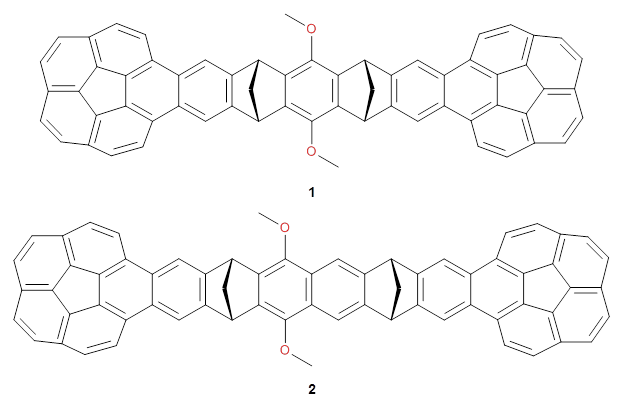
Two very intriguing new buckycatchers were recently prepared in the Sygula lab, and also examined by DFT.1 Compounds 1 and 2 make use of the scaffold developed by Klärner.2 In these two buckycatchers, the tongs are corranulenes, providing a curved aromatic surface to match the C60 and C70 surface. They differ in the length of the connector unit.
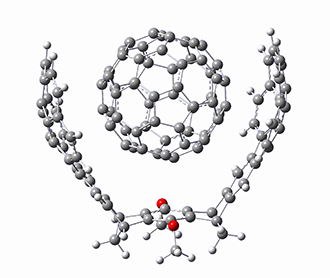
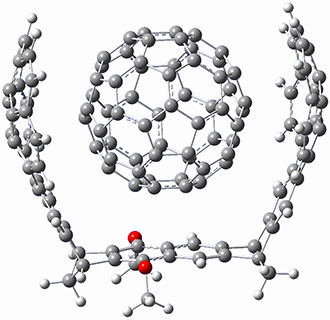
B97-D/TZVP computations of the complex of 1 and 2 with C60 were carried out. The optimized structures are shown in Figure 1. The binding energies (computed at B97-D/QZVP*//B97-D/TZVP) of these two complexes are really quite large. The binding energy for 1:C60 is 33.6 kcal mol-1, comparable to some previous Buckycatchers, but the binding energy of 2:C60 is 50.0 kcal mol-1, larger than any predicted before.

1

2
Figure 1. B97-D/TZVP optimized geometries of 1:C60and 2:C60.

Measurement of the binding energy using NMR was complicated by a competition for one or two molecules of 2 binding to buckyballs. Nonetheless, the experimental data show 2 binds to C60 and C70more effectively than any previous host. They were also able to obtain a crystal structure of 2:C60.


References

(1) Abeyratne Kuragama, P. L.; Fronczek, F. R.; Sygula, A. "Bis-corannulene Receptors for Fullerenes Based on Klärner’s Tethers: Reaching the Affinity Limits," Org. Lett. 2015, ASAP, DOI:10.1021/acs.orglett.5b02666.
(2) Klärner, F.-G.; Schrader, T. "Aromatic Interactions by Molecular Tweezers and Clips in Chemical and Biological Systems," Acc. Chem. Res. 201346, 967-978, DOI: 10.1021/ar300061c.


InChIs

1: InChI=1S/C62H34O2/c1-63-61-57-43-23-45(41-21-37-33-17-13-29-9-5-25-3-7-27-11-15-31(35(37)19-39(41)43)53-49(27)47(25)51(29)55(33)53)59(57)62(64-2)60-46-24-44(58(60)61)40-20-36-32-16-12-28-8-4-26-6-10-30-14-18-34(38(36)22-42(40)46)56-52(30)48(26)50(28)54(32)56/h3-22,43-46H,23-24H2,1-2H3/t43-,44+,45+,46-
InChIKey=RLOJCVYXCBOUQB-RYSLUOGPSA-N
2: InChI=1S/C66H36O2/c1-67-65-51-24-45-43-23-44(42-20-38-34-16-12-30-8-4-27-3-7-29-11-15-33(37(38)19-41(42)43)59-55(29)53(27)56(30)60(34)59)46(45)25-52(51)66(68-2)64-50-26-49(63(64)65)47-21-39-35-17-13-31-9-5-28-6-10-32-14-18-36(40(39)22-48(47)50)62-58(32)54(28)57(31)61(35)62/h3-22,24-25,43-44,49-50H,23,26H2,1-2H3/t43-,44+,49+,50-
InChIKey=JAUUHTKCNSNBMD-NETXOKAWSA-N


This work is licensed under a Creative Commons Attribution-NoDerivs 3.0 Unported License.

Thursday, May 14, 2015

Using dispersion-corrected density functional theory to understand supramolecular binding thermodynamics

Antony, J.; Sure, R.; Grimme, S. Chem. Commun. 2015, 51, 1764-1774
Contributed by Steven Bachrach.
Reposted from Computational Organic Chemistry with permission

Grimme and coworkers have a featured article on computing host-guest complexes in a recentChemComm.1 They review the techniques his group has pioneered, particularly dispersion corrections for DFT and ways to treat the thermodynamics in moving from electronic energy to free energy. they briefly review some studies done by other groups. They conclude with a new study of eight different host guest complexes, three of which are shown in Figure 1.

1

2

3
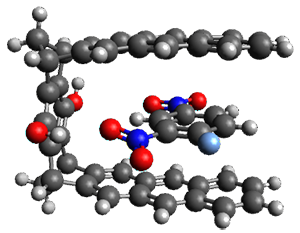
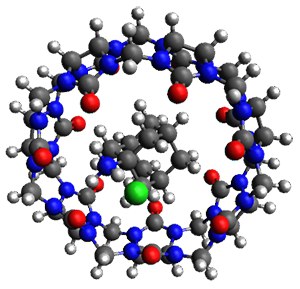
Figure 1. TPSS-D3(BJ)/def2-TZVP optimized structures of 1-3.

These eight host-guest complexes are fairly large systems, and the computational method employed means some fairly long computations. Geometries were optimized at TPSS-D3(BJ)/def2-TZVP, then single point energy determined at PW6B95-D3(BJ)/def2-QZVP. Solvent was included using COSMO-RS. The curcurbituril complex 2 includes a counterion (chloride) along with the guest adamantan-1-aminium. Overall agreement of the computed free energy of binding with the experimental values was very good, except for 3 and the related complex having a larger nanohoop around the fullerene. The error is due to problems in treating the solvent effect, which remains an area of real computational need.

An interesting result uncovered is that the binding energy due to dispersion is greater than the non-dispersion energy for all of these complexes, including the examples that are charged or where hydrogen bonding may be playing a role in the bonding. This points to the absolute necessity of including a dispersion correction when treating a host-guest complex with DFT.

As an aside, you’ll note one of the reasons I was interested in this paper: 3 is closely related to the structure that graces the cover of the second edition of my book.

References
(1) Antony, J.; Sure, R.; Grimme, S. "Using dispersion-corrected density functional theory to understand supramolecular binding thermodynamics," Chem. Commun. 201551, 1764-1774, DOI:10.1039/C4CC06722C.


This work is licensed under a Creative Commons Attribution-NoDerivs 3.0 Unported License.

Wednesday, April 30, 2014

Approaches to dispersion in DFT

Contributed by David Bowler
Reposted from Atomistic Computer Simulations with permission


Dispersion is a general term referring to weak, long-range dynamic correlations in electronic structure (and includes van der Waals interactions). These interactions are not well modelled by standard DFT functionals, and the development of approaches to fix this has been a growth area in DFT recently. I will cover the most common approaches here, at a relatively non-technical level, but there are many references at the end which give much more detail. Probably the most important piece of technical information in this area is that the leading term in a distance-based expansion of the dispersion energy falls off as 1/r^6, and the expansion coefficients of this term are often known as C6 coefficients. Most practical approaches to dispersion use semi-local forms: the interaction is either between pairs of atoms or between two points in space.
We can divide approaches to dispersion in DFT into four areas, becoming steadily more accurate (and expensive) as we progress: semi-empirical, pair-wise approaches to the C6 terms, such as DFT-D2[1]; approaches which go beyond semi-empirical, and introduce environment-dependent C6 coefficients and some ab initio information, such as DFT-D3[2] and TS[3]; density functional approaches based on the vdW-DF-04[4] of Langreth and Lundqvist (and co-workers); and approaches which go beyond pair-wise additivity, such as many-body dispersion[5] and the random-phase approximation (RPA)[6]. Many of these are available in standard DFT codes, though the functionals with which they can be paired vary from method to method (and can have a strong effect on their accuracy[7]).
Almost all pair-wise approaches also introduce scaling factors. A short-range scaling is used to turn off dispersion when atoms are close together (both for pragmatic and physical reasons: 1/r^6 diverges as r becomes small, and dispersion is negligible at small distances). A long-range cutoff or scaling is also common, to remove unnecessary computational load and reduce scaling; pragmatically, the 1/r^6 scaling will make this an excellent approximation.
Semi-empirical approaches, the most well-known of which is the DFT-D2 approach, fit C6 terms to ab initio or experimental data. DFT-D2 was based on a particular GGA functional (at least in the original paper, though it is now used with many others) and adds C6 terms pair-wise between all atoms, hence giving a formal scaling of N^2. The C6 terms are calculated from atomic polarisabilities, and take no account of the environment; the approach is aimed at biomolecules in the main, where it has had significant success; it is, however, essentially a force-field.
Including environment dependence as well as ab initio data makes approaches significantly more transferrable. The TS method starts with C6 coefficients found for interactions between free atoms, calculated with self-interaction corrected TDDFT. These terms are assembled and weighted using a scheme to divide the ground state DFT charge density and assign contributions to atoms at different points in space. The DFT-D3 method also uses TDDFT calculations for polarisabilities (though with a hybrid functional – which can have a similar effect). The method calculates not just pair-wise C6 terms but also three-body C9 terms (using a geometric mean of the isolated C6 terms), and weights the C6 terms via a coordination number. Both methods are more sophisticated than a simple force field approach, and allow the geometry or DFT density to influence the calculations. They are applicable to most of the periodic table, and are accurate and fast.
The next stage in accuracy is to base the dispersion calculation on the DFT density itself. All functionals in this class are based on the work of Langreth, Lundqvist and co-workers, known as vdW-DF[4]. The approach is to take a double integral over a pair of points in space, and at each point calculate the product of the charge densities at the two points and a kernel which depends on both points. The form of the kernel, of course, is the key point that determines the accuracy and effectiveness of the method. The original vdW-DF is based on the frequency-dependent plasmon-pole model (which is the correct physics), and is accurate for many different problems. The method was extended to be self-consistent[8] and has been updated[9] to improve the response of the functional to gradients in the charge density, making it more accurate (these functionals are commonly known as vdW-DF04 and vdW-DF10). A significant variant on the kernel used was proposed and optimised by Vydrov and van Voorhis[10]: this approach is numerically simpler, but makes approximations which are somewhat controversial (there is a Comment and a Reply if you follow the Phys. Rev. Lett. reference below). There have been a number of papers on implementing these kernels, which are numerically demanding, the most important of which uses a factorisation of the kernel and fast fourier transforms to reduce the scaling to N log(N)[11]. This implementation is available in SIESTA and as a stand-alone package, and is an important contribution to the community. There have been a number of investigations of how the exchange functional paired with this functional can affect energy; one of these (which I co-authored) found that chemical accuracy could be achieved[7].
Going beyond pair-wise interactions is challenging. The TS method has been extended to include many-body dispersion[5] by representing interactions between atomic densities in terms of quantum harmonic oscillators. The method uses the electron density from DFT, and involves the diagonalisation of a Hamiltonian with the dimension of the number of atoms. As the name suggests, the method includes terms beyond two-body, and effectively sums the coefficients to infinite order. It requires the fitting of a range-separation parameter (to prevent the small distance divergence). The other main method is the RPA (random phase approximation)[6,12] which is an approach to separating the one-particle and collective degrees of freedom for an electron gas. The RPA has been included into DFT, and is a good approximation to correlation, including dispersion effects; it is often applied post hoc, in other words non-self-consistently, and is computationally expensive, scaling as N^4 at best.
What can we conclude ? At present, the cheapest, reasonably reliable approaches are DFT-D3 and TS, which add little to the cost of a standard DFT calculation, and are available in various codes (both, I think, are in VASP and QuantumEspresso). An implementation of DFT-D3 and a complete set of coefficients are freely available from Stefan Grimme. The vdW-DF functionals, in whatever form you choose, are more expensive, but are more satisfying to many people, as they do not impose any division into atoms or fragments. For now, I would say that the many-body work is still experimental, and should only be tackled by experts. But overall, dispersion can now be included in DFT calculations with some confidence, and should be a part of most investigations.
[1] S. Grimme, J. Comput. Chem. 27, 1787 (2006) 10.1002/jcc.20495
[2] S. Grimme, J. Antony, S. Ehrlich & H. Krieg, J. Chem. Phys. 132, 154104 (2010)10.1063/1.3382344
[3] A. Tkatchenko & M. Scheffler, Phys. Rev. Lett. 102, 073005 (2009)10.1103/PhysRevLett.102.073005
[4] M. Dion, H. Rydberg, E. Schroder, D. C. Langreth & B. I. Lundqvist, Phys. Rev. Lett. 92, 246401 (2004) 10.1103/PhysRevLett.92.246401
[5] R. A. DiStasio, Jr, O. A. von Lilienfeld and A. Tkatchenko, Proc. Nat. Acad. Sci. 109, 14791 (2012) 10.1073/pnas.1208121109
[6] J. F. Dobson & T. Gould, J. Phys.: Condens. Matter 24, 073201 (2012) 10.1088/0953-8984/24/7/073201
[7] J. Klimes, D. R. Bowler & A. Michaelides, J. Phys.: Condens. Matter 22, 022201 (2010)10.1088/0953-8984/22/2/022201
[8] T. Thonhauser, V. R. Cooper, S. Li, A. Puzder, P. Hylgaard and D. C. Langreth, Phys. Rev. B 76125112 (2007) 10.1103/PhysRevB.76.125112
[9] K. Lee, E. D. Murray, L. Kong. B. I. Lundqvist and D. C. Langreth, Phys. Rev. B 82, 081101(R)10.1103/PhysRevB.82.081101
[10] O. A. Vydrov and T. van Voorhis J. Chem. Phys. 133, 244103 (2010) 10.1063/1.3521275 (see also Phys. Rev. Lett. 103 063004 and the attendant Comment/Reply)
[11] G. Roman-Perez & J.M. Soler, Phys. Rev. Lett. 103, 096102 (2009)10.1103/PhysRevLett.103.096102
[12] There is a large, complex literature; see, for instance, J. Mater. Sci. 47, 7447 (2012)10.1007/s10853-0012-6570-4

Thursday, April 24, 2014

Nature Utilizes Unusual High London Dispersion Interactions for Compact Membranes Composed of Molecular Ladders

Wagner, J. P.; Schreiner, P. R. J. Chem. Theor. Comput. 2014,10, 1353-1358
Contributed by Steven Bachrach.
Reposted from Computational Organic Chemistry with permission

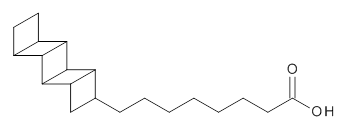
Schreiner provides another beautiful example of the important role that dispersion plays, this time in a biological system.1 The microbe Candidatus Brocadia Anammoxidans oxidizes ammonia with nitrite. This unusual process must be done anaerobically and without allowing toxic side products, like hydrazine to migrate into the cellular environment. So this cell has a very dense membrane surrounding the enzymes that perform the oxidation. This dense membrane is home to some very unusual lipids, such as 1. These lipids contain the ladderane core, a highly strained unit. Schreiner hypothesized that these ladderane groups might pack very well and very tightly due to dispersion.

1
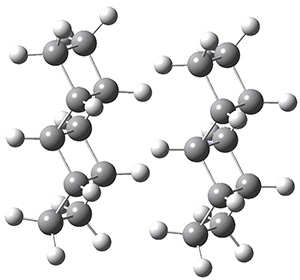
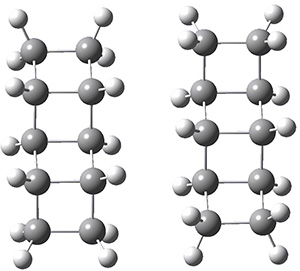
The geometries of the [2]- through [5]-ladderanes and their dimers were optimized at MP2/aug-cc-pVDZ, and the binding energies corrected for larger basis sets and higher correlation effects. The dimers were oriented in their face-to-face orientation (parallel-displaced dimer, PDD) or edge-to-edge (side-on dimer, SD). Figure 1 shows the optimized structures of the two dimeric forms of [4]-ladderane.

[4]-PDD

[4]-SD
Figure 1. MP2/aug-cc-pVDZ optimized geometries of the dimers of [4]-ladderane in the PDD and SD orientations.
The binding energies of the ladderane dimers, using the extrapolated energies and at B3LYP-D3/6-311+G(d,p), are listed in Table 1. (The performance of the B3LYP-D3 functional is excellent, by the way.) The binding is quite appreciable, greater than 6 kcal mol-1 for both the [4]- and [5]-ladderanes. Interestingly, these binding energies far exceed the binding energies of similarly long alkanes. So, very long alkyl lipid chains would be needed to duplicate the strong binding. Nature appears to have devised a rather remarkable solution to its cellular isolation problem!

Eextrapolated
EB3LYP-D3
[2]-PDD
-27.
-3.2
[3]-PDD
-4.2
-4.1
[4]-PDD
-5.5
-5.3
[5]-PDD
-6.6
-6.5
[2]-SD
-3.3
-3.1
[3}-SD
-4.1
-4.4
[4]-SD
-6.5
-5.7
[5]-SD
-7.5
-7.0


References

(1) Wagner, J. P.; Schreiner, P. R. "Nature Utilizes Unusual High London Dispersion
Interactions for Compact Membranes Composed of Molecular Ladders," J. Chem. Theor. Comput. 2014,10, 1353-1358, DOI: 10.1021/ct5000499.


InChIs

1: InChI=InChI=1S/C20H30O2/c21-15(22)7-5-3-1-2-4-6-11-10-14-16(11)20-18-13-9-8-12(13)17(18)19(14)20/h11-14,16-20H,1-10H2,(H,21,22)/t11-,12-,13+,14-,16+,17+,18-,19-,20+/m0/s1
InChIKey=ZKKJRZDMLYQUNK-QIPWGTBCSA-N
[2]-ladderane: InChI=1S/C6H10/c1-2-6-4-3-5(1)6/h5-6H,1-4H2/t5-,6+
InChIKey=YZLCEXRVQZNGEK-OLQVQODUSA-N
[3]-ladderane: InChI=1S/C8H12/c1-2-6-5(1)7-3-4-8(6)7/h5-8H,1-4H2/t5-,6+,7+,8-
InChIKey=YTZCZYFFHKYOBJ-SOSBWXJGSA-N
[4]-ladderane: InChI=1S/C10H14/c1-2-6-5(1)9-7-3-4-8(7)10(6)9/h5-10H,1-4H2/t5-,6+,7+,8-,9-,10+
InChIKey=VZHFDSXKIJOCAY-UXAOAXNSSA-N
[5]-ladderane: InChI=1S/C12H16/c1-2-6-5(1)9-10(6)12-8-4-3-7(8)11(9)12/h5-12H,1-4H2/t5-,6+,7-,8+,9+,10-,11-,12+
InChIKey=CWUAAECPDWVJSU-SBBGGFAWSA-N


This work is licensed under a Creative Commons Attribution-NoDerivs 3.0 Unported License.

Wednesday, February 12, 2014

Effects of London dispersion correction in density functional theory on the structures of organic molecules in the gas phase

Grimme, S.; Steinmetz, M. Phys. Chem. Chem. Phys. 2013, 15, 16031 
Contributed by Steven Bachrach.
Reposted from Computational Organic Chemistry with permission

The importance of dispersion in determining molecular structure, even the structure of a single medium-sized molecule, is now well recognized. This means that quantum methods that do not account for dispersion might give very poor structures.

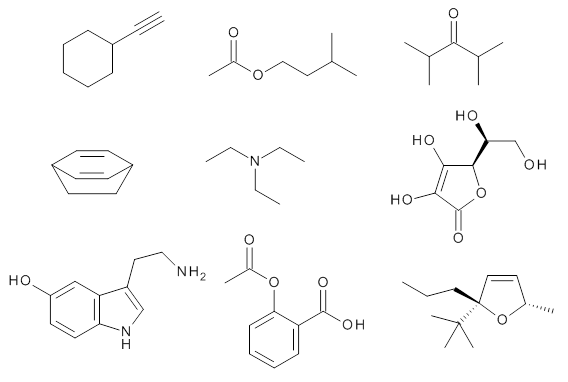
Grimme1 takes an interesting new twist towards assessing the geometries produced by computational methods by evaluating the structures based on their rotational constants B0 obtained from microwave experiments. He uses nine different molecules in his test set, shown in Scheme 1. This yields 25 different rotational constants (only one rotational constant is available from the experiment on triethylamine). He evaluates a number of different computational methods, particularly DFT with and without a dispersion correction (either the D3 or the non-local correction). The fully optimized geometry of each compound with each method is located to then the rotational constants are computed. Since this provides Be values, he has computed the vibrational correction to each rotational constant for each molecule, in order to get “experimental” Be values for comparisons.
Scheme 1.
Grimme first examines the basis set effect for vitamin C and aspirin using B3LYP-D3. He concludes that def2-TZVP or lager basis sets are necessary for reliable structures. However, the errors in the rotational constant obtained at B3LYP-D3/6-31G* is at most 1.7%, and even with CBS the error can be as large as 1.1%, so to my eye even this very small basis set may be completely adequate for many purposes.

In terms of the different functionals (using the DZVP basis set), the best results are obtained with the double hybrid B2PLYP-D3 functional where the mean relative deviation is only 0.3%; omitting the dispersion correction only increases the mean error to 0.6%. Common functionals lacking the dispersion correction have mean errors of about 2-3%, but with the correction, the error is appreciably diminished. In fact B3LYP-D3 has a mean error of 0.9% and B3LYP-NL has an error of only 0.6%. In general, the performance follows the Jacob’s Ladder hierarchy.


References

(1) Grimme, S.; Steinmetz, M. "Effects of London dispersion correction in density functional theory on the structures of organic molecules in the gas phase," Phys. Chem. Chem. Phys. 201315, 16031-16042, DOI: 10.1039/C3CP52293H.


This work is licensed under a Creative Commons Attribution-NoDerivs 3.0 Unported License.


Thursday, October 31, 2013

Dispersion-Driven Conformational Isomerism in σ-Bonded Dimers of Larger Acenes

Ehrlich, S.; Bettinger, H. F.; Grimme, S. Angew. Chem. Int. Ed. 2013, 41, 10892
Contributed by Steven Bachrach.
Reposted from Computational Organic Chemistry with permission
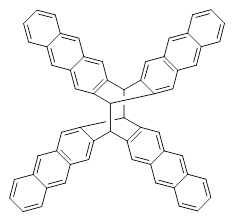
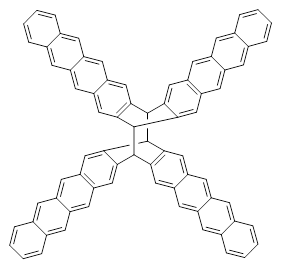
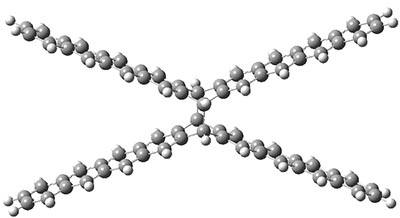
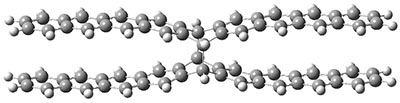
The role of dispersion in large systems is increasingly recognized as critical towards understanding molecular geometry. An interesting example is this study of acene dimers by Grimme.1 The heptacene and nonacene dimers (1 and 2) were investigated with an eye towards the separation between the “butterfly wings” – is there a “stacked” conformation where the wings are close together, along with the “open” conformer?

1

2
The LPNO-CEPA/CBS potential energy surface of 1 shows only a single local energy minima, corresponding to the open conformer. B3LYP-D3 and B3LYP-NL, two different variations of dealing with dispersion (see this post), do a reasonable job at mimicking the LPNO-CEPA results, while MP2 indicates the stacked conformer is lower in energy than the open conformer.

B3LYP-D3 predicts both conformers for the nonacene dimer 2, and the optimized structures are shown in Figure 2. The stacked conformer is slightly lower in energy than the open one, with a barrier of about 3.5 kcal mol-1. However in benzene solution, the open conformer is expected to dominate due to favorable solvation with both the interior and exterior sides of the wings.

open

stacked
Figure 1. B3LYP-D3/ef2-TZVP optimized structures of the open and stacked conformations of 2.


References

(1) Ehrlich, S.; Bettinger, H. F.; Grimme, S. "Dispersion-Driven Conformational Isomerism in σ-Bonded Dimers of Larger Acenes," Angew. Chem. Int. Ed. 201341, 10892–10895, DOI:10.1002/anie.201304674.


InChIs

1: InChI=1S/C60H36/c1-2-10-34-18-42-26-50-49(25-41(42)17-33(34)9-1)57-51-27-43-19-35-11-3-4-12-36(35)20-44(43)28-52(51)58(50)60-55-31-47-23-39-15-7-5-13-37(39)21-45(47)29-53(55)59(57)54-30-46-22-38-14-6-8-16-40(38)24-48(46)32-56(54)60/h1-32,57-60H
InChIKey=OYVUURMCCBPDLI-UHFFFAOYSA-N
2: InChI=1S/C76H44/c1-2-10-42-18-50-26-58-34-66-65(33-57(58)25-49(50)17-41(42)9-1)73-67-35-59-27-51-19-43-11-3-4-12-44(43)20-52(51)28-60(59)36-68(67)74(66)76-71-39-63-31-55-23-47-15-7-5-13-45(47)21-53(55)29-61(63)37-69(71)75(73)70-38-62-30-54-22-46-14-6-8-16-48(46)24-56(54)32-64(62)40-72(70)76/h1-40,73-76H
InChIKey=FTSMWBVFVPAXOB-UHFFFAOYSA-N


Creative Commons License
This work is licensed under a Creative Commons Attribution-NoDerivs 3.0 Unported License.