Showing posts with label aromaticity. Show all posts

Wednesday, March 27, 2019

Planar rings in nano-Saturns and related complexes

Bachrach, S. M., Chem. Commun. 2019, 55, 3650-3653
Contributed by Steven Bacharach
Reposted from Computational Organic Chemistry with permission

For the past twelve years, I have avoided posting on any of my own papers, but I will stoop to some shameless promotion to mention my latest paper,1 since it touches on some themes I have discussed in the past.

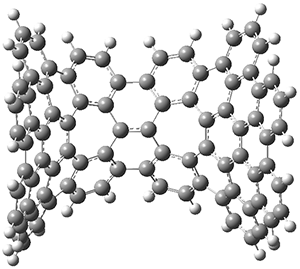
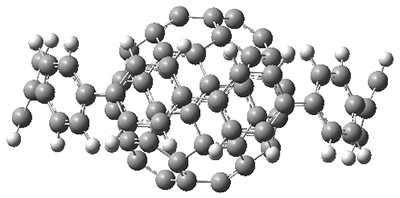
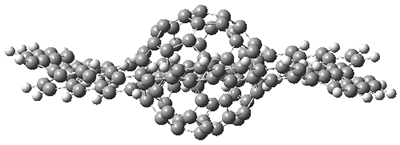
Back in 2011, Iwamoto, et al. prepared the complex of C60 1 surrounded by [10]cycloparaphenylene 2 to make the Saturn-like system 3.2 Just last year, Yamamoto, et al prepared the Nano-Saturn 5a as the complex of 1 with the macrocycle 4a.3 The principle idea driving their synthesis was to utilize a ring that is flatter than 2. The structures of 3 and 5b (made with the parent macrocycle 4b) are shown in side view in Figure 1, and clearly seen is the achievement of the flatter ring.

3

5b

7
Figure 1. Computed structures of 3, 5, and 7.

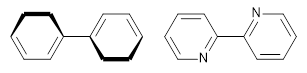
However, the encompassing ring is not flat, with dihedral angles between the anthrenyl groups of 35°. This twisting is due to the steric interactions of the ortho-ortho’ hydrogens. A few years ago, my undergraduate student David Stück and I suggested that selective substitution of a nitrogen for one of the C-H groups would remove the steric interaction,4 leading to a planar poly-aryl system, such as making twisted biphenyl into the planar 2-(2-pyridyl)-pyridine (Scheme 1)

Scheme 1.

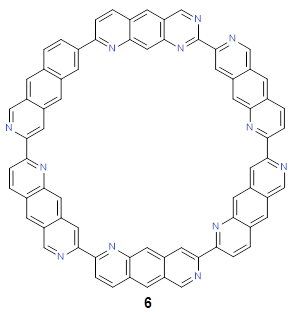
Following this idea leads to four symmetrical nitrogen-substituted analogues of 4b; and I’ll mention just one of them here, 6.

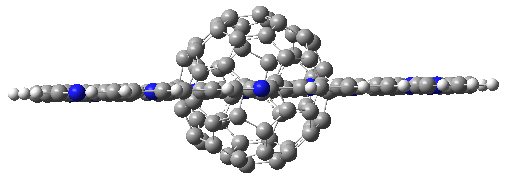
As expected, 6 is perfectly flat. The ring remains flat even when complexed with (as per B3LYP-D3(BJ)/6-31G(d) computations), see the structure of 7 in Figure 1.

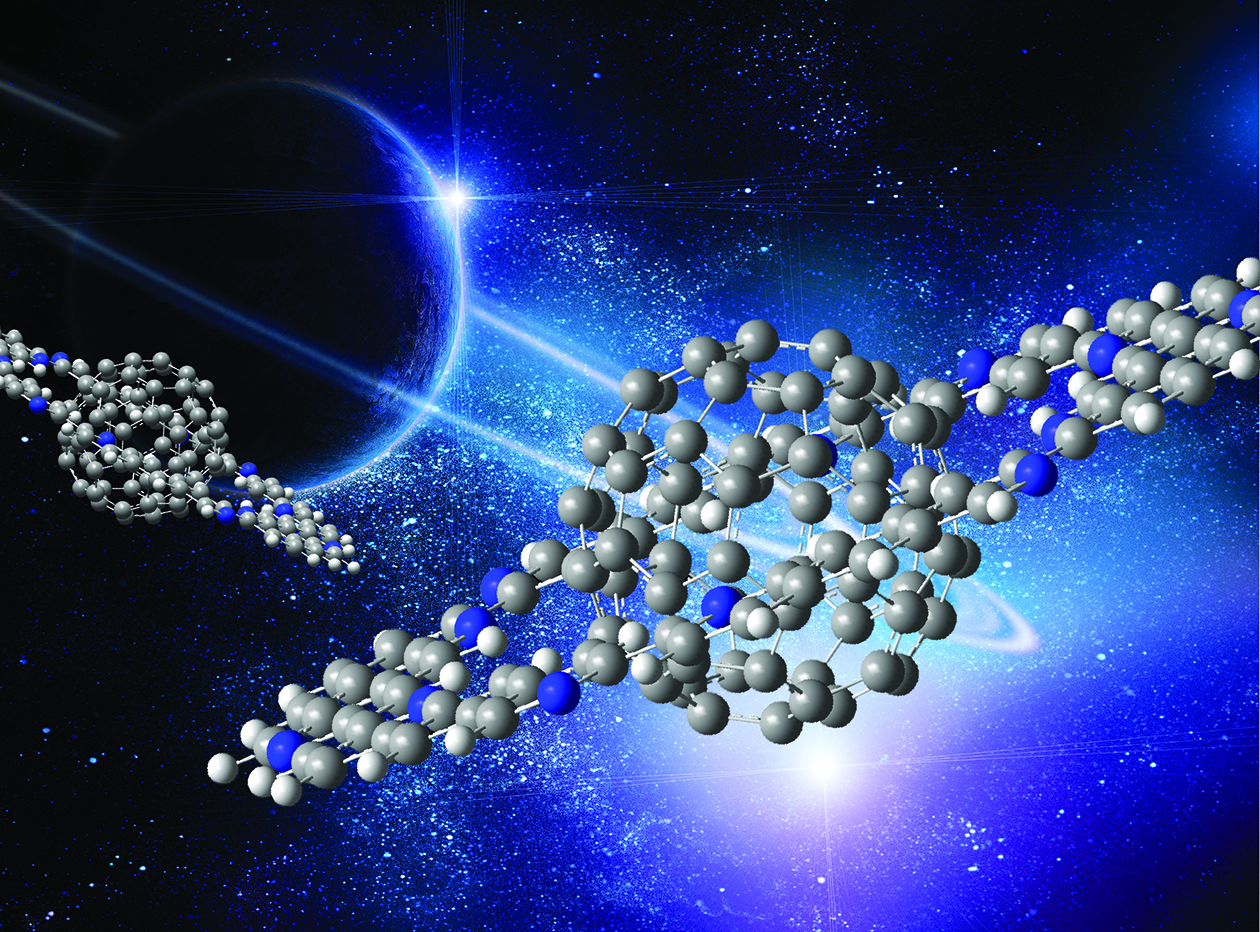
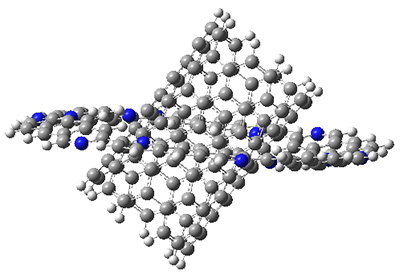
I also examined the complex of the flat macrocycle 6 (and its isomers) with a [5,5]-nanotube, 7. The tube bends over to create better dispersion interaction with the ring, which also become somewhat non-planar to accommodate the tube. Though not mentioned in the paper, I like to refer to 7 as Beyoncene, in tribute to All the Single Ladies.
Figure 2. Computed structure of 7.

My sister is a graphic designer and she made this terrific image for this work:


References

1. Bachrach, S. M., “Planar rings in nano-Saturns and related complexes.” Chem. Commun. 201955, 3650-3653, DOI: 10.1039/C9CC01234F.
2. Iwamoto, T.; Watanabe, Y.; Sadahiro, T.; Haino, T.; Yamago, S., “Size-Selective Encapsulation of C60 by [10]Cycloparaphenylene: Formation of the Shortest Fullerene-Peapod.” Angew. Chem. Int. Ed. 201150, 8342-8344, DOI: 10.1002/anie.201102302
3. Yamamoto, Y.; Tsurumaki, E.; Wakamatsu, K.; Toyota, S., “Nano-Saturn: Experimental Evidence of Complex Formation of an Anthracene Cyclic Ring with C60.” Angew. Chem. Int. Ed. 2018 57, 8199-8202, DOI: 10.1002/anie.201804430.
4. Bachrach, S. M.; Stück, D., “DFT Study of Cycloparaphenylenes and Heteroatom-Substituted Nanohoops.” J. Org. Chem. 201075, 6595-6604, DOI: 10.1021/jo101371m


InChIs

4b: InChI=1S/C84H48/c1-13-61-25-62-15-3-51-33-75(62)43-73(61)31-49(1)50-2-14-63-26-64-16-4-52(34-76(64)44-74(63)32-50)54-6-18-66-28-68-20-8-56(38-80(68)46-78(66)36-54)58-10-22-70-30-72-24-12-60(42-84(72)48-82(70)40-58)59-11-23-71-29-69-21-9-57(39-81(69)47-83(71)41-59)55-7-19-67-27-65-17-5-53(51)35-77(65)45-79(67)37-55/h1-48H
InChIKey=ZYXXLAYETADMDM-UHFFFAOYSA-N
6: InChI=1S/C72H36N12/c1-2-38-14-44-20-45-25-67(73-31-50(45)13-37(1)44)57-9-4-39-15-51-32-74-68(26-46(51)21-61(39)80-57)58-10-5-40-16-52-33-75-69(27-47(52)22-62(40)81-58)59-11-6-41-17-53-34-76-70(28-48(53)23-63(41)82-59)60-12-7-42-18-54-35-77-71(29-49(54)24-64(42)83-60)72-78-36-55-19-43-3-8-56(38)79-65(43)30-66(55)84-72/h1-36H
InChIKey=NSSCKPFBHGOOIJ-UHFFFAOYSA-N


'
This work is licensed under a Creative Commons Attribution-NoDerivs 3.0 Unported License.

Wednesday, February 27, 2019

Dodecaphenyltetracene

Xiao, Y.; Mague, J. T.; Schmehl, R. H.; Haque, F. M.; Pascal Jr., R. A., Angew. Chem. Int. Ed. 2019, 58, 2831-2833
Contributed by Steven Bacharach
Reposted from Computational Organic Chemistry with permission

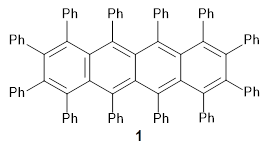
The Pascal group has synthesized dodecaphenyltetracene 1.1


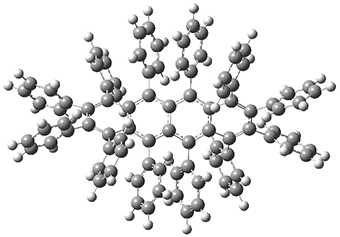
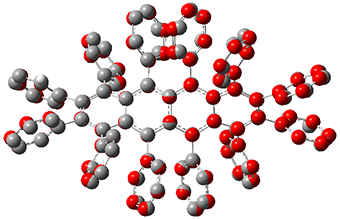
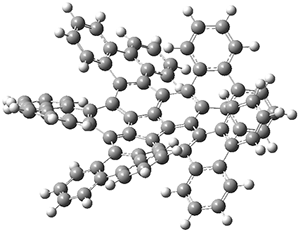
While this paper has little computational work, it is of interest to readers of this blog since I have discussed many aspect of aromaticity. This new tetracene is notable for its large twisting along the tetracene axis: about 97° in the x-ray structure. I have optimized the structure of 1 at B3LYP-D3(BJ)/6-311G(d) and its structure is shown in Figure 1. It is twisted by about 94°. The computed and x-ray structures are quite similar, as seen in Figure 2. Here the x-ray structure is shown with red balls, the computed structure with gray balls, and hydrogens have been removed for clarity.

Figure 1. B3LYP-D3(BJ)/6-311G(d) optimized structure of 1.

Figure 2. Comparison of the x-ray (red) and computed (gray) structures of 1. (Hydrogens omitted for clarity.)

The authors note that this molecule is chiral, having near D2 symmetry. (The optimized structure has D2symmetry.) They performed AM1 computations to estimate a very low barrier for racemization of only 17.3 kcal mol-1, leading to a half-life of less than one second at RT.

A notable aspect of the molecule is that aromaticity can adapt to significant twisting yet retain aromatic character. For example, the molecule is stable even surviving boiling off of chloroform (61 °C) to form crystals and the majority of the C-C bonds in the tetracene portion have distances typical of aromatic systems (~1.4 Å).


References

1) Xiao, Y.; Mague, J. T.; Schmehl, R. H.; Haque, F. M.; Pascal Jr., R. A., “Dodecaphenyltetracene.” Angew. Chem. Int. Ed. 201958, 2831-2833, DOI: 10.1002/anie.201812418.


InChIs

1: InChI=1S/C90H60/c1-13-37-61(38-14-1)73-74(62-39-15-2-16-40-62)78(66-47-23-6-24-48-66)86-82(70-55-31-10-32-56-70)90-84(72-59-35-12-36-60-72)88-80(68-51-27-8-28-52-68)76(64-43-19-4-20-44-64)75(63-41-17-3-18-42-63)79(67-49-25-7-26-50-67)87(88)83(71-57-33-11-34-58-71)89(90)81(69-53-29-9-30-54-69)85(86)77(73)65-45-21-5-22-46-65/h1-60H
InChIKey=NJQABVWYMCSFNE-UHFFFAOYSA-N


'
This work is licensed under a Creative Commons Attribution-NoDerivs 3.0 Unported License.

Thursday, November 15, 2018

Carbo‐biphenyls and Carbo‐terphenyls: Oligo(phenylene ethynylene) Ring Carbo‐mers

Chongwei, Z.; Albert, P.; Carine, D.; Brice, K.; Alix, S.; Valérie, M.; Remi, C., Angew. Chem. Int. Ed. 2018, 57, 5640-5644
Contributed by Steven Bacharach
Reposted from Computational Organic Chemistry with permission

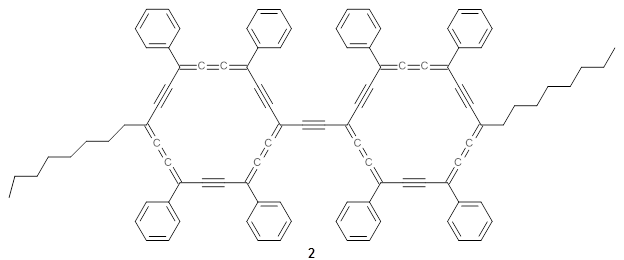
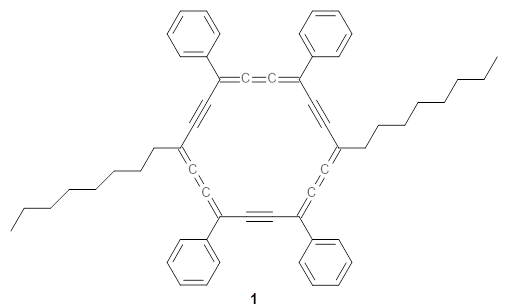
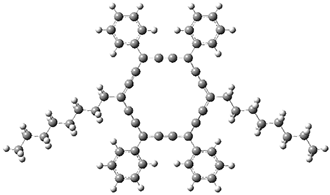
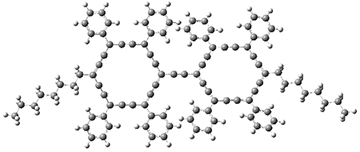
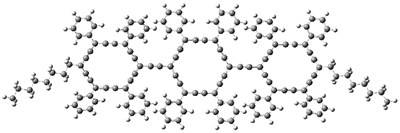
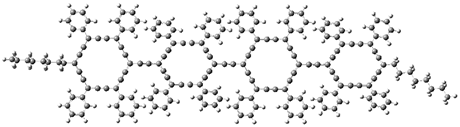
Interesting 18 π-electron systems involving cyclooctadecanonenetriyne rings have been synthesized and examined by computations.1 The mono-, di- and tri-C18
ring compounds 12, and 3 were prepared and the x-ray structure of 2 was obtained. The B3PW91/6-31G(d,p) optimized geometries of 1-3 and of the tetra ring 4 are shown in Figure 1.


1

2

3

4
Figure 1. B3PW91/6-31G(d,p) optimized geometries of 1-4.

Since the rings are composed of 18 π-electrons in the π-system perpendicular to the nearly planar ring, the natural question is to wonder if the ring is aromatic. The authors computed NICS(0) and NICS(1) values at the center of the C18 rings. For all four compounds, both the NICS(0) and NICS(1) values are negative, ranging from -12.4 to -14.9 ppm, indicating that the rings are aromatic.


References

1) Chongwei, Z.; Albert, P.; Carine, D.; Brice, K.; Alix, S.; Valérie, M.; Remi, C., "Carbo‐biphenyls and Carbo‐terphenyls: Oligo(phenylene ethynylene) Ring Carbo‐mers." Angew. Chem. Int. Ed. 201857, 5640-5644, DOI: 10.1002/anie.201713411.


InChIs

1: InChI=1S/C58H54/c1-3-5-7-9-11-17-27-49-37-41-55(51-29-19-13-20-30-51)45-47-57(53-33-23-15-24-34-53)43-39-50(28-18-12-10-8-6-4-2)40-44-58(54-35-25-16-26-36-54)48-46-56(42-38-49)52-31-21-14-22-32-52/h13-16,19-26,29-36H,3-12,17-18,27-28H2,1-2H3
InChIKey=KWXYBTWOEJBCQD-UHFFFAOYSA-N
2: InChI=1S/C102H74/c1-3-5-7-9-11-21-39-83-59-67-95(87-41-23-13-24-42-87)75-79-99(91-49-31-17-32-50-91)71-63-85(64-72-100(92-51-33-18-34-52-92)80-76-96(68-60-83)88-43-25-14-26-44-88)57-58-86-65-73-101(93-53-35-19-36-54-93)81-77-97(89-45-27-15-28-46-89)69-61-84(40-22-12-10-8-6-4-2)62-70-98(90-47-29-16-30-48-90)78-82-102(74-66-86)94-55-37-20-38-56-94/h13-20,23-38,41-56H,3-12,21-22,39-40H2,1-2H3
InChIKey=HHRPTZGYBIHFOL-UHFFFAOYSA-N
3: InChI=1S/C146H94/c1-3-5-7-9-11-25-51-117-81-93-135(123-53-27-13-28-54-123)105-109-139(127-61-35-17-36-62-127)97-85-119(86-98-140(128-63-37-18-38-64-128)110-106-136(94-82-117)124-55-29-14-30-56-124)77-79-121-89-101-143(131-69-43-21-44-70-131)113-115-145(133-73-47-23-48-74-133)103-91-122(92-104-146(134-75-49-24-50-76-134)116-114-144(102-90-121)132-71-45-22-46-72-132)80-78-120-87-99-141(129-65-39-19-40-66-129)111-107-137(125-57-31-15-32-58-125)95-83-118(52-26-12-10-8-6-4-2)84-96-138(126-59-33-16-34-60-126)108-112-142(100-88-120)130-67-41-20-42-68-130/h13-24,27-50,53-76H,3-12,25-26,51-52H2,1-2H3
InChIKey=WCBXPLIBHKYESX-UHFFFAOYSA-N
4: InChI=1S/C190H114/c1-3-5-7-9-11-29-63-151-103-119-175(159-65-31-13-32-66-159)135-139-179(163-73-39-17-40-74-163)123-107-153(108-124-180(164-75-41-18-42-76-164)140-136-176(120-104-151)160-67-33-14-34-68-160)97-99-155-111-127-183(167-81-47-21-48-82-167)143-147-187(171-89-55-25-56-90-171)131-115-157(116-132-188(172-91-57-26-58-92-172)148-144-184(128-112-155)168-83-49-22-50-84-168)101-102-158-117-133-189(173-93-59-27-60-94-173)149-145-185(169-85-51-23-52-86-169)129-113-156(114-130-186(170-87-53-24-54-88-170)146-150-190(134-118-158)174-95-61-28-62-96-174)100-98-154-109-125-181(165-77-43-19-44-78-165)141-137-177(161-69-35-15-36-70-161)121-105-152(64-30-12-10-8-6-4-2)106-122-178(162-71-37-16-38-72-162)138-142-182(126-110-154)166-79-45-20-46-80-166/h13-28,31-62,65-96H,3-12,29-30,63-64H2,1-2H3
InChIKey=LLVPDVPZEIYJGN-UHFFFAOYSA-N


'
This work is licensed under a Creative Commons Attribution-NoDerivs 3.0 Unported License.

Thursday, September 27, 2018

Curved Aromatic molecules – 4 new examples

Contributed by Steven Bacharach
Reposted from Computational Organic Chemistry with permission

I have recently been interested in curved aromatic systems – see my own paper on double helicenes.1 In this post, I cover four recent papers that discuss non-planar aromatic molecules.

The first paper2 discusses the warped aromatic 1 built off of the scaffold of depleiadene 3. The crystal structure of 1 shows the molecule to be a saddle with near C2v symmetry. B3LYP/6-31G computations indicate that the saddle isomer is 10.5 kcal mol-1 more stable than the twisted isomer, and the barrier between them is 16.0 kcal mol-1, with a twisted saddle intermediate as well.


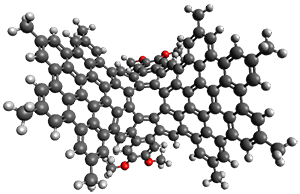
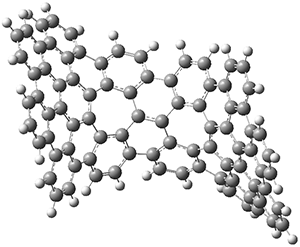
The PES is significantly simpler for the structure lacking the t-butyl groups, 2. The B3LYP/6-31G PES of 2has the saddle as the transition state interconverting mirror images of the twisted saddle isomer, and this barrier is only 1.8 kcal mol-1. Figure 1 displays the twisted saddle and the saddle transition state. Clearly, the t-butyl groups significantly alter the flexibility of this C86 aromatic surface. One should be somewhat concerned about the small basis set employed here, especially lacking polarization functions, and a functional that lacks dispersion correction. However, the computed geometry of 1 is quite similar to that of the x-ray structure.

2 twisted saddle (ground state)

2 saddle (transition state)
Figure 1. B3LYP/6-31G optimized geometries of the isomer of 2.

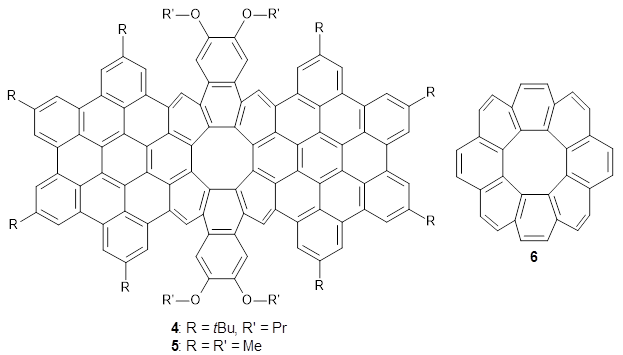
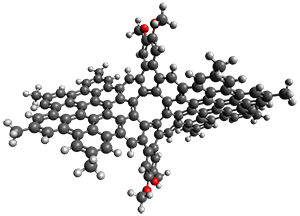
The second paper presents 4, a non-planar aromatic based on [8]circulene 6.3 (See this post for a general study of circulenes.) [8]circulene has a tub-shape, but is flexible and can undergo tub-to-tub inversion. The expanded aromatic 4 is found to have a twisted shape in the x-ray crystal structure. A simplified model 5 was computed at B3LYP/6-31G(d) and the twisted isomer is 4.1 kcal mol-1 lower in energy than the saddle (tub) isomer (see Figure 2). The barrier for interconversion of the two isomers is only 6.2 kcal mol-1, indicating a quite labile structure.

5 twisted
0.0

5 TS
6.2

5 saddle
4.1
Figure 2. B3LYP/6-31G(d) optimized geometries and relative energies (kcal mol-1) of the isomers of 5.

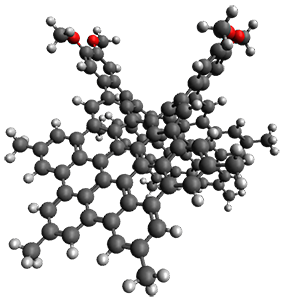
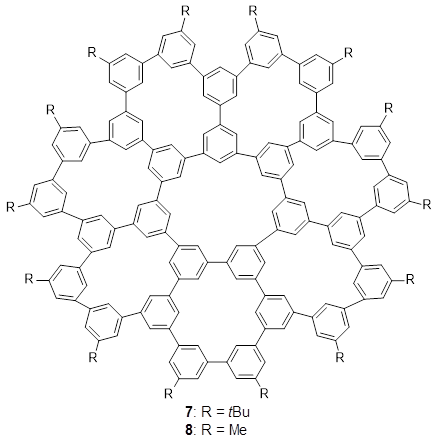
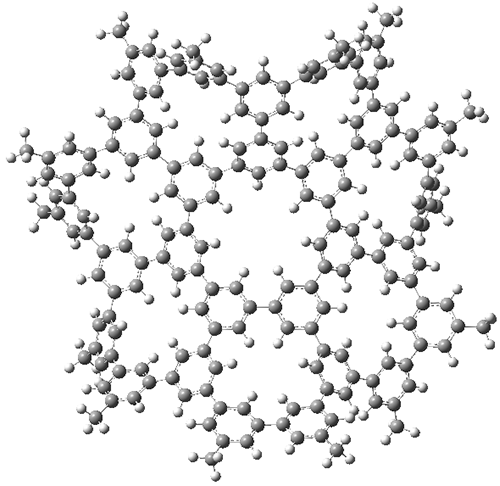
The third paper presents a geodesic molecule based on 1,3,5-trisubstitued phenyl repeat units.4 The authors prepared 7, and its x-ray structure shows a saddle-shape. The NMR indicate a molecule that undergoes considerable conformational dynamics. To address this, they did some computations on the methyl analogue 8. The D7h structure is 309 kcal mol-1 above the local energy minimum structure, which is way too high to be accessed at room temperature. PM6 computations identified a TS only 0.6 kcal mol-1above the saddle ground state. (I performed a PM6 optimization starting from the x-ray structure, which is highly disordered, and the structure obtained is shown in Figure 3. Unfortunately, the authors did not report the optimized coordinates of any structure!)

Figure 3. PM6 optimized structure of 8.

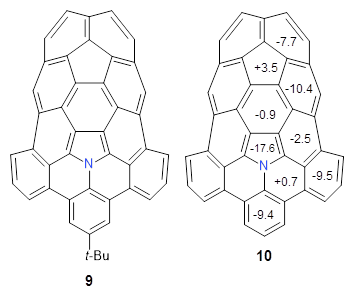
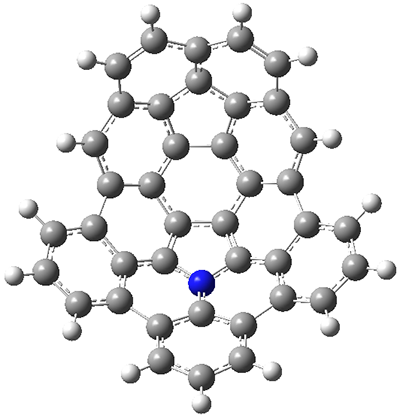
The fourth and last paper describes the aza-buckybowl 9.5 The x-ray crystal structure shows a curved bowl shape with Cs symmetry. NICS(0) values were computed for the parent molecule 10 B3LYP/6-31G(d). These values are shown in Scheme 1 and the geometry is shown in Figure 4. The 6-member rings that surround the azacylopentadienyl ring all have NICS(0) near zero, which suggests significant bond localisation.

Scheme 1. NICS(0) values of 10
Figure 4. B3LYP/6-31G(d) optimized structure of 10.

Our understanding of what aromaticity really means is constantly being challenged!


References

1. Bachrach, S. M., "Double helicenes." Chem. Phys. Lett. 2016666, 13-18, DOI: 10.1016/j.cplett.2016.10.070.
2. Ho, P. S.; Kit, C. C.; Jiye, L.; Zhifeng, L.; Qian, M., "A Dipleiadiene-Embedded Aromatic Saddle Consisting
of 86 Carbon Atoms." Angew. Chem. Int. Ed. 201857, 1581-1586, DOI: 10.1002/anie.201711437.
3. Yin, C. K.; Kit, C. C.; Zhifeng, L.; Qian, M., "A Twisted Nanographene Consisting of 96 Carbon Atoms." Angew. Chem. Int. Ed. 201756, 9003-9007, DOI: 10.1002/anie.201703754.
4. Koki, I.; Jennie, L.; Ryo, K.; Sota, S.; Hiroyuki, I., "Fluctuating Carbonaceous Networks with a Persistent
Molecular Shape: A Saddle-Shaped Geodesic Framework of 1,3,5-Trisubstituted Benzene (Phenine)." Angew. Chem. Int. Ed. 201857, 8555-8559, DOI: 10.1002/anie.201803984.
5. Yuki, T.; Shingo, I.; Kyoko, N., "A Hybrid of Corannulene and Azacorannulene: Synthesis of a Highly Curved Nitrogen-Containing Buckybowl." Angew. Chem. Int. Ed. 201857, 9818-9822, DOI: 10.1002/anie.201805678.


InChIs

1: InChI=1S/C134H128/c1-123(2,3)57-37-65-66-38-58(124(4,5)6)42-70-74-46-62(128(16,17)18)50-82-94(74)110-106(90(66)70)105-89(65)69(41-57)73-45-61(127(13,14)15)49-81-93(73)109(105)119-113-97(81)85(131(25,26)27)53-77-78-54-87(133(31,32)33)99-83-51-63(129(19,20)21)47-75-71-43-59(125(7,8)9)39-67-68-40-60(126(10,11)12)44-72-76-48-64(130(22,23)24)52-84-96(76)112-108(92(68)72)107(91(67)71)111(95(75)83)121-115(99)103(78)118-104-80(56-88(134(34,35)36)100(84)116(104)122(112)121)79-55-86(132(28,29)30)98(82)114(120(110)119)102(79)117(118)101(77)113/h37-56H,1-36H3
InChIKey=GKUTUWMASUJSFD-UHFFFAOYSA-N
2: InChI=1S/C86H32/c1-9-33-34-10-2-14-38-42-18-6-22-46-50-26-30-55-56-32-28-52-48-24-8-20-44-40-16-4-12-36-35-11-3-15-39-43-19-7-23-47-51-27-31-54-53-29-25-49-45-21-5-17-41-37(13-1)57(33)73-74(58(34)38)78(62(42)46)84-70(50)66(55)81(65(53)69(49)83(84)77(73)61(41)45)82-67(54)71(51)85-79(63(43)47)75(59(35)39)76(60(36)40)80(64(44)48)86(85)72(52)68(56)82/h1-32H
InChIKey=MXCDWJZMTKLBDM-UHFFFAOYSA-N
3: InChI=1S/C18H12/c1-2-6-14-11-12-16-8-4-3-7-15-10-9-13(5-1)17(14)18(15)16/h1-12H
InChIKey=KVJJNMIHWIRGRP-UHFFFAOYSA-N
4: InChI=1S/C132H108O4/c1-125(2,3)53-29-65-66-30-54(126(4,5)6)34-70-74-38-58(130(16,17)18)42-78-86-46-82-63-51-91(135-27)92(136-28)52-64(63)84-48-88-80-44-60(132(22,23)24)40-76-72-36-56(128(10,11)12)32-68-67-31-55(127(7,8)9)35-71-75-39-59(131(19,20)21)43-79-87-47-83-62-50-90(134-26)89(133-25)49-61(62)81-45-85-77-41-57(129(13,14)15)37-73-69(33-53)93(65)109-110(94(66)70)114(98(74)78)122-106(86)118-103(82)104(84)120-108(88)124-116(100(76)80)112(96(68)72)111(95(67)71)115(99(75)79)123(124)107(87)119(120)102(83)101(81)117(118)105(85)121(122)113(109)97(73)77/h29-52H,1-28H3
InChIKey=ZLPRACZKLACDHX-UHFFFAOYSA-N
5: InChI=1S/C108H60O4/c1-37-13-49-50-14-38(2)18-54-58-22-42(6)26-62-70-30-66-47-35-75(111-11)76(112-12)36-48(47)68-32-72-64-28-44(8)24-60-56-20-40(4)16-52-51-15-39(3)19-55-59-23-43(7)27-63-71-31-67-46-34-74(110-10)73(109-9)33-45(46)65-29-69-61-25-41(5)21-57-53(17-37)77(49)93-94(78(50)54)98(82(58)62)106-90(70)102-87(66)88(68)104-92(72)108-100(84(60)64)96(80(52)56)95(79(51)55)99(83(59)63)107(108)91(71)103(104)86(67)85(65)101(102)89(69)105(106)97(93)81(57)61/h13-36H,1-12H3
InChIKey=ZSIVUKSPPZUSQL-UHFFFAOYSA-N
6: InChI=1S/C32H16/c1-2-18-5-6-20-9-11-22-13-15-24-16-14-23-12-10-21-8-7-19-4-3-17(1)25-26(18)28(20)30(22)32(24)31(23)29(21)27(19)25/h1-16H
InChIkey=BASWMOIVIHXTRC-UHFFFAOYSA-N
7: InChI=1S/C224H210/c1-211(2,3)197-99-169-85-183(113-197)184-86-170(100-198(114-184)212(4,5)6)157-66-149-67-158(79-157)172-88-187(117-200(102-172)214(10,11)12)188-90-174(104-202(118-188)216(16,17)18)161-70-151-71-162(81-161)176-92-191(121-204(106-176)218(22,23)24)193-95-179(109-207(123-193)221(31,32)33)165-74-153-75-166(83-165)180-96-195(125-208(110-180)222(34,35)36)196-98-182(112-210(126-196)224(40,41)42)168-77-154-76-167(84-168)181-97-194(124-209(111-181)223(37,38)39)192-94-178(108-206(122-192)220(28,29)30)164-73-152-72-163(82-164)177-93-190(120-205(107-177)219(25,26)27)189-91-175(105-203(119-189)217(19,20)21)160-69-150-68-159(80-160)173-89-186(116-201(103-173)215(13,14)15)185-87-171(101-199(115-185)213(7,8)9)156-65-148(64-155(169)78-156)141-50-127-43-128(51-141)130-45-132(55-143(150)53-130)134-47-136(59-145(152)57-134)138-49-140(63-147(154)61-138)139-48-137(60-146(153)62-139)135-46-133(56-144(151)58-135)131-44-129(127)52-142(149)54-131/h43-126H,1-42H3
InChIKey=ZDDKJXIESSWTIA-UHFFFAOYSA-N
8: InChI=1S/C182H126/c1-99-15-113-43-127(29-99)141-57-142-65-155(64-141)162-78-169-92-170(79-162)172-82-164-83-174(94-172)176-85-166-87-178(96-176)180-89-168-91-182(98-180)181-90-167-88-179(97-181)177-86-165-84-175(95-177)173-81-163(80-171(169)93-173)156-66-143(128-30-100(2)16-114(113)44-128)58-144(67-156)130-32-103(5)19-117(47-130)118-20-104(6)34-132(48-118)147-60-148(71-158(165)70-147)134-36-107(9)23-121(51-134)123-25-109(11)39-137(53-123)151-62-152(75-160(167)74-151)138-40-111(13)27-125(55-138)126-28-112(14)42-140(56-126)154-63-153(76-161(168)77-154)139-41-110(12)26-124(54-139)122-24-108(10)38-136(52-122)150-61-149(72-159(166)73-150)135-37-106(8)22-120(50-135)119-21-105(7)35-133(49-119)146-59-145(68-157(164)69-146)131-33-102(4)18-116(46-131)115-17-101(3)31-129(142)45-115/h15-98H,1-14H3
InChIKey=FJHGGHOTCCNJNI-UHFFFAOYSA-N
9: InChI=1S/C44H23N/c1-44(2,3)21-16-28-24-8-4-6-22-26-14-19-12-10-18-11-13-20-15-27-23-7-5-9-25-29(17-21)41(28)45-42(33(22)24)39-35(26)37-31(19)30(18)32(20)38(37)36(27)40(39)43(45)34(23)25/h4-17H,1-3H3
InChIKey=QHBWEZKXFSKCSM-UHFFFAOYSA-N
10: InChI=1S/C40H15N/c1-4-19-23-8-3-9-24-20-5-2-7-22-26-15-18-13-11-16-10-12-17-14-25-21(6-1)30(19)39-36-32(25)34-28(17)27(16)29(18)35(34)33(26)37(36)40(31(20)22)41(39)38(23)24/h1-15H
InChIKey=XWSUADIIRLXSBY-UHFFFAOYSA-N

'
This work is licensed under a Creative Commons Attribution-NoDerivs 3.0 Unported License.

Wednesday, August 29, 2018

Nano-Saturn: Experimental Evidence of Complex Formation of an Anthracene Cyclic Ring with C60

Yuta, Y.; Eiji, T.; Kan, W.; Shinji, T., Angew. Chem. Int. Ed. 2018, 57, 8199-8202
Contributed by Steven Bacharach
Reposted from Computational Organic Chemistry with permission

It never hurts to promote one’s science through clever names – think cubane, buckminsterfullerene, bullvalene, etc. Host-guest chemistry is not immune to this cliché too, and this post discusses the latest synthesis and computations of a nano-Saturn; nano-Saturns are a spherical guest molecule captured inside a ring host molecule. I discussed an example of this a number of years ago – the nano-Saturn comprised of C60 fullerene surrounded by [10]cycloparaphenylene.

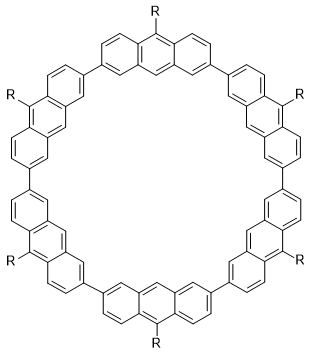
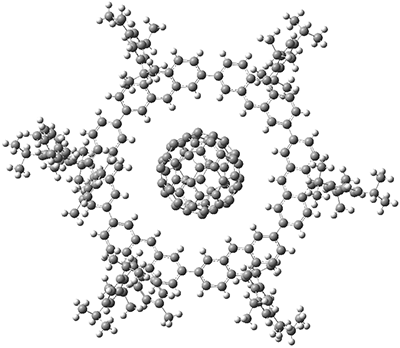
Yamamoto, Tsurumaki, Wakamatsu, and Toyota have prepared a nano-Saturn complex with the goal of making a flatter ring component.1 The inner planet is modeled again by C60 and the ring is the [24]circulene analogue 1. The x-ray crystal structure of this nano-Saturn complex is shown in Figure 1.

1: R = 2,4,6-tri-iso-propylphenyl
2: R = H
Figure 1. X-ray crystal structure of the nano-Saturn complex of 1 with C60.

Variable temperature NMR experiments gave the binding values of ΔH = -18.1 ± 2.3 kJ mol-1 and TΔS = 0.8 ± 2.2 kJ mol-1 at 298 K. To gauge this binding energy, they computed the complex of C60 with the parent compound 2 at B3LYP/6-1G(d)//M05-2X/6-31G(d), unfortunately without publishing the coordinates in the supporting materials. The computed binding enthalpy is ΔH = -50.6 kJ mol-1, but this computation is for the gas phase. The computed structure shows close contacts of 0.29 nm between the fullerene and the C9-proton of the anthracenyl groups, in excellent agreement with the x-ray structure. These weak C-Hπ interactions undoubtedly help stabilize the complex, especially given that the fullerene carries a very tiny Mulliken charge of +0.08 e.

References

1) Yuta, Y.; Eiji, T.; Kan, W.; Shinji, T., "Nano-Saturn: Experimental Evidence of Complex Formation of an Anthracene Cyclic Ring with C60." Angew. Chem. Int. Ed. 2018, 57, 8199-8202, DOI: 10.1002/anie.201804430.

InChIs

1: InChI=1S/C174H180/c1-91(2)121-78-150(97(13)14)164(151(79-121)98(15)16)163-90-128-71-139-70-127-59-109(37-38-120(127)77-162(139)163)110-39-49-140-129(60-110)72-130-61-111(40-50-141(130)165(140)170-152(99(17)18)80-122(92(3)4)81-153(170)100(19)20)112-41-51-142-131(62-112)73-132-63-113(42-52-143(132)166(142)171-154(101(21)22)82-123(93(5)6)83-155(171)102(23)24)114-43-53-144-133(64-114)74-134-65-115(44-54-145(134)167(144)172-156(103(25)26)84-124(94(7)8)85-157(172)104(27)28)116-45-55-146-135(66-116)75-136-67-117(46-56-147(136)168(146)173-158(105(29)30)86-125(95(9)10)87-159(173)106(31)32)118-47-57-148-137(68-118)76-138-69-119(128)48-58-149(138)169(148)174-160(107(33)34)88-126(96(11)12)89-161(174)108(35)36/h37-108H,1-36H3
InChIKey=AMDNULXMAMDTMX-UHFFFAOYSA-N
2: InChI=1S/C84H48/c1-13-61-25-62-15-3-51-33-75(62)43-73(61)31-49(1)50-2-14-63-26-64-16-4-52(34-76(64)44-74(63)32-50)54-6-18-66-28-68-20-8-56(38-80(68)46-78(66)36-54)58-10-22-70-30-72-24-12-60(42-84(72)48-82(70)40-58)59-11-23-71-29-69-21-9-57(39-81(69)47-83(71)41-59)55-7-19-67-27-65-17-5-53(51)35-77(65)45-79(67)37-55/h1-48H
InChIKey=ZYXXLAYETADMDM-UHFFFAOYSA-N


'
This work is licensed under a Creative Commons Attribution-NoDerivs 3.0 Unported License.
Wednesday, April 11, 2018

A Quintuple [6]Helicene with a Corannulene Core as a C5-Symmetric Propeller-Shaped π-System

Kato, K.; Segawa, Y.; Scott, L. T.; Itami, K., Angew. Chem. Int. Ed. 2018, 57, 1337-1341
Contributed by Steven Bacharach
Reposted from Computational Organic Chemistry with permission

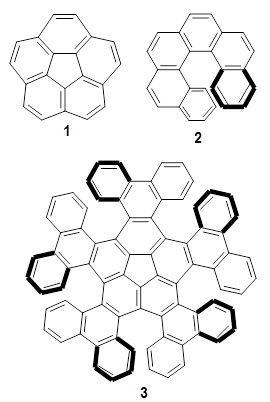
Corannulene 1 is an interesting aromatic compound because it is nonplanar, having a bowl shape. [6]helicene is an interesting aromatic compound because it is nonplanar, having the shape of a helix. Kato, Segawa, Scott and Itami have joined these together to synthesize the interesting quintuple helicene compound 3.1
The optimized structure of 3 is shown in Figure 1. They utilized computations to corroborate two experimental findings. First, the NMR spectra of 3 shows a small number of signals indicating that the bowl inversion should be rapid. The molecule has C5 symmetry due to the bowl shape of the corannulene core. Rapid inversion makes the molecule effectively D5. (The inversion transition state is of D5 symmetry, and would be a nice quiz question for those looking for molecules of unusual point groups.) The B3LYP/6-31G(d) computed bowl inversion barrier is only 1.9 kcal mol-1, significantly less that the bowl inversion barrier of 1: 10.4 kcal mol-1. This reduction is partly due to the shallower bowl depth of 3 (0.572 Å in the x-ray structure, 0.325 Å in the computed structure) than in 1 (0.87 Å).

Figure 1. Optimized structure of 3.

Second, they took the enhanced MMMMM-isomer and heated it to obtain the thermodynamic properties for the inversion to the PPPPP-isomer. (The PPPPP-isomer is shown in the top scheme.) The experimental values are ΔH = 36.8 kcal mol-1, ΔS = 8.7 cal mol-1 K-1, and ΔG = 34.2 kcal mol-1 at 298 K. They computed all of the stereoisomers of 3 along with the transition states connecting them. The largest barrier is found in going from MMMMM3 to MMMMP3 with a computed barrier of 34.5 kcal mol-1, in nice agreement with experiment.


References

1. Kato, K.; Segawa, Y.; Scott, L. T.; Itami, K., "A Quintuple [6]Helicene with a Corannulene Core as a C5-Symmetric Propeller-Shaped π-System." Angew. Chem. Int. Ed. 201857, 1337-1341, DOI: 10.1002/anie.201711985.


InChIs

1: InChI=1S/C20H10/c1-2-12-5-6-14-9-10-15-8-7-13-4-3-11(1)16-17(12)19(14)20(15)18(13)16/h1-10H
InChIKey=VXRUJZQPKRBJKH-UHFFFAOYSA-N
2: InChI=1S/C26H16/c1-3-7-22-17(5-1)9-11-19-13-15-21-16-14-20-12-10-18-6-2-4-8-23(18)25(20)26(21)24(19)22/h1-16H
InChIKey=UOYPNWSDSPYOSN-UHFFFAOYSA-N
3: InChI=1S/C80H40/c1-11-31-51-41(21-1)42-22-2-12-32-52(42)62-61(51)71-63-53-33-13-3-23-43(53)44-24-4-14-34-54(44)64(63)73-67-57-37-17-7-27-47(57)48-28-8-18-38-58(48)68(67)75-70-60-40-20-10-30-50(60)49-29-9-19-39-59(49)69(70)74-66-56-36-16-6-26-46(56)45-25-5-15-35-55(45)65(66)72(62)77-76(71)78(73)80(75)79(74)77/h1-40H
InChIKey=XYUIBQJVZTYREY-UHFFFAOYSA-N

'
This work is licensed under a Creative Commons Attribution-NoDerivs 3.0 Unported License.
Wednesday, January 10, 2018

Antiaromatic compounds stabilized by benzenoid fusion

Konishi, A.; Okada, Y.; Nakano, M.; Sugisaki, K.; Sato, K.; Takui, T.; Yasuda, M., "Synthesis and Characterization of Dibenzo[a,f]pentalene: Harmonization of the Antiaromatic and Singlet Biradical Character." J. Am. Chem. Soc. 2017, 139, 15284
Jin, Z.; Teo, Y. C.; Teat, S. J.; Xia, Y., "Regioselective Synthesis of [3]Naphthylenes and Tuning of Their Antiaromaticity." J. Am. Chem. Soc. 2017, 139, 15933
Contributed by Steven Bacharach
Reposted from Computational Organic Chemistry with permission

Antiaromatic compounds by definition are unstable and so difficult to prepare. One approach to increase their stability is to fuse aromatic ring(s) onto the antiaromatic system. I discuss in this blog post two different scaffolds where this approach has been successful in preparing molecules that express some degree of antiaromaticity. In addition, I mention a technique to aid in evaluating the aromatic/antiaromatic character.

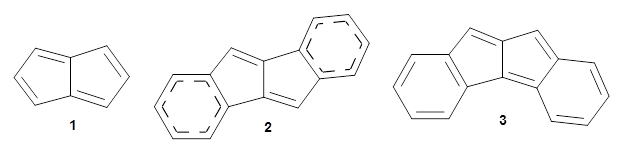
Pentalene 1 is a formal 8-π electron system and would be antiaromatic. To avoid this antiaromatic character, the double bonds are localized. Fusing benzenoid rings to pentalene to give dibenzo[a,e]penatalene 2 has been done, but the central rings avoid antiaromatic character by expressing the Kekule structure shown below.
Yasuda and coworkers report the preparation of mesityl-substituted dibenzo[a,f]penatalene
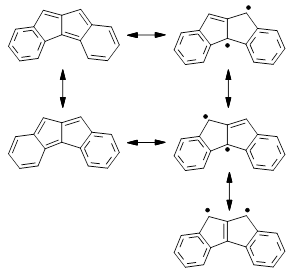
3.1 Resonance structures of 3¸ shown below, either have only one aromatic ring, or have two aromatic rings along with a trimethylenemethane (TMM) diradical component. Thus, one might expect 3 to express more antiaromatic character than 2.
NICS(1) values, computed at B3LYP/6-31G**, for 2 are -6.23 for the 6-member ring and +5.87 ppm for the 5-member ring, showing reduced aromaticity of the former ring. In sharp contrast, the NICS(1) values for 3 are +7.48 for the 6-member ring and +25.5 ppm for the 5-member ring, indicating substantial antiaromatic character for both rings. The calculated spin density distribution shows largest unpaired density on the expected carbon atoms based on the resonance structures involving the TMM fragment.

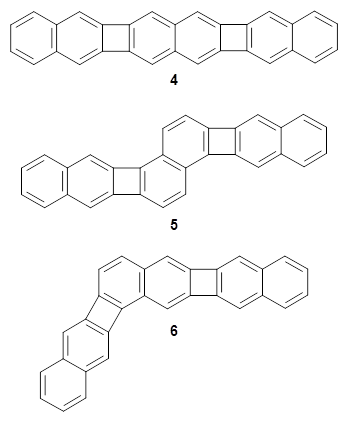
Xia and coworkers have prepared substituted analogues of the three structural isomers whereby three naphthylene units are fused together creating two cyclobutadienoid rings.2 These three frameworks are molecules 4-6. The 4-member rings are formally antiaromatic, tempered by the fused aromatic naphthylene groups. The question is then how does the different attachment geometry manifest in aromatic and/or antiaromatic character?
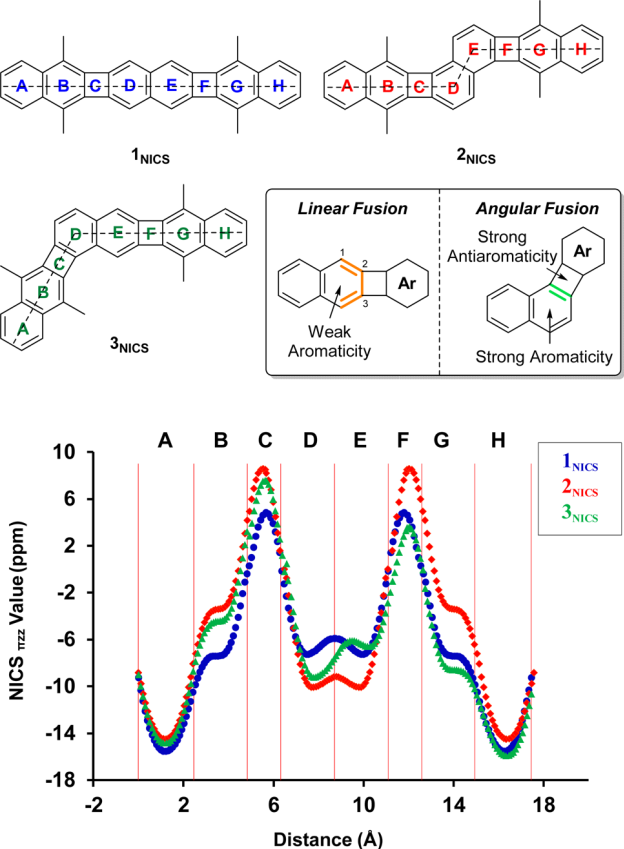
The computations take advantage of the NICS-XY method – well, a variation of this method. I had meant to write a post about the NICS-XY method when Stanger published it,3 but I just never got around to it. The idea is that NICS is evaluated typically at a single point, and just which point to use has been the subject of some discussion. Instead, Stanger proposes the NICS-XY method as a grid of points perpendicular to the plane of the molecule, typically in the plane bisecting the molecule. Trends in the values as one moves across the ring and perpendicular to the ring could assist in identifying aromatic/antiaromatic behaviour.

Xia computed the NICSπZZ along a line in the molecular plane bisecting the rings. This is shown in the figure below, which I have reproduced from the article. For example, for 4, which is compound 1 in the Xia paper and the figure below, the NICS values are taken along the line that horizontally bisects the molecule. In ring A, the values are negative, indicative of an aromatic ring. Across ring B, the values are still negative, but not as negative as for ring A, indicating a diminished aromaticity. In ring C, the values are positive, as one would expect for the antiaromatic cyclobutadienoid ring.

Figure taken from J. Am. Chem. Soc. 2017139, 15933-15939.

The authors highlight two trends. First, in the linear fusion (see the inset above), the aromatic ring fused to the cyclobutadienoid ring expresses diminished aromaticity. This can be understood in the following way. In naphthalene, the C2-C3 bond is longer than the C1-C2 bond. When the cyclobutadienoid is fused at the C2-C3 bond, it can lengthen even more to weaken the antiaaromaticity of the 4-member ring, and this consequently reduces the aromaticity of the 6-member ring. Fusion of the cyclobutadienoid ring at C1-C2, the shorter bond, causes a higher degree of antiaromaticity in the 4-member ring. The lengthening of this C1-C2 bond to try to reduce the antiromaticity of the 4-member ring leads to greater bond equalization in the 6-member ring, and its consequently greater aromatic character.


References

1. Konishi, A.; Okada, Y.; Nakano, M.; Sugisaki, K.; Sato, K.; Takui, T.; Yasuda, M., "Synthesis and Characterization of Dibenzo[a,f]pentalene: Harmonization of the Antiaromatic and Singlet Biradical Character." J. Am. Chem. Soc. 2017139, 15284-15287, DOI: 10.1021/jacs.7b05709.
2. Jin, Z.; Teo, Y. C.; Teat, S. J.; Xia, Y., "Regioselective Synthesis of [3]Naphthylenes and Tuning of Their Antiaromaticity." J. Am. Chem. Soc. 2017139, 15933-15939, DOI: 10.1021/jacs.7b09222.
3. Gershoni-Poranne, R.; Stanger, A., "The NICS-XY-Scan: Identification of Local and Global Ring Currents in Multi-Ring Systems." Chem. Eur. J. 201420, 5673-5688, DOI: 10.1002/chem.201304307.


InChIs

1: InChI=1S/C8H6/c1-3-7-5-2-6-8(7)4-1/h1-6H
InChIKey=GUVXZFRDPCKWEM-UHFFFAOYSA-N
2: InChI=1S/C16H10/c1-3-7-13-11(5-1)9-15-14-8-4-2-6-12(14)10-16(13)15/h1-10H
InChIKey=OZEPXROCWSMGGM-UHFFFAOYSA-N
3: InChI=1S/C16H10/c1-3-7-14-11(5-1)9-13-10-12-6-2-4-8-15(12)16(13)14/h1-10H
InChIKey=XOERMEAUYMRNNZ-UHFFFAOYSA-N
4: InChI=1S/C30H16/c1-2-6-18-10-24-23(9-17(18)5-1)27-13-21-15-29-25-11-19-7-3-4-8-20(19)12-26(25)30(29)16-22(21)14-28(24)27/h1-16H
InChIKey=CHDMCKMZQIHGAH-UHFFFAOYSA-N
5: InChI=1S/C30H16/c1-3-7-19-15-27-25(13-17(19)5-1)23-11-9-22-21(29(23)27)10-12-24-26-14-18-6-2-4-8-20(18)16-28(26)30(22)24/h1-16H
InChIKey=LPXGODOTGXTPRU-UHFFFAOYSA-N
6: InChI=1S/C30H16/c1-2-7-19-13-26-25(12-18(19)6-1)27-15-21-9-10-22-24-11-17-5-3-4-8-20(17)14-29(24)30(22)23(21)16-28(26)27/h1-16H
InChIKey=BKMGPFRQJXDFJQ-UHFFFAOYSA-N

'
This work is licensed under a Creative Commons Attribution-NoDerivs 3.0 Unported License.
Wednesday, December 13, 2017

A Zwitterionic, 10 π Aromatic Hemisphere

Hafezi, N.; Shewa, W. T.; Fettinger, J. C.; Mascal, M., Angew. Chem. Int. Ed. 2017, 56, 14141-14144
Contributed by Steven Bacharach
Reposted from Computational Organic Chemistry with permission

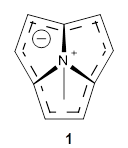
The range of aromatic compounds seems limitless. Mascal and co-workers have prepared the azatriquinacene 1 in a remarkably simple fashion.1 The molecule is a zwitterion, with the carbon atoms forming a 9-center, but 10 π-electron ring, and the quaternary nitrogen sitting above it. The carbon ring satisfies Hückel’s rule (4n+2) and so should be aromatic. The capping nitrogen should help to keep the carbon ring fixed in a shallow bowl.


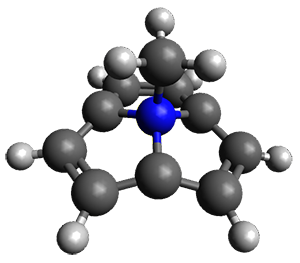
As expected, the molecule in fact turns out to possess an aromatic 10 π-electron ring. The B3LYP/6-311++G(d,p) geometry is shown in Figure 1. There is little bond alternation among the C-C distances: the mean deviation is only 0.015 Å with the largest difference only 0.024 &Aring. The x-ray crystal structure shows the same trends. The NICS(1) value is -12.31 ppm, larger even than that of benzene (-10.22 ppm).

Figure 1. B3LYP/6-311++G(d,p) geometry of 1.


References

1) Hafezi, N.; Shewa, W. T.; Fettinger, J. C.; Mascal, M., "A Zwitterionic, 10 π Aromatic Hemisphere." Angew. Chem. Int. Ed. 201756, 14141-14144, DOI: 10.1002/anie.201708521.


InChIs

1: InChI=1S/C10H9N/c1-11-8-2-3-9(11)6-7-10(11)5-4-8/h2-7H,1H3
InChIKey=ZXZPLDVSQUVKTH-UHFFFAOYSA-N

'
This work is licensed under a Creative Commons Attribution-NoDerivs 3.0 Unported License.