Showing posts with label (bio)inorganic chemistry. Show all posts

Saturday, February 14, 2015

Metal oxidation states in the oxygen-evolving complex: A computational challenge

V. Krewald, M. Retegan, N. Cox, J. Messinger, W. Lubitz, S. DeBeer, F. Neese and D.A. Pantazis,
Chemical Science 2015, early-view (Open-Access)
Contributed by Marcel Swart

The determination of oxidation states of metals in biological systems is not an easy task and can lead to surprises or controversies. This was for instance shown last year when an unusual molybdenum(III) oxidation state in the nitrogenase enzyme was reported [1], or the year before [2] for a Sc-capped iron-oxygen complex where the crystal structure shows a iron(III) oxidation state unlike the expected iron(IV) state based on solution data [3].
The situation is infinitely more complex when more than one metal ion is present, as is the case in the oxygen evolving complex (OEC) of photosystem II that is studied here through a combination of computational chemistry and spectroscopy. The OEC contains 4 manganese and 1 calcium as the active species to convert water into oxygen. Many studies have been performed on the five stages along the catalytic cycle, often with contradictory conclusions about the geometry, electronic structure, oxidation and protonation states involved.
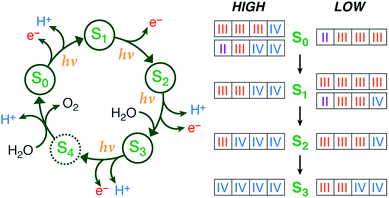

Summary of the catalytic cycle with the five stages (reproduced with permission from Chem. Sci., 2015, Advance Article, DOI: 10.1039/C4SC03720K; Published by The Royal Society of Chemistry

A breakthrough was a recent atomic resolution crystal structure [4] that largely confirmed the theoretical predictions by Siegbahn [5] about the geometrical positioning of the manganese ions and the oxygens. Still, a detailed understanding of the oxidation states was lacking, which is being explored in the paper by Pantazis and co-workers through a combination of a variety of experimental and theoretical techniques.
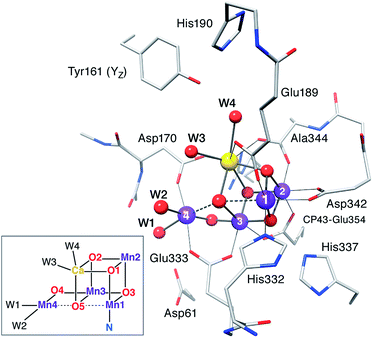

Typical model system used in the calculations (reproduced with permission from Chem. Sci., 2015, Advance Article, DOI: 10.1039/C4SC03720K; Published by The Royal Society of Chemistry

It is this combination of both theory and experiment, and the systematic exploration of protonation states, open- vs. closed cubane structure, distribution of +3/+4 oxidation states over the different manganese ions that makes this a complete and convincing story for the assignment of high-valent (HV) oxidation states along the catalytic cycle.
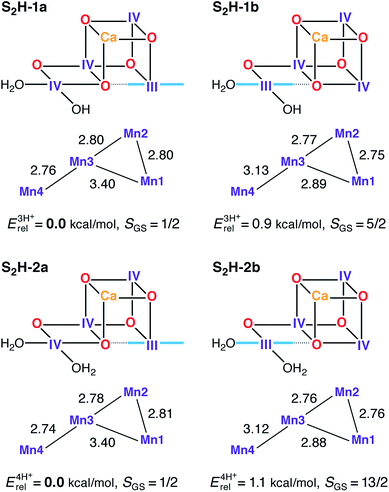

One example of the different possible distributions of oxidation states (III or IV) and spin states (1/2, 5/2 or 13/2), for state 2 models (reproduced with permission from Chem. Sci., 2015, Advance Article, DOI: 10.1039/C4SC03720K; Published by The Royal Society of Chemistry

The HV assignments made are consistent with the experimental data obtained so far, including a very recent “radiation-damage-free” crystal structure [6], for the first three stages of the catalytic cycle (S1-S3). What remains to be explored is how the enzyme produces the dioxygen molecule in the S4 stage and returns back to the resting state S0. Without any doubt, further unexpected findings will be coming along for this intriguing catalytic cycle.

[1] Chem. Sci. 2014, 5, 3096-3103, DOI: 10.1039/C4SC00337C 
[2] Chem. Commun. 2013, 49, 6650-6652, DOI: 10.1039/c3cc42200c
[3] Nature Chem. 2010, 2, 756-759, DOI: 10.1038/nchem.731
[4] Nature 2011, 473, 55-60, DOI: 10.1038/nature09913
[5] Acc. Chem. Res. 2009, 42, 1871-1880, DOI: 10.1021/ar900117k
[6] Nature 2015, 517, 99-103, DOI: 10.1038/nature13991

Creative Commons License
This work is licensed under a Creative Commons Attribution 3.0 Unported License

Sunday, May 6, 2012

ROBIA and Dolabriferol


Currie, R. H.; Goodman, J. M. Angew. Chem. Int. Ed. 2012, 51, 4695-4697: "In Silico Inspired Total Synthesis of (-)-Dolabriferol"
Socorro, I. M.; Goodman, J. M. J. Chem. Inf. Model. 2006, 46, 606-614: "The ROBIA Program for Predicting Organic Reactivity"
Socorro, I. M.; Taylor, K.; Goodman, J. M. Org. Lett. 2005, 7, 3541-3544: "ROBIA: A Reaction Prediction Program"


In 2005, Goodman and co-workers introduced the ROBIA (Reaction Outcome By Informatics Analysis) program for predicting the possible products of organic reactions and assessing the kinetic and/or thermodynamic feasibility of product formation. This program combines a series of rules based on typical reactivity patterns of certain organic functional groups with molecular mechanics and/or quantum chemical energy calculations on predicted products and/or transition state structures for possible reactions. Using this program, Goodman and co-workers predicted that (-)-dolabriferol might be formed - both biosynthetically and possibly synthetically - by a retro-Claisen reaction of a polyketide-derived precursor, i.e., they predicted that dolabriferol would likely be one of the major thermodynamic products of such a reaction. Now, Goodman and co-workers describe in ACIE a laboratory synthesis of (-)-dolabriferol that involves just such a (biomimetic) reaction (of a suitably protected precursor). This report not only showcases the utility of their modeling approach in the context of synthesis design, but also provides support for its utility in assessing the feasibility of biosynthetic proposals.


Monday, April 2, 2012

Exchange-Enhanced Open-Shell States: Hund's rule for Bioinorganic Species Applied to H-Abstraction

D. Janardanan, D. Usharani, S. Shaik Angewandte Chemie International Edition 2012, 51, 4421-4425 (Paywall)

In a Perspective in Nature Chemistry last year1 Sason Shaik and co-workers described bond activation by metal-oxo enzymes and synthetic reagents. In it, they argued that Hund's rule of maximum multiplicity (valid for atoms) has an analogue for reactions and kinetics of (bio)inorganic species: the exchange-enhanced reactivity (EER). Pathways that increase the number of unpaired and spin-identical electrons on a metal center will be favored by exchange interactions, and hence are favored over pathways that keep the same number (or less) of exchange interactions.

In this recent paper in Angewandte Chemie International Edition Shaik and co-workers apply their EER principle on H-abstraction reactions, and show how dramatic axial ligand effects can be explained by it. The systems under study are [(Cz)(X)MnVO] (Cz: corrolazinato3-, X=None, F-, CN-) complexes (see Figure below), which probably have a singlet ground state (X=None) or a triplet ground state (X=F-, CN-).


More important than the ground state of the reactant is however the spin state of the transition states (TSs). The hydrogen abstraction involves a proton-coupled electron transfer (PCET): the migrating H· radical transfers its radical to the d-block of the metal, while at the same time the proton makes the O-H bond. For the singlet state, one obtains at the TS an open-shell singlet with an alpha electron on the metal and a beta electron on the substrate. In the exchange-enhanced triplet state, there are now three alpha electrons on the metal (with favorable exchange interactions) that gives the dramatic decrease in barrier (from 32 kcal·mol-1 for the singlet to 23.0 kcal·mol-1 for the triplet).

The axial ligand effect has two origins: the exchange interactions become stronger (11.1, 12.4 and 12.9 kcal·mol-1 for the three complexes) while at the same time the d-orbitals become closer in energy (smaller excitation energy).

References

(1) S. Shaik, H. Chen, D. Janardanan, "Exchange-enhanced reactivity in bond activation by metal-oxo enzymes and synthetic reagents", Nature Chem. 2011, 3, 19-27, DOI: 10.1038/NChem.943

Creative Commons License
This work is licensed under a Creative Commons Attribution 3.0 Unported License