Showing posts with label pKa. Show all posts

Wednesday, February 22, 2017

Preparation of an ion with the highest calculated proton affinity: ortho-diethynylbenzene dianion

Poad, B. L. J.; Reed, N. D.; Hansen, C. S.; Trevitt, A. J.; Blanksby, S. J.; Mackay, E. G.; Sherburn, M. S.; Chan, B.; Radom, L., Chem. Sci. 2016, 7, 6245-6250
Contributed by Steven Bacharach
Reposted from Computational Organic Chemistry with permission


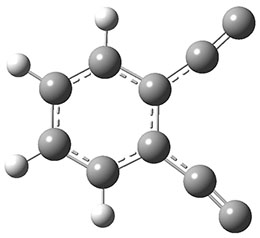
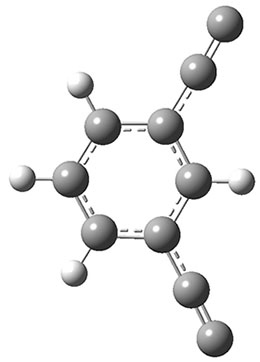
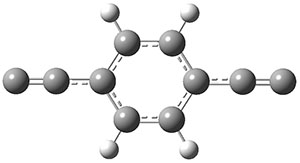
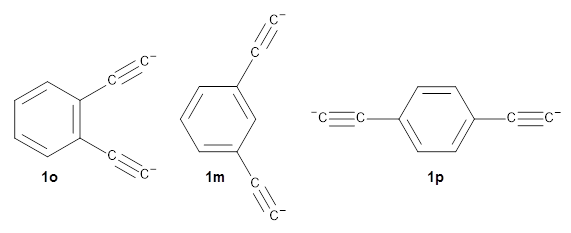
The new benchmark has been set for superbases. The previous record holder was LiO, with a computed proton affinity of 424.9 kcal mol-1. A new study by Poad, et al., examines the dianions of the three isomeric phenyldiacetylides: 1o1m, and 1p.1 Their computed proton affinities (G4(MP2)-6X) are 440.6, 427.0, and 425.6 kcal mol-1, respectively. The optimized geometries of these dianions are shown in Figure 1.

1o

1m

1p
Figure 1. Optimized geometries of 1o1m, and 1p.

The authors also prepared these bases inside a mass spectrometer. All three deprotonate water, but do not deprotonate methane, though that might be a kinetic issue.
The authors speculate that 1o will be hard to beat as a base since loss of an electron is always a concern with small dianions.


References

1) Poad, B. L. J.; Reed, N. D.; Hansen, C. S.; Trevitt, A. J.; Blanksby, S. J.; Mackay, E. G.; Sherburn, M. S.; Chan, B.; Radom, L., "Preparation of an ion with the highest calculated proton affinity: ortho-diethynylbenzene dianion." Chem. Sci. 2016, 7, 6245-6250, DOI: 10.1039/C6SC01726F.


InChIs

1o: InChI=1S/C10H4/c1-3-9-7-5-6-8-10(9)4-2/h5-8H/q-2
InChIKey=RVSCTJNIQWGMPY-UHFFFAOYSA-N
1m: InChI=1S/C10H4/c1-3-9-6-5-7-10(4-2)8-9/h5-8H/q-2
InChIKey=ATCNFGGQUWGWOE-UHFFFAOYSA-N
1p: InChI=1S/C10H4/c1-3-9-5-7-10(4-2)8-6-9/h5-8H/q-2
InChIKey=GGQMWKMAMDPRPA-UHFFFAOYSA-N

'
This work is licensed under a Creative Commons Attribution-NoDerivs 3.0 Unported License.

Wednesday, March 5, 2014

Computational Study on the pKa Shifts in Proline Induced by Hydrogen-Bond-Donating Cocatalysts

Xue, X.-S.; Yang, C.; Li, X.; Cheng, J.-P. J. Org. Chem. 2014, 79, 1166
Contributed by Steven Bachrach.
Reposted from Computational Organic Chemistry with permission

Organocatalysis affected by proline is an extremely active research area, and computational chemists have made considerable contributions (see Chapter 5.3 of my book – and this is expanded on in the 2ndedition which should be out in just a few months). Most importantly, the Houk-List model1 for the catalysis was largely developed on the basis of computations.

Recent experiments have indicated cocatalysts that can hydrogen bond to proline may increase the catalytic effect, including the enantioselectivity. Xue and co-workers have examined a series of potential cocatalysts for their ability to enhance the acidity of proline.2 This is important in that a proton transfer is a component to the key step of the Houk-List model.

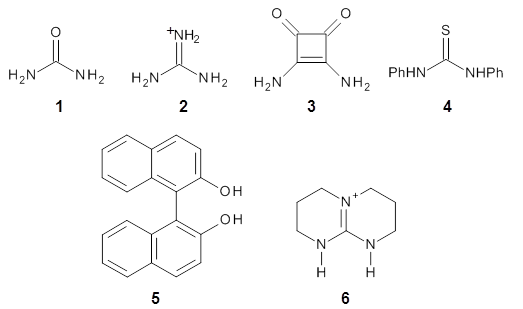
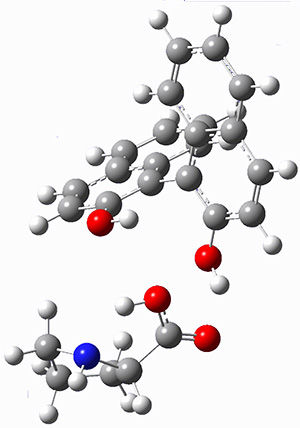
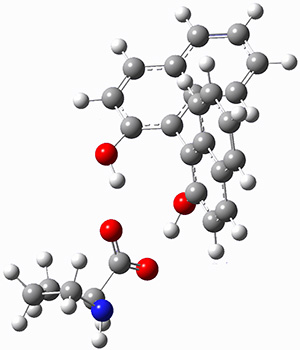
The cocatalysts examined included such compounds as 1-6. The deprotonation energy of proline with the associated cocatalysts was compared with that of proline itself. The energies were computed at M06-2x/6-311++G(2df,2p)//B3LYP/6-31+G(d) with the SMD treatment of five solvents. The structure of 5with proline is shown in Figure 1.

5 with proline

5 with proline conjugate base
Figure 1. M06-2x/6-311++G(2df,2p)//B3LYP/6-31+G(d) optimized structure of 5 with proline and its conjugate base.

The effect of the cocatalysts is striking. In the gas phase, these additives decrease the pKa of proline by 15 – 70 pKa units, with 2 showing the largest effect. In solvent, the effect of the cocatalyst is attenuated, especially in more polar solvents, but still a considerable decrease in the pKa is seen (as much as a 12 pKa unit increase in acidity). Further exploration of potential cocatalysts seems fully warranted.


References

(1) Allemann, C.; Gordillo, R.; Clemente, F. R.; Cheong, P. H.-Y.; Houk, K. N. "Theory of Asymmetric Organocatalysis of Aldol and Related Reactions:  Rationalizations and Predictions," Acc. Chem. Res. 2004,37, 558-569, DOI: 10.1021/ar0300524.
(2) Xue, X.-S.; Yang, C.; Li, X.; Cheng, J.-P. "Computational Study on the pKa Shifts in Proline Induced by Hydrogen-Bond-Donating Cocatalysts," J. Org. Chem. 201479, 1166–1173, DOI: 10.1021/jo402605n.


InChIs

1: InChI=1S/CH4N2O/c2-1(3)4/h(H4,2,3,4)
InChIKey=XSQUKJJJFZCRTK-UHFFFAOYSA-N
2: InChI=1S/CH5N3/c2-1(3)4/h(H5,2,3,4)/p+1
InCiKey=ZRALSGWEFCBTJO-UHFFFAOYSA-O
3: InChI=1S/C4H4N2O2/c5-1-2(6)4(8)3(1)7/h5-6H2
InChIKey=WUACDRFRFTWMHE-UHFFFAOYSA-N
4: InChI=1S/C13H12N2S/c16-13(14-11-7-3-1-4-8-11)15-12-9-5-2-6-10-12/h1-10H,(H2,14,15,16)
InChIKey=FCSHMCFRCYZTRQ-UHFFFAOYSA-N
5: InChI=1S/C20H14O2/c21-17-11-9-13-5-1-3-7-15(13)19(17)20-16-8-4-2-6-14(16)10-12-18(20)22/h1-12,21-22H
InChIKey=PPTXVXKCQZKFBN-UHFFFAOYSA-N
6: InChI=1S/C7H13N3/c1-3-8-7-9-4-2-6-10(7)5-1/h1-6H2,(H,8,9)/p+1
InChIKey=FVKFHMNJTHKMRX-UHFFFAOYSA-O
Proline: InChI=1S/C5H9NO2/c7-5(8)4-2-1-3-6-4/h4,6H,1-3H2,(H,7,8)/t4-/m0/s1
InChIKey= ONIBWKKTOPOVIA-BYPYZUCNSA-N


This work is licensed under a Creative Commons Attribution-NoDerivs 3.0 Unported License.

Sunday, November 25, 2012

Predicting pKa of Amines for CO2 Capture: Computer versus Pencil-and-Paper


K Z. Sumon, A. Henni, and Allan L. L. East. Industrial & Engineering Chemistry Research 2012 51 (37), 11924-11930
Contributed by Thomas Cundari

I tell my students, as was told tome, that the title is the shortest abstract for a paper. The title should becarefully chosen to be as succinct as possible, and also to catch the reader'sattention and make them want to read the rest of the paper. I mention this inconnection with a recent paper[1]by Sumon, Henni and East of the University of Regina, entitled"Predicting pKa of Aminesfor CO2 Capture: Computer versus Pencil-and-Paper."  This title has three factors to recommend it - an important andpopular application (carbon dioxide capture), one of the most fundamental concepts in chemistry (pKa andhence Brønsted acidity), and the title itselfinvokes images of a titanic struggle between a giant pencil and a multi-headedLinux cluster beast, perhaps akin to the Leviathans from recent Avengers movie.

Thus, suitably intrigued, I read on.The authors reported a new pKa calculational method, entitled SHE - one assumes thatthe abbreviation denotes theauthor's last names. The rationale for the various energetic contributionsneeded for ab initio computed pKavalues like the free energy of the proton in aqueous solution were given. Themethod was then applied to organic amines of interest in carbon capture, morespecifically the amines used to strip carbon dioxide from power plant effluent.

The underlying electronic energiesneeded to compute thedifference in free energy between an amine base (B) and its Brønsted conjugate acid (BH+)were computed at the MP2/6-31G(d) level of theory. The basis set settled uponby the authors was compared to larger basis sets - triple zeta, withpolarization functions on H, inclusion of diffusion functions, etc. - and the smaller basis setreproduced a larger, extended basis set reasonably well for a subset ofprimary, secondary, tertiary and cyclic amines. Moreover, I assumed that anydifferences introduced by the use of a less complete basis set could be accounted for with theempirical constant C (more about that below). Obviously, smaller basis setswill permit access to larger amines, as the authors pointed out.

For the ab initio calculations, the authors also investigated the role ofthe atomic radii (used in the continuum solvation calculations) as well as the impactof conformational flexibility. The latter issue is also one of the majordifficulties in developing and applying paper-and-pencil methods, in that thefunctional groups of a molecule are the same whether or not it is in a low orhigh energy conformation, and thus so-called 2D methods cannot distinguish onefrom the other, and both would thus be predicted to have identical properties.

 Interestingly, only electronic energies (thusobviating the need for a potentially expensive Hessian calculation) wereutilized as current and previous analyses by the author indicated that the zeropoint, enthalpic and entropic corrections to convert electronic energiesto free energies were nearconstant given the chemical similarity of the conjugate acid-base pairs (B andBH+ or B-OH2 and BH+-OH2) that makeup the amine systems of interest. For the latter conjugate pair, an extra watermolecule was added to the continuum solvent cavity to mimic what some mightrefer to as microsolvation (Model II in the author's jargon).

An empirical constant of 1.7 pKaunits for cyclic amines and 0.7 pKa units for acyclic amines was subtracted toput computed values into better correspondence with experimentalvalues for a test set of 32 molecules, and presumably to account for some ofthe uncertainty and approximations made elsewhere in the SHE procedure.

Hence, the authors presented acompact, computationally efficient procedure for computing the pKa's of amines.Arrayed against this approach is a more old school, parametric method. For those of us old enoughto remember the days before computers were all powerful, the use of parametricmethods for estimating important quantities was a popular researchendeavor for understanding and estimating important physicalquantities of novel materials. Benson's rules for predicting heats offormation,[2]and Drago's EC model for acid-base reaction enthalpies,[3]are but two examples of parametric methods. Today, the parametric approach is embodied in QSPR and QSARanalyses, many of which have at their heart an assumption of group additivity,which assumes that the whole (molecule) is the sum of its parts (functionalgroups).

The pencil-and-paper method utilizedby the authors was the PDS (Perrin-Dempsey-Sarjeant) technique. Not requiringany MP2 computations,the method is, ofcourse, much faster than "computer" methods. Like all methods, it islimited by the functional group approximation. Therefore, if one would like touse PDS to estimate thepKa of a new material, which contains a functional group not in the originalparameterization, then one is faced with the daunting task of extending theparameterization to the new functional group. Of course, any attempts to go “outsidethe box,” will always going to suffer from the uncertainty that arises fromextrapolation versus interpolation, which has always been a problem forparametric methods.

The authors presented an updated PDSmethod by introducing new base values and functional group corrections, whichessentially halved the RMS error for amines of interest in carbon dioxidecapture.

Finally, with this framework, theepic battle between computer and paper/pencil was on! And, it was a true battleroyale, with parametric and computational methods squaring off among themselvesand with each other. The old and new PDS methods were compared for a test setof 32 amines, and the latter, as alluded to above, outperformed the former by afactor of two. The new PDS method yielded a pKa error of only 0.18 pKa units.The SHE method had an RMS error of 0.28, hence only marginally higher. Theinclusion of the C empirical constant reduced the error in the SHE method bynearly 1 pKa unit. At the end of the struggle, the SHE method stood alone inthe ring. It had an RMS error less than the other approaches investigated bythe authors in this paper, and given the attention the authors put into makingit as computationally efficient as possible, one would expect this recipe tohave significant upside for larger organic amines. However, the updated PDSmethod fought valiantly, and would seem to be an interesting candidate for furtherresearch to diversify it to alarger functional grouplibrary.

Likewise, it would also be ofinterest to diversify the SHE method in a similar manner to investigate a greater range of possible CO2sorbents. Other possible extensions include assessing the impact of lessexpensive abs initio methods likeHartree-Fock (yes, good old Hartree-Fock!) or perhaps DFT, instead of MP2, tobring the SHE method to larger and more complex organics amines and indeed evennon-amines.


[1]      Predicting pKa of Amines for CO2 Capture: Computer versusPencil-and-Paper.  K Z. Sumon, A. Henni, and Allan L. L. East. Industrial& Engineering Chemistry Research 2012 51 (37),11924-11930
[2]      Estimation of heats of formation of organic compounds by additivitymethods. N. Cohen and S. W.Benson. Chemical Reviews 1993 93 (7), 2419-2438
[3]      A Double-Scale Equation for Correlating Enthalpies of Lewis Acid-BaseInteractions. R. S. Dragoand B. B. Wayland. Journal of the American Chemical Society 1965 87(16), 3571-3577
Wednesday, August 29, 2012

Effect of Hydrogen Bonds on pKa Values: Importance of Networking

Shokri, A.; Abedin, A.; Fattahi, A.; Kass, S. R.  J. Am. Chem. Soc. 2012, 134, 10646 (Paywall)
Contributed by Steven Bachrach.
Reposted from Computational Organic Chemistry with permission

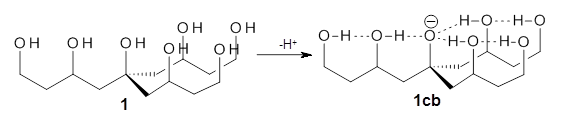
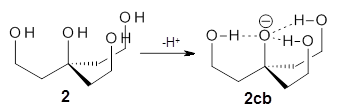
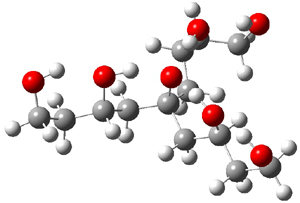
Can a hydrogen bonding network affect acidity? Kass has examined the polyol 1 whose conjugate base1cb can potentially be stabilized by a large hydrogen bonding network.1 Kass had previously found a significant acidy enhancement in comparing t-butanol (ΔG(deprotonation) = 369.2 kcal mol-1) with that of 2 (ΔG(deprotonation) = 334.4 kcal mol-1).2

Table 1 lists the computed and experimental free energies of deprotonation of 1. The experimental values are computed at M06-2x/maug-cc-pVT(+d)Z. The structure of 1cb is drawn in Figure 1.

Table 1. Computed and experimental free energies (kcal mol-1 of deprotonation of some alcohols.

MO6-2x
Expt
t-butanol
368.6
369.3
2
335.0
334.4
1
320.2
313.5
The difference in the acidity of t-butanol and 2, some 30 kcal mol-1, reflects the stability afforded by three intramolecular hydrogen bonds to the oxyanion. In going from 2cb to 1cb, each of the hydroxyl groups that donate to the oxyanion act as the acceptor of a hydrogen bond from the more removed hydroxyl groups. There is in effect a first and second layer of hydrogen bond network in 1cb. These secondary hydrogen bonds lead to further stabilization of the anion, as reflected in the diminished DPE of 1 over 2: 320.2 vs. 335.0 kcal mol-1. Note that this secondary layer does not stabilize the anion to the same degree as the primary layer, but nonetheless its effect is large and quite striking.

1cb
Figure 1. M06-2x/maug-cc-pVT(+d)Z optimized structure of 1cb.

Even in solution these more remote hydrogen bonds can stabilize the anion. So, using the CPCM approach and modeling DMSO, 2 is predicted have a pKa that is 15 units below that of t-butanol, and 1is predicted to be 3 pKa units more acidic than 2. Experiments verify this prediction with the pKas of 16.1 for 2 and 11.4 for 1.

References

(1) Shokri, A.; Abedin, A.; Fattahi, A.; Kass, S. R. "Effect of Hydrogen Bonds on pKa Values: Importance of Networking," J. Am. Chem. Soc. 2012134, 10646-10650, DOI: 10.1021/ja3037349
(2) Tian, Z.; Fattahi, A.; Lis, L.; Kass, S. R. "Single-Centered Hydrogen-Bonded Enhanced Acidity (SHEA) Acids: A New Class of Brønsted Acids," J. Am. Chem. Soc. 2009131, 16984-16988, DOI:10.1021/ja9075106

InChIs

1: InChI=1S/C13H28O7/c14-4-1-10(17)7-13(20,8-11(18)2-5-15)9-12(19)3-6-16/h10-12,14-20H,1-9H2
InChIKey=HGTVPOTWAYDRSM-UHFFFAOYSA-N
1cb: InChI=1S/C13H27O7/c14-4-1-10(17)7-13(20,8-11(18)2-5-15)9-12(19)3-6-16/h10-12,14-19H,1-9H2/q-1
InChIKey=UQPPTNIHRICITD-UHFFFAOYSA-N
2: InChI=1S/C7H16O4/c8-4-1-7(11,2-5-9)3-6-10/h8-11H,1-6H2
InChIKey=FAQWYKIIWYVDPQ-UHFFFAOYSA-N
2cb: InChI=1S/C7H15O4/c8-4-1-7(11,2-5-9)3-6-10/h8-10H,1-6H2/q-1
InChIKey=WSCPTRIAWKZJFZ-UHFFFAOYSA-N