Monday, March 12, 2018

Comprehensive theoretical study of all 1812 C60 isomers

Sure, R.; Hansen, A.; Schwerdtfeger, P.; Grimme, S., Phys. Chem. Chem. Phys. 2017, 19, 14296
Contributed by Steven Bacharach
Reposted from Computational Organic Chemistry with permission

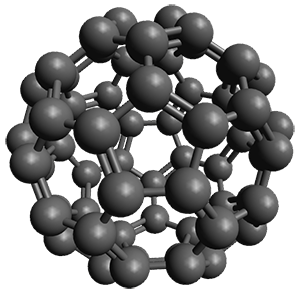
The Grimme group has examined all 1812 C60 isomers, in part to benchmark some computational methods.1 They computed all of these structures at PW6B95-D3/def2-QZVP//PBE-D3/def2-TZVP. The lowest energy structure is the expected fullerene 1 and the highest energy structure is the nanorod 2 (see Figure 1).

1

2
Figure 1. Optimized structures of the lowest (1) and highest (2) energy C60 isomers.

About 70% of the isomers like in the range of 150-250 kcal mol-1 above the fullerene 1, and the highest energy isomer 2 lies 549.1 kcal mol-1 above 1. To benchmark some computational methods, they selected the five lowest energy isomers and five other isomers with higher energy to serve as a new database (C60ISO), with energies computed at DLPNO-CCSD(T)/CBS*. The mean absolute deviation of the PBE-D3/def2-TZVP relative energies with the DLPNO-CCSD(T)/CBS* energies is relative large 10.7 kcal mol-1. However, the PW6B95-D3/def2-QZVP//PBE-D3/def2-TZVP method is considerably better, with a MAD of only 1.7 kcal mol-1. This is clearly a reasonable compromise method for fullerene-like systems, balancing accuracy with computational time.

They also compared the relative energies of all 1812 isomers computed at PW6B95-D3/def2-QZVP//PBE-D3/def2-TZVP with a number of semi-empirical methods. The best results are with the DFTB-D3 method, with an MAD of 5.3 kcal mol-1.


References

1) Sure, R.; Hansen, A.; Schwerdtfeger, P.; Grimme, S., "Comprehensive theoretical study of all 1812 C60isomers." Phys. Chem. Chem. Phys. 201719, 14296-14305, DOI: 10.1039/C7CP00735C.


InChIs

1: InChI=1S/C60/c1-2-5-6-3(1)8-12-10-4(1)9-11-7(2)17-21-13(5)23-24-14(6)22-18(8)28-20(12)30-26-16(10)15(9)25-29-19(11)27(17)37-41-31(21)33(23)43-44-34(24)32(22)42-38(28)48-40(30)46-36(26)35(25)45-39(29)47(37)55-49(41)51(43)57-52(44)50(42)56(48)59-54(46)53(45)58(55)60(57)59
InChIKey=XMWRBQBLMFGWIX-UHFFFAOYSA-N
2: InChI=1S/C60/c1-11-12-2-21(1)31-41-32-22(1)3-13(11)15-5-24(3)34-43(32)53-55-47-36-26-6-16-17-7(26)28-9-19(17)20-10-29-8(18(16)20)27(6)37-46(36)54(51(41)55)52-42(31)33-23(2)4(14(12)15)25(5)35-44(33)58-56(52)48(37)39(29)50-40(30(9)10)49(38(28)47)57(53)59(45(34)35)60(50)58
InChIKey=AGZHNPDQKMDYHI-UHFFFAOYSA-N


'
This work is licensed under a Creative Commons Attribution-NoDerivs 3.0 Unported License.

Wednesday, February 28, 2018

Automated Transition State Theory Calculations for High-Throughput Kinetics

Pierre L. Bhoorasingh, Belinda L. Slakman, Fariba Seyedzadeh Khanshan, Jason Y. Cain, and Richard H. West (2017)
Highlighted by Jan Jensen

Figure 1 from Bhoorasingh et al. J. Phys. Chem. A 2017, 121, 6896. 
Copyright 2017 American Chemical Society

I have written about automated transition state searching before, so I was interested to see how this work differed. Both methods aim at obtaining the best possible guess of the TS structure, which is then used as a starting point for a conventionional TS optimization. In the current work this is done by estimating bond lengths between the reacting atoms using a group contribution method based on known TS structures. These distances are then constrained while a conformational search is performed for the rest of the molecular structure using the UFF force field. The method is described in more detail here.

This approach is thus not too different from the TS template structure approach used in the Schrödinger study, but goes on to perform a conformational search for the TS, which the Schrödinger study did not. So it indeed encouraging to see that the conformational search seems to work and give reasonable results.

Both approaches requires that the atom orders are the same in the reactants and products. In general this is a hard problem and the Schrödinger paper offers one approach to this. However, in the current study the products are automatically generated from the reactants using the Reaction Mechanism Generator (RMG) program in such a way (I believe) that the atom order is preserved.

So if you're interested in a particular TS the current approach is unlikely to be useful since it is rather intimately tied to the RMG program and certain types of chemical reactions. However, if you are interested in these types of chemical reactions then the approach seems quite useful since the entire process is automated and appears quite robust. 

More importantly is an important proof-of-concept of what is possible in terms of automation given a large an carefully constructed training set of chemical reactions.


This work is licensed under a Creative Commons Attribution 4.0 International License.

Wednesday, February 21, 2018

Kinetics of the Strain-Promoted Oxidation-Controlled Cycloalkyne-1,2-quinone Cycloaddition: Experimental and Theoretical Studies

Escorihuela, J.; Das, A.; Looijen, W. J. E.; van Delft, F. L.; Aquino, A. J. A.; Lischka, H.; Zuilhof, H., J. Org. Chem. 2018, 83, 244
Contributed by Steven Bacharach
Reposted from Computational Organic Chemistry with permission

Click chemistry has been used in a broad range of applications. The use of metal catalysts has limited its application to biological system, but the development of strain-promoted cycloaddition to cyclooctyne has opened up click chemistry to bioorthogonal labelling.

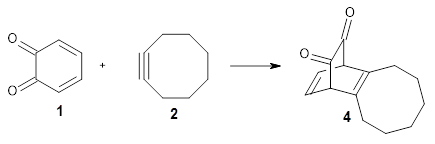
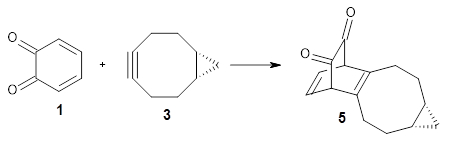
An interesting variation on this is the use of 1,2-benzoquinone 1 and substituted analogues as the Diels-Alder diene component. Escorihuela and co-workers have reported on the use of this diene with a number of cyclooctyne derivatives, measuring kinetics and also using computations to assess the mechanism.1

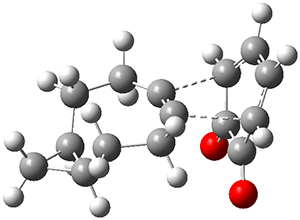
Their computations focused on two reactions using cyclooctyne 2 and the cyclopropane-fused analogue 3:
Reaction 1
Reaction 2
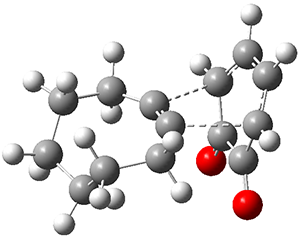
They examined these reactions with a variety of density functionals along with some post-HF methods. The transition states of the two reactions are shown in Figure 1. A variety of different density functionals and MP2 are consistent in finding synchronous or nearly synchronous transition states.

Rxn1-TS

Rxn2-TS
Figure 1. B97D/6-311+G(d,p) transition states for Reactions 1 and 2.

In terms of activation energies, all of the DFT methods consistently overestimate the barrier by about 5-10 kcal mol-1, with B97D-D3 doing the best. MP2 drastically underestimates the barriers, though the SOS-MP2 or SCS-MP2 improve the estimate. Both CCSD(T) and MR-AQCC provide estimates of about 8.5 kcal mol-1, still 3-4 kcal mol-1 too high. The agreement between CCSD(T), a single reference method, and MR-AQCC, a multireference method, indicate that the transition states have little multireference character. Given the reasonable estimate of the barrier afforded by B97D-D3, and its tremendous performance advantage over SCS-MP2, CCSD(T) and MR-AQCC, this is the preferred method (at least with current technology) for examining Diels-Alder reactions like these, especially with larger molecules.


References

1) Escorihuela, J.; Das, A.; Looijen, W. J. E.; van Delft, F. L.; Aquino, A. J. A.; Lischka, H.; Zuilhof, H., "Kinetics of the Strain-Promoted Oxidation-Controlled Cycloalkyne-1,2-quinone Cycloaddition: Experimental and Theoretical Studies." J. Org. Chem. 201883, 244-252, DOI: 10.1021/acs.joc.7b02614.


InChIs

1: InChI=1S/C6H4O2/c7-5-3-1-2-4-6(5)8/h1-4H
InChIKey=WOAHJDHKFWSLKE-UHFFFAOYSA-N
2: InChI=1S/C8H12/c1-2-4-6-8-7-5-3-1/h1-6H2
InChIKey=ZPWOOKQUDFIEIX-UHFFFAOYSA-N
3: InChI=1S/C9H12/c1-2-4-6-9-7-8(9)5-3-1/h8-9H,3-7H2
InChIKey=rQDNSAFCVPAMWCJ-UHFFFAOYSA-N
4: InChI=1S/C14H16O2/c15-13-11-7-8-12(14(13)16)10-6-4-2-1-3-5-9(10)11/h7-8,11-12H,1-6H2
InChIKey=OQMYZEFKUMPECV-UHFFFAOYSA-N
5: InChI=1S/C15H16O2/c16-14-12-5-6-13(15(14)17)11-4-2-9-7-8(9)1-3-10(11)12/h5-6,8-9,12-13H,1-4,7H2/t8-,9+,12?,13?
InChIKey=NKDGTIVNLDJQKR-RFZWMSCOSA-N


'
This work is licensed under a Creative Commons Attribution-NoDerivs 3.0 Unported License.

Tuesday, February 6, 2018

Fully Automated Quantum-Chemistry-Based Computation of Spin–Spin-Coupled Nuclear Magnetic Resonance Spectra

Grimme, S.; Bannwarth, C.; Dohm, S.; Hansen, A.; Pisarek, J.; Pracht, P.; Seibert, J.; Neese, F., Angew. Chem. Int. Ed. 2017, 56, 14763-14769
Contributed by Steven Bacharach
Reposted from Computational Organic Chemistry with permission

Computed NMR spectra have become a very useful tool in identifying chemical structures. I have blogged on this multiple times. A recent trend has been the development of computational procedures that lead to computed spectra (again, see that above link). Now, Grimme, Neese and coworkers have offered their approach to computed NMR spectra, including spin-spin splitting.1
Their procedure involves four distinct steps.
  1. Generation of the conformer and rotamer space. This is a critical distinctive element of their method in that they take a number of different tacks for sampling conformational space to insure that they have identified all low-energy structures. This involves a combination of normal mode following, genetic structure crossing (based on genetic algorithms for optimization), and molecular dynamics. Making this all work is their choice of using the computational efficient GFN-xTB2 quantum mechanical method.
  2. The low-energy structures are then subjected to re-optimization at PBEh-3c and then single-point energies obtained at DSD-BLYP-D3/def2-TZVPP including treatment of solvation by COSMO-RS. The low-energy structures that contribute 4% or more of the Boltzmann-weighted population are then carried forward.
  3. Chemical shifts and spin-spin coupling constants are then computed with the PBE0 method and the pcS and pcJ basis sets developed by Jensen for computing NMR shifts.3
  4. Lastly, the chemical shifts and coupling constants are averaged and the spin Hamiltonian is solved.
The paper provides a number of examples of the application of the methodology, all with quite good success. The computer codes to run this method are available for academic use from xtb@thch.uni-bonn.de.


References

1) Grimme, S.; Bannwarth, C.; Dohm, S.; Hansen, A.; Pisarek, J.; Pracht, P.; Seibert, J.; Neese, F., "Fully Automated Quantum-Chemistry-Based Computation of Spin–Spin-Coupled Nuclear Magnetic Resonance Spectra." Angew. Chem. Int. Ed. 201756, 14763-14769, DOI: 10.1002/anie.201708266.
2) Grimme, S.; Bannwarth, C.; Shushkov, P., "A Robust and Accurate Tight-Binding Quantum Chemical Method for Structures, Vibrational Frequencies, and Noncovalent Interactions of Large Molecular Systems Parametrized for All spd-Block Elements (Z = 1–86)." J. Chem. Theory Comput. 201713, 1989-2009, DOI: 10.1021/acs.jctc.7b00118.
3) Jensen, F., "Basis Set Convergence of Nuclear Magnetic Shielding Constants Calculated by Density Functional Methods." J. Chem. Theory Comput. 20084, 719-727, DOI: 10.1021/ct800013z.

'
This work is licensed under a Creative Commons Attribution-NoDerivs 3.0 Unported License.

Wednesday, January 31, 2018

Rational Density Functional Selection Using Game Theory

Suzanne McAnanama-Brereton and Mark P. Waller (2018)
Highlighted by Jan Jensen


Copyright 2018 American Chemical Society

This paper describes a method for finding the optimum combination of DFT functional and basis set for a particular calculation by using game theory, more specifically by finding the corresponding Nash equilibria. As the authors write:
A Nash equilibrium (NE) is an optimal strategy in game theory, given that all players have differing payoffs for different strategies. It is a strategy that, when all players have full knowledge of their own and their opponents’ payoffs for each strategy, every rational player will choose.

For this application the three "players" are 1) the complexity or computational cost of the method, 2) the accuracy of the method for a benchmark set, and 3) the similarities of the system of interest with the molecules in the benchmark set.

Scores for each player are entered into a payoff matrix and then fed to the Gambit program that computes the Nash equilibria, which are then converted into a score for each combination of functional and basis set. The method, called Decider, is made available as via a web-interface.

The method is for the benzene dimerization energy using the S22 benchmark set (where the benzene dimer has been removed). The top 81 functional/basis set combinations are given and the top five, middle five, and bottom five combinations are tested, i.e. the benzene dimerization energy is computed and compared to the reference value. As expected, the top five combinations are among both the fastest and most accurate of the 15 combinations tested.

Because the molecules in the benchmark set are all quite small, Decider invariably suggested the def2-QZVP basis because it affordable for these kinds of systems and provides accurate results (in fact this happens for every molecule pair I have tried to far).

As far as I can tell the version available via the web interface is based on the S22 benchmark, so it can only be used for interaction energies at present. Every molecule I have tried to far has led to def2-QZVP as the only basis set suggestion.  Unfortunately, it doesn't appear that the source code is available.  The source code is available on Github.

The authors have also set up a Turing test of the method.


This work is licensed under a Creative Commons Attribution 4.0 International License.

Wednesday, January 24, 2018

Isotope-Controlled Selectivity by Quantum Tunneling: Hydrogen Migration versus Ring Expansion in Cyclopropylmethylcarbenes

Nandi, A.; Gerbig, D.; Schreiner, P. R.; Borden, W. T.; Kozuch, S.,  J. Am. Chem. Soc. 2017, 139, 9097-9099
Contributed by Steven Bacharach
Reposted from Computational Organic Chemistry with permission

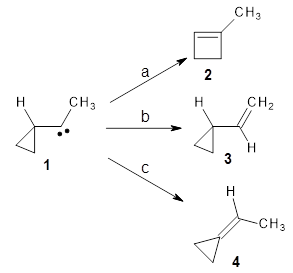
I seem to be recently flooded with papers dealing with tunneling in organic systems. Well, here’s one more! Kozuch, Borden, Schreiner and co-workers seek out systems whereby isotopic substitution might lead to reaction selectivity.1 Their base system is cyclopropylmethylcarbene 1, which can undergo three different reactions: (a) the ring can expand to give 1-methylcyclobut-1-ene 2, (b) a hydrogen can shift from the terminal methyl group to give vinylcyclopropane 3, or (c) the methane hydrogen can shift to produce ethylidenecyclopropane 4. This last option can be neglected since its barrier (20.5 kcal mol-1) is so much higher than for the other two, 7.5 kcal mol-1 for the ring expansion and 12.1 kcal mol-1 for the [1,2]H-shift converting 1 → 3.
At high temperature, the ring expansion to 2 will dominate, but at low temperature the hydrogen shift to 3might dominate by tunneling through the barrier due to the low mass and short distances involved. The reaction rates were computed using B3LYP/6-31G(d,p) and small-curvature tunneling. At low temperature, the rate for the hydrogen shift is 10 orders of magnitude faster than the ring expansion. Thinking that deuterium substitution of the terminal methyl group might slow down the rate of the [1,2]-shift, they computed the rates for the reactions of 1-d3, and in fact the rate of this shift does reduce by 104 but it is still much faster than the rate for ring expansion. What is needed is a system where the rate for ring expansion is slower than the rate for hydrogen migration but faster than the rate of deuterium migration.

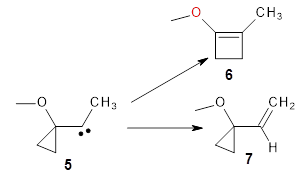
They examine a number of different substituents that may help to lower the barrier for the ring expansion. The methoxy derivative 5 turns out to suit the bill perfectly. The methoxy group reduces the barrier for ring expansion from 7.5 kcal mol-1 with 1 to 2.5 kcal mol-1 with 5. With hydrogenated 5, the [1,2]H-shift is 103 times faster than ring expansion, but with deuterated 5, ring expansion is twice as fast as the deuterium migration.

The authors call this isotope controlled selectivity (ICS), and this is the first example of this type of control.


References

1. Nandi, A.; Gerbig, D.; Schreiner, P. R.; Borden, W. T.; Kozuch, S., Isotope-Controlled Selectivity by Quantum Tunneling: Hydrogen Migration versus Ring Expansion in Cyclopropylmethylcarbenes. J. Am. Chem. Soc. 2017139, 9097-9099, DOI: 10.1021/jacs.7b04593.


InChIs

1: InChI=1S/C5H8/c1-2-5-3-4-5/h5H,3-4H2,1H3
InChIKey=KJIJNBZLGHBOTI-UHFFFAOYSA-N
2: InChI<=1S/C5H8/c1-5-3-2-4-5/h3H,2,4H2,1H3
InChIKey=AVPHQXWAMGTQPF-UHFFFAOYSA-N
3: InChI=1S/C5H8/c1-2-5-3-4-5/h2,5H,1,3-4H2
InChIKey=YIWFBNMYFYINAD-UHFFFAOYSA-N
4: InChI=1S/C5H8/c1-2-5-3-4-5/h2H,3-4H2,1H3
InChIKey=ZIFNDRXSSPCNID-UHFFFAOYSA-N
5: InChI=1S/C6H10O/c1-3-6(7-2)4-5-6/h4-5H2,1-2H3
InChIKey=YMBSTCICUAORNN-UHFFFAOYSA-N
6: InChI<=1S/C6H10O/c1-5-3-4-6(5)7-2/h3-4H2,1-2H3
InChIKey=QBLNAZHAVPMLHB-UHFFFAOYSA-N
7: InChI<=1S/C6H10O/c1-3-6(7-2)4-5-6/h3H,1,4-5H2,2H3
InChIKey=FHYLDABSPVPDTJ-UHFFFAOYSA-N

'
This work is licensed under a Creative Commons Attribution-NoDerivs 3.0 Unported License.

Wednesday, January 10, 2018

Antiaromatic compounds stabilized by benzenoid fusion

Konishi, A.; Okada, Y.; Nakano, M.; Sugisaki, K.; Sato, K.; Takui, T.; Yasuda, M., "Synthesis and Characterization of Dibenzo[a,f]pentalene: Harmonization of the Antiaromatic and Singlet Biradical Character." J. Am. Chem. Soc. 2017, 139, 15284
Jin, Z.; Teo, Y. C.; Teat, S. J.; Xia, Y., "Regioselective Synthesis of [3]Naphthylenes and Tuning of Their Antiaromaticity." J. Am. Chem. Soc. 2017, 139, 15933
Contributed by Steven Bacharach
Reposted from Computational Organic Chemistry with permission

Antiaromatic compounds by definition are unstable and so difficult to prepare. One approach to increase their stability is to fuse aromatic ring(s) onto the antiaromatic system. I discuss in this blog post two different scaffolds where this approach has been successful in preparing molecules that express some degree of antiaromaticity. In addition, I mention a technique to aid in evaluating the aromatic/antiaromatic character.

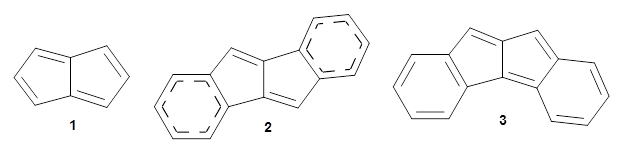
Pentalene 1 is a formal 8-π electron system and would be antiaromatic. To avoid this antiaromatic character, the double bonds are localized. Fusing benzenoid rings to pentalene to give dibenzo[a,e]penatalene 2 has been done, but the central rings avoid antiaromatic character by expressing the Kekule structure shown below.
Yasuda and coworkers report the preparation of mesityl-substituted dibenzo[a,f]penatalene
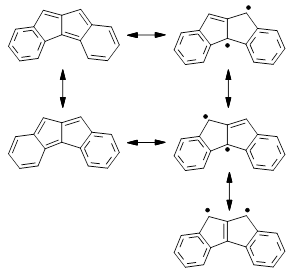
3.1 Resonance structures of 3¸ shown below, either have only one aromatic ring, or have two aromatic rings along with a trimethylenemethane (TMM) diradical component. Thus, one might expect 3 to express more antiaromatic character than 2.
NICS(1) values, computed at B3LYP/6-31G**, for 2 are -6.23 for the 6-member ring and +5.87 ppm for the 5-member ring, showing reduced aromaticity of the former ring. In sharp contrast, the NICS(1) values for 3 are +7.48 for the 6-member ring and +25.5 ppm for the 5-member ring, indicating substantial antiaromatic character for both rings. The calculated spin density distribution shows largest unpaired density on the expected carbon atoms based on the resonance structures involving the TMM fragment.

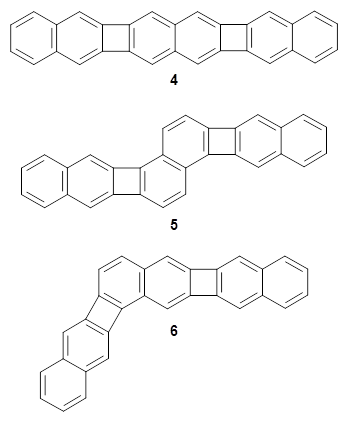
Xia and coworkers have prepared substituted analogues of the three structural isomers whereby three naphthylene units are fused together creating two cyclobutadienoid rings.2 These three frameworks are molecules 4-6. The 4-member rings are formally antiaromatic, tempered by the fused aromatic naphthylene groups. The question is then how does the different attachment geometry manifest in aromatic and/or antiaromatic character?
The computations take advantage of the NICS-XY method – well, a variation of this method. I had meant to write a post about the NICS-XY method when Stanger published it,3 but I just never got around to it. The idea is that NICS is evaluated typically at a single point, and just which point to use has been the subject of some discussion. Instead, Stanger proposes the NICS-XY method as a grid of points perpendicular to the plane of the molecule, typically in the plane bisecting the molecule. Trends in the values as one moves across the ring and perpendicular to the ring could assist in identifying aromatic/antiaromatic behaviour.

Xia computed the NICSπZZ along a line in the molecular plane bisecting the rings. This is shown in the figure below, which I have reproduced from the article. For example, for 4, which is compound 1 in the Xia paper and the figure below, the NICS values are taken along the line that horizontally bisects the molecule. In ring A, the values are negative, indicative of an aromatic ring. Across ring B, the values are still negative, but not as negative as for ring A, indicating a diminished aromaticity. In ring C, the values are positive, as one would expect for the antiaromatic cyclobutadienoid ring.
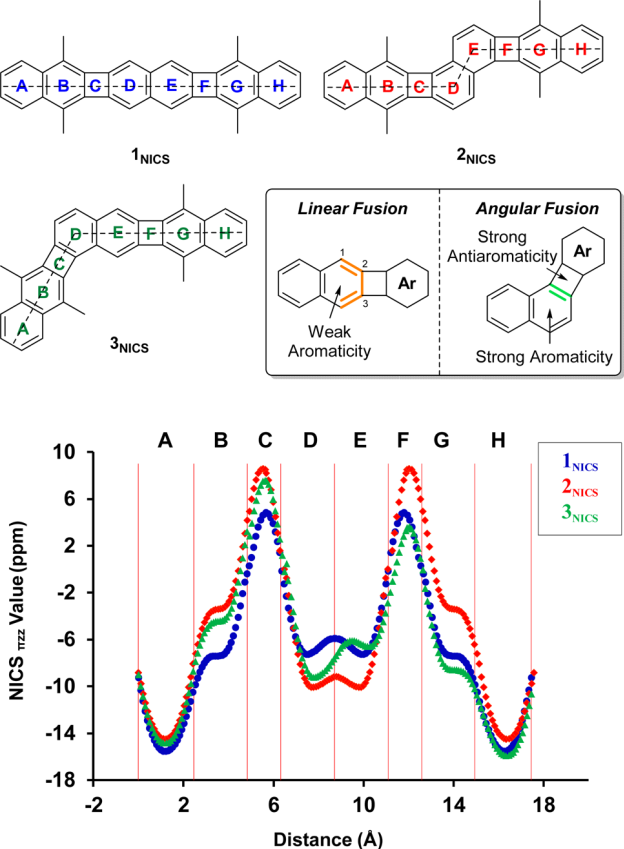
Figure taken from J. Am. Chem. Soc. 2017139, 15933-15939.

The authors highlight two trends. First, in the linear fusion (see the inset above), the aromatic ring fused to the cyclobutadienoid ring expresses diminished aromaticity. This can be understood in the following way. In naphthalene, the C2-C3 bond is longer than the C1-C2 bond. When the cyclobutadienoid is fused at the C2-C3 bond, it can lengthen even more to weaken the antiaaromaticity of the 4-member ring, and this consequently reduces the aromaticity of the 6-member ring. Fusion of the cyclobutadienoid ring at C1-C2, the shorter bond, causes a higher degree of antiaromaticity in the 4-member ring. The lengthening of this C1-C2 bond to try to reduce the antiromaticity of the 4-member ring leads to greater bond equalization in the 6-member ring, and its consequently greater aromatic character.


References

1. Konishi, A.; Okada, Y.; Nakano, M.; Sugisaki, K.; Sato, K.; Takui, T.; Yasuda, M., "Synthesis and Characterization of Dibenzo[a,f]pentalene: Harmonization of the Antiaromatic and Singlet Biradical Character." J. Am. Chem. Soc. 2017139, 15284-15287, DOI: 10.1021/jacs.7b05709.
2. Jin, Z.; Teo, Y. C.; Teat, S. J.; Xia, Y., "Regioselective Synthesis of [3]Naphthylenes and Tuning of Their Antiaromaticity." J. Am. Chem. Soc. 2017139, 15933-15939, DOI: 10.1021/jacs.7b09222.
3. Gershoni-Poranne, R.; Stanger, A., "The NICS-XY-Scan: Identification of Local and Global Ring Currents in Multi-Ring Systems." Chem. Eur. J. 201420, 5673-5688, DOI: 10.1002/chem.201304307.


InChIs

1: InChI=1S/C8H6/c1-3-7-5-2-6-8(7)4-1/h1-6H
InChIKey=GUVXZFRDPCKWEM-UHFFFAOYSA-N
2: InChI=1S/C16H10/c1-3-7-13-11(5-1)9-15-14-8-4-2-6-12(14)10-16(13)15/h1-10H
InChIKey=OZEPXROCWSMGGM-UHFFFAOYSA-N
3: InChI=1S/C16H10/c1-3-7-14-11(5-1)9-13-10-12-6-2-4-8-15(12)16(13)14/h1-10H
InChIKey=XOERMEAUYMRNNZ-UHFFFAOYSA-N
4: InChI=1S/C30H16/c1-2-6-18-10-24-23(9-17(18)5-1)27-13-21-15-29-25-11-19-7-3-4-8-20(19)12-26(25)30(29)16-22(21)14-28(24)27/h1-16H
InChIKey=CHDMCKMZQIHGAH-UHFFFAOYSA-N
5: InChI=1S/C30H16/c1-3-7-19-15-27-25(13-17(19)5-1)23-11-9-22-21(29(23)27)10-12-24-26-14-18-6-2-4-8-20(18)16-28(26)30(22)24/h1-16H
InChIKey=LPXGODOTGXTPRU-UHFFFAOYSA-N
6: InChI=1S/C30H16/c1-2-7-19-13-26-25(12-18(19)6-1)27-15-21-9-10-22-24-11-17-5-3-4-8-20(17)14-29(24)30(22)23(21)16-28(26)27/h1-16H
InChIKey=BKMGPFRQJXDFJQ-UHFFFAOYSA-N

'
This work is licensed under a Creative Commons Attribution-NoDerivs 3.0 Unported License.