Thursday, March 31, 2016

From Wires to Cables: Attempted Synthesis of 1,3,5-Trifluorenylcyclohexane as a Platform for Molecular Cables

Talipov, M. R.; Abdelwahed, S. H.; Thakur, K.; Reid, S. A.; Rathore, R.  J. Org. Chem. 2016
Contributed by Steven Bachrach
Reposted from Computational Organic Chemistry with permission

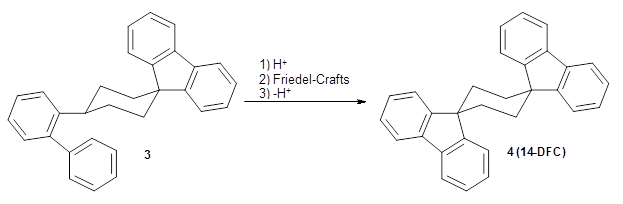
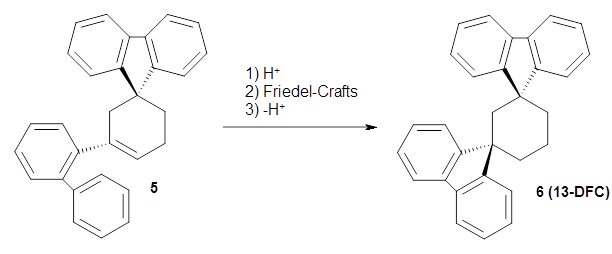
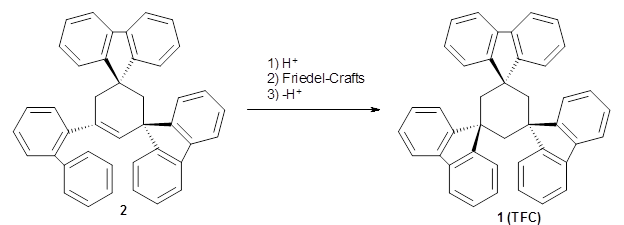
Reid, Rathore and colleagues report on the attempted preparation of the interesting molecule 1,3,5-trifluorenylcyclohexane (TFC) 1.1 They had hoped to prepare it by subjecting the precursor 2 to acid, which might then undergo a Friedel-Crafts reaction to prepare the last fluorenyl group, and subsequent loss of a proton would give 1. Unfortunately, they could not get this step to occur, even at high temperature and for long reaction times. What made it particularly frustrating was that they could get 3 to react under these conditions to give 1,4-difluorenylcyclohexane (14-DFC) 4, and convert 5 into 1,4-difluorenylcyclohexane (13-DFC) 6.

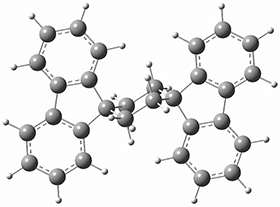
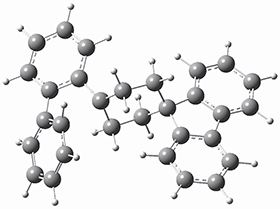
To get at why 1 could not be formed they utilized PCM(CH2Cl2)/M06-2X/6-31G(d) calculations. The lowest energy conformations of 1 and 4 are shown in Figure 1. While 4 is in a chair conformation, 1 is not in a chair conformation since this would bring the three fluorenyl groups into very close contact. Instead, the cyclohexyl ring of 1 adopts a twist-boat conformation, with a much flattened ring. They estimate that 1 is strained by about 17 kcal mol-1, with 10 kcal mol-1 coming from strain in the twist-boat conformation and another 7 kcal mol-1 of strain due to steric crowding of the fluorenyl groups.

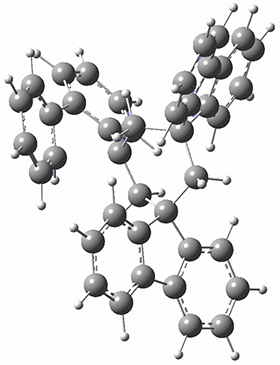
They next optimized the structures of the intermediates and transition states on the path taking 2 into 1 and 3 into 4. The transition states of the Friedel-Crafts reaction are the highest points on these paths, and their geometries are shown in Figure 1. The barrier through the TS for the Friedel-Crafts step forming 1 is about 17 kcal mol-1 higher than for the barrier to form 4. This very large increase in activation barrier, due to the strains imposed by that third fluorenyl group, explains the lack of reaction. Furthermore, since the reaction 2 → 1 is 2.0 kcal mol-1 endothermic, at high temperature the reaction is likely to be reversible and favors 2.
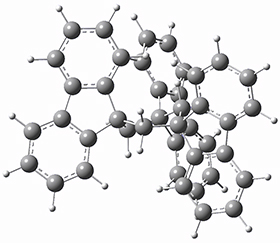
1

4

TS to 1

TS to 4
Figure 1. PCM(CH2Cl2)/M06-2X/6-31G(d) optimized geometries.


References

(1) Talipov, M. R.; Abdelwahed, S. H.; Thakur, K.; Reid, S. A.; Rathore, R. "From Wires to Cables: Attempted Synthesis of 1,3,5-Trifluorenylcyclohexane as a Platform for Molecular Cables," J. Org. Chem. 2016, DOI:10.1021/acs.joc.5b02792.


InChIs

1 (TFC): InChI=1S/C42H30/c1-7-19-34-28(13-1)29-14-2-8-20-35(29)40(34)25-41(36-21-9-3-15-30(36)31-16-4-10-22-37(31)41)27-42(26-40)38-23-11-5-17-32(38)33-18-6-12-24-39(33)42/h1-24H,25-27H2
InChIKey=CXXRVQFQMRJLAI-UHFFFAOYSA-N
4 (14-DFC): InChI=1S/C30H24/c1-5-13-25-21(9-1)22-10-2-6-14-26(22)29(25)17-19-30(20-18-29)27-15-7-3-11-23(27)24-12-4-8-16-28(24)30/h1-16H,17-20H2
InChIkey=ZZTDGVHNROVFMK-UHFFFAOYSA-N
6 (13-DFC):InChI=1S/C30H24/c1-2-11-22(12-3-1)24-14-4-5-15-25(24)23-13-10-20-30(21-23)28-18-8-6-16-26(28)27-17-7-9-19-29(27)30/h1-9,11-19H,10,20-21H2
InChIKey=TTZIUDUAWUTKAI-UHFFFAOYSA-N


This work is licensed under a Creative Commons Attribution-NoDerivs 3.0 Unported License.

Wednesday, March 30, 2016

Development of a True Transition State Force Field from Quantum Mechanical Calculations

Ádám Madarász, Dénes Berta, and Robert S. Paton (2016)
Contributed by Jan Jensen


A true TS FF (TTSFF) is a force field for which the TS is a true saddle point on the PES, i.e. an unconstrained geometry with a zero gradient and exactly one imaginary frequency.  The idea is that you develop the FF parameters for each TS of interest from QM calculations and then use the TTSFF to do a conformational search to find the lowest energy TS structure. The TTSFF itself cannot be used to compute the barrier.

The main trick to making this work is to include harmonic stretch terms between 1-3 atom pairs (i.e. Urey-Bradley) terms in the FF expression. Some trial-and-error is required in selecting which FF parameters to optimise and exactly what to optimise against.

The approach is developed primarily to study selectivity, where the relative energies of TS structures determine which product is made.  However, one could imagine several other potential uses.  For example, one could probably parameterise the TTSFF using a small structural model and then use the TTSFF to find TS structures with large substituents, which would then be used a initial guesses for a QM TS search.  Furthermore, if QM//(TTS)FF barriers turn out to be reasonably accurate then one could save a tremendous amount of CPU time.

I thank @CompChemNews for bringing this paper to my attention


This work is licensed under a Creative Commons Attribution 4.0

Sunday, March 27, 2016

Accurate and Reliable Prediction of Relative Ligand Binding Potency in Prospective Drug Discovery by Way of a Modern Free-Energy Calculation Protocol and Force Field

Wang, L.; Wu, Y.; Deng, Y.; Kim, B.; Pierce, L.; Krilov, G.; Lupyan, D.; Robinson, S.; Dahlgren, M. K.; Greenwood, J.; Romero, D. L.; Masse, C.; Knight, J. L.; Steinbrecher, T.; Beuming, T.; Damm, W.; Harder, E.; Sherman, W.; Brewer, M.; Wester, R.; Murcko, M.; Frye, L.; Farid, R.; Lin, T.; Mobley, D. L.; Jorgensen, W. L.; Berne, B. J.; Friesner, R. A.; Abel, R.  J. Am. Chem. Soc. 2015, 137, 2695-2703
Contributed by Steven Bachrach
Reposted from Computational Organic Chemistry with permission

The ACS National Meeting this week in San Diego had computers in chemistry as its theme. A number of sessions featured computer-aided drug design, and the paper that garnered a lot of attention in many of these sessions was one I missed from last year. The work, done by the Schrödinger company, presents the application of some improved techniques for performing free energy perturbation (FEP) computations.1 FEP involves changing a small number of atoms from one type to another and determining the free energy change with this perturbation. Since so much of the system is left unaffected, the idea is that errors in the non-perturbed parts of the system will cancel, allowing for accurate determination of the free energy change due to the perturbation.

This study features a number of new technologies that have enabled much more accurate predictions. First, they have employed a new force field, OPLS2.1, which appears to provide much improved energies. Second, they have improved sampling of configuration space using the Desmond program and replica exchange with solute tempering (REST). Third, these have been implemented on GPUs that results in dramatically improved throughput. And fourth, they developed a workflow to automate the selection of ligands, created by the perturbations with the protein of interest. They examined up to 10 atom perturbations within the initial ligand.

In a validation study of 8 proteins involving 330 ligands, the RMS error in the free energy of binding was about 1 kcal mol-1. Case studies of different types of perturbations leading to gain or loss of hydrophobic or electrostatic interactions, loss of a binding water and exposure to solvent are detailed. Lastly, in a study of two new proteins, they report a high success in predicting both strong binders and weak binders, with very few false positives.

References

(1) Wang, L.; Wu, Y.; Deng, Y.; Kim, B.; Pierce, L.; Krilov, G.; Lupyan, D.; Robinson, S.; Dahlgren, M. K.; Greenwood, J.; Romero, D. L.; Masse, C.; Knight, J. L.; Steinbrecher, T.; Beuming, T.; Damm, W.; Harder, E.; Sherman, W.; Brewer, M.; Wester, R.; Murcko, M.; Frye, L.; Farid, R.; Lin, T.; Mobley, D. L.; Jorgensen, W. L.; Berne, B. J.; Friesner, R. A.; Abel, R. "Accurate and Reliable Prediction of Relative Ligand Binding Potency in Prospective Drug Discovery by Way of a Modern Free-Energy Calculation Protocol and Force Field," J. Am. Chem. Soc. 2015, 137, 2695-2703, DOI: 10.1021/ja512751q.


This work is licensed under a Creative Commons Attribution-NoDerivs 3.0 Unported License.

Friday, March 4, 2016

Cinchona Alkaloid-Catalyzed Asymmetric Conjugate Additions: The Bifunctional Brønsted Acid–Hydrogen Bonding Model

Grayson, M. N.; Houk, K. N. J. Am. Chem. Soc. 2016, 138, 1170-1173
Contributed by Steven Bachrach
Reposted from Computational Organic Chemistry with permission

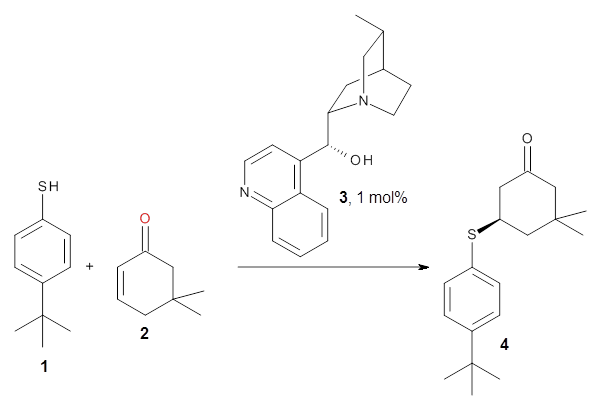
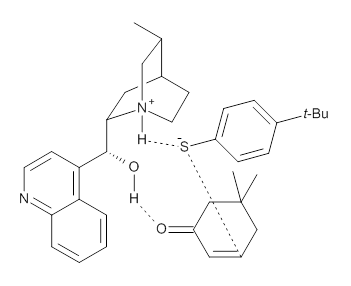
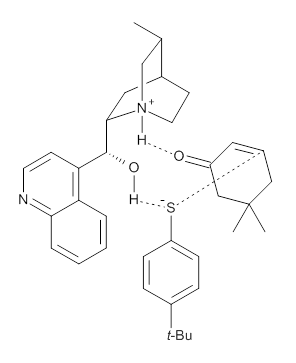
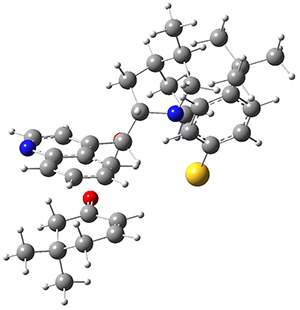
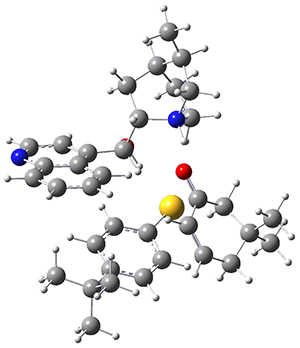
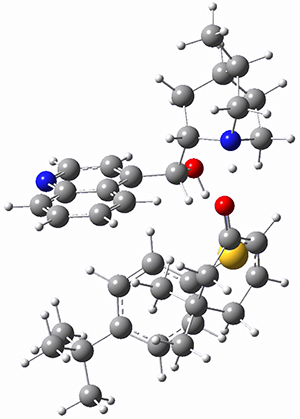
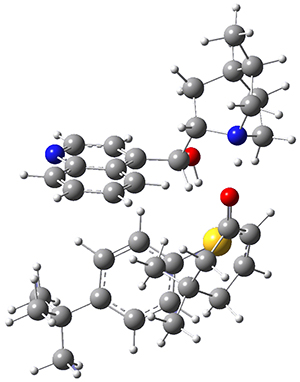
Cinchona alkaloids cat catalyze reactions, such as shown in Reaction 1. Wynberg1 proposed a model to explain the reaction, shown in Scheme 1, based on NMR. Grayson and Houk have now used DFT computations to show that the mechanism actually reverses the arrangements of the substrates.2
Reaction 1
Scheme 1.

Wynberg Model

Grayson and Houk Model
M06-2X/def2-TZVPP−IEFPCM(benzene)//M06-2X/6-31G(d)−IEFPCM(benzene) computations show that the precomplex of catalyst 3 with nucleophile 1 and Michael acceptor 2 is consistent with Wynberg’s model. The alternate precomplex is 5.6 kcal mol-1 higher in energy. These precomplexes are shown in Figure 1.

Wynberg precomplex

Grayson/Houk precomplex
Figure 1. Precomplexes structures

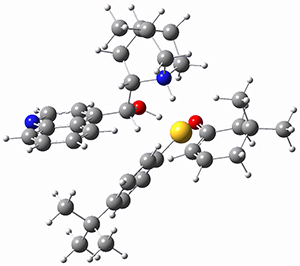
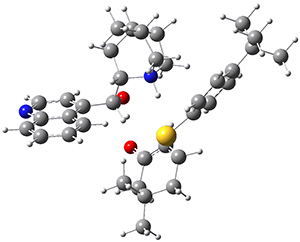
However, the lowest energy transition state takes the Grayson/Houk pathway and leads to the major isomer observed in the reaction. The Grayson/Houk TS that leads to the minor product has a barrier that is 3 kcal mol-1 higher in energy. The lowest energy TS following the Wynberg path leads to the minor product, and is 2.2 kcal mol-1 higher than the Grayson/Houk path. These transition states are shown in Figure 2. The upshot is that complex formation is not necessarily indicative of the transition state structure.

Wynberg TS (major)
Rel ΔG = 5.3

Wynberg TS (minor)
Rel ΔG = 2.2

Grayson/Houk TS (major)
Rel ΔG = 0.0

Grayson/Houk TS (minor)
Rel ΔG = 3.0
Figure 2. TS structures and relative free energies (kcal mol-1).


References

(1) Hiemstra, H.; Wynberg, H. "Addition of aromatic thiols to conjugated cycloalkenones, catalyzed by chiral .beta.-hydroxy amines. A mechanistic study of homogeneous catalytic asymmetric synthesis," J. Am. Chem. Soc. 1981, 103, 417-430, DOI: 10.1021/ja00392a029.
(2) Grayson, M. N.; Houk, K. N. "Cinchona Alkaloid-Catalyzed Asymmetric Conjugate Additions: The Bifunctional Brønsted Acid–Hydrogen Bonding Model," J. Am. Chem. Soc. 2016, 138, 1170-1173, DOI:10.1021/jacs.5b13275.


InChIs

1: InChI=1S/C10H14S/c1-10(2,3)8-4-6-9(11)7-5-8/h4-7,11H,1-3H3
InChIKey=GNXBFFHXJDZGEK-UHFFFAOYSA-N
2: InChI=1S/C8H12O/c1-8(2)5-3-4-7(9)6-8/h3-4H,5-6H2,1-2H3
InChIKey=CDDGRARTNILYAB-UHFFFAOYSA-N
3: InChI=1S/C18H22N2O/c1-12-11-20-9-7-13(12)10-17(20)18(21)15-6-8-19-16-5-3-2-4-14(15)16/h2-6,8,12-13,17-18,21H,7,9-11H2,1H3/t12?,13?,17?,18-/m1/s1
InChIKey=ZOZLJWFJLBUKKL-NKHWWFDVSA-N
4: InChI=1S/C18H26OS/c1-17(2,3)13-6-8-15(9-7-13)20-16-10-14(19)11-18(4,5)12-16/h6-9,16H,10-12H2,1-5H3/t16-/m0/s1
InChIKey=XUTYYZOSKLYWLW-INIZCTEOSA-N


This work is licensed under a Creative Commons Attribution-NoDerivs 3.0 Unported License.

Wednesday, February 24, 2016

From C60 to Infinity: Large-Scale Quantum Chemistry Calculations of the Heats of Formation of Higher Fullerenes

Chan, B.; Kawashima, Y.; Katouda, M.; Nakajima, T.; Hirao, K. J. Am. Chem. Soc. 2016,138, 1420-1429
Contributed by Steven Bachrach
Reposted from Computational Organic Chemistry with permission

What is the size of a molecule that will stretch computational resources today? Chan and co-workers have examined some very large fullerenes1 to both answer that question, and also to explore how large a fullerene must be to approach graphene-like properties.

They are interested in predicting the heat of formation of large fullerenes. So, they benchmark the heats of formation of C60 using four different isodesmic reactions (Reaction 1-4), comparing the energies obtained using a variety of different methods and basis sets to those obtained at W1h. The methods include traditional functionals like B3LYP, B3PW91, CAM-B3LYP, PBE1PBE, TPSSh, B98, ωB97X, M06-2X3, and MN12-SX, and supplement them with the D3 dispersion correction. Additionally a number of doubly hybrid methods are tested (again with and without dispersion corrections), such as B2-PLYP, B2GPPLYP, B2K-PLYP, PWP-B95, DSD-PBEPBE, and DSD-B-P86. The cc-pVTZ and cc-pVQZ basis sets were used. Geometries were optimized at B3LYP/6-31G(2df,p).

C60 + 10 benzene → 6 corannulene
Reaction 1
C60 + 10 naphthalene → 8 corannulene
Reaction 2
C60 + 10 phenanthrene → 10 corannulene
Reaction 3
C60 + 10 triphenylene → 12 corannulene
Reaction 4

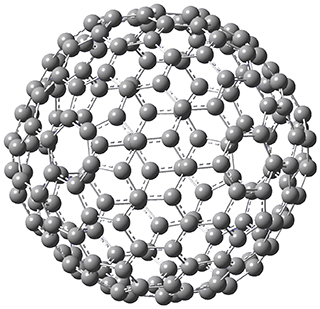
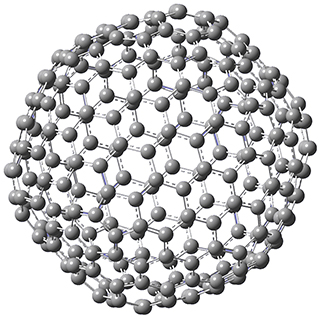
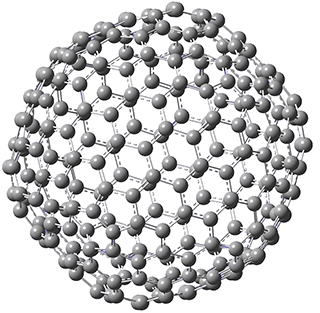
Excellent results were obtained with DSD-PBEPBE-D3/cc-pVQZ (an error of only 1.8 kJ/mol), though even a method like BMK-D3/cc-pVTZ had an error of only 9.2 kJ/mol. They next set out to examine large fullerenes, including such behemoths as C180, C240, and C320, whose geometries are shown in Figure 1. Heats of formation were obtained using isodesmic reactions that compare back to smaller fullerenes, such as in Reaction 5-8.

C70 + 5 styrene → C60 + 5 naphthalene
Reaction 5
C180 → 3 C60
Reaction 6
C320 + 2/3 C60 → 2 C180
Reaction 7

C180

C240

C320
Figure 1. B3LYP/6-31G(2df,p) optimized geometries of C180, C240, and C320. (Don’t forget that clicking on these images will launch Jmol and allow you to manipulate the molecules in real-time.)

Next, taking the heat of formation per C for these fullerenes, using a power law relationship, they were able to extrapolate out the heat of formation per C for truly huge fullerenes, and find the truly massive fullerenes, like C9680, still have heats of formation per carbon 1 kJ/mol greater than for graphene itself.


References

(1) Chan, B.; Kawashima, Y.; Katouda, M.; Nakajima, T.; Hirao, K. "From C60 to Infinity: Large-Scale Quantum Chemistry Calculations of the Heats of Formation of Higher Fullerenes," J. Am. Chem. Soc. 2016,138, 1420-1429, DOI: 10.1021/jacs.5b12518.


This work is licensed under a Creative Commons Attribution-NoDerivs 3.0 Unported License.

Thursday, February 18, 2016

Theory of Graphene Raman Scattering

Eric J. Heller, Yuan Yang, Lucas Kocia, Wei Chen, Shiang Fang, Mario Borunda, and Efthimios Kaxiras

ACS Nano Article ASAP January 2016 doi:10.1021/acsnano.5b07676

Contributed by Alán Aspuru-Guzik

The recent paper by Eric Heller and collaborators is a tour de force that provides the definitive and correct theory for the unusual features of the Raman spectrum of  perhaps the most popular material of the decade, graphene. Heller and collaborators place in serious doubt literally more than 3000 papers that employ a fourth order perturbative ("double resonance") unphysical model. Instead, the authors employ the Kramers-Heisenberg Dirac model that "has been used ever since to explain more than half a million Raman spectra in a very wide range of systems".

 This paper is also a case study of negative inertia effect in science, where once a dominant theory is established as a de facto explanation, thousands of researchers in a subfield do not examine it further and hence it becomes a dogma. It also shows that unfortunately, cross-pollination of theoretical models and ideas between different communities of scientists can take many years to happen.

Several key elements came into play for this paper. The non-negotiable inclusion of coordinate-dependent transition moments is necessary to reproduce the spectra. In addition, Heller and co-workers introduce a new mechanism, named "transition sliding" that is responsible for the unusual high intensity overtones observed in the spectrum. This transition sliding relies on the linear dispersion and Dirac cones of graphene. The linear dispersion leads to a coherent addition of amplitude in the excited state that reinforces a particular state of graphene (2D). The authors argue that due to the lack of linear dispersion in most if not all other molecules, this effect is mostly absent in regular conjugated polymers due to the lack of constructive interference in such cases.

The article contains a comprehensive discussion of all the other spectral features of the material in a very lucid presentation style.

In summary, the authors make a convincing and irrefutable case for the fact that "[t]here is no reason that removing hydrogens from carbon materials should cause KHD to catastrophically fail and require replacement by a theory based on different physics." This paper should be a must-read for any scholar of two-dimensional materials and a case study for every graduate student of theoretical chemistry.

Friday, February 12, 2016

Atropisomerization of 8-Membered Dibenzolactam: Experimental NMR and Theoretical DFT Study

Buevich, A. V.   J. Org. Chem. 2016, 81, 485–501
Contributed by Steven Bachrach
Reposted from Computational Organic Chemistry with permission

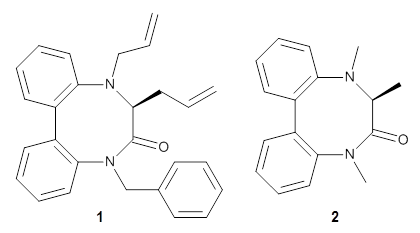
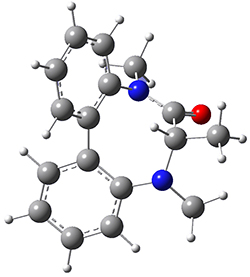
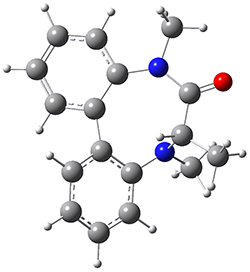
Atropisomers are stereoisomer that differ by axial symmetry, such as in substituted biphenyls or allenes. These acyclic systems have received a fair amount of attention, but now Buevich has looked at atropisomerization that occurs in a ring system.1 1 has a biphenyl as part of the eight-member ring, and the biphenyl can exist in either an M or P orientation. Since C3 is chiral (S), the two isomers are (M,S)-1and (P,S)-1. Variable temperature NMR analysis concludes that (P,S)-1 is 1.19 kcal mol-1 more stable than (M,S)-1, and the barrier for the interchange (P,S)-1 → (M,S)-1 is 26.77 kcal mol-1.


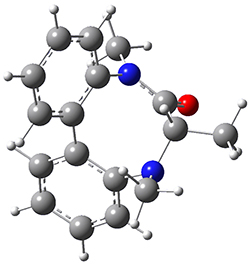
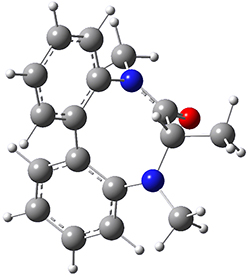
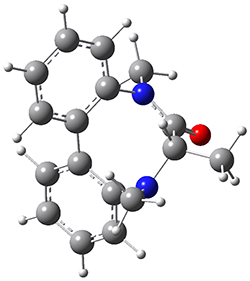
To identify the process for this atropisomerization process, he utilized B3LYP/6-31G(d) computations of the model system 2. A variety of different techniques were used to identify the local energy minimum conformations of both (M,S)-2 and (P,S)-2, and the lowest energy conformers (M1 for (P,S)-2 and M4 for (M,S)-2) are shown in Figure 1. He then produced a series of 2-D potential energy surfaces varying two of the dihedral angles defining the eight-member ring to help identify potential initial geometries for searching for transition states. (As an aside, this procedure ended up identifying a few additional local energy minima not identified in the initial conformational search – and these all have trans amide groups instead of the cis relationship found initially. These trans isomer are considerably higher in energy than the conformers.) With this model and this computational level, (P,S)-2 is 0.76 kcal mol-1 lower in energy than (M,S)-2.

M1
0.0


TS1
3.54


M2
2.21


TS4
25.83


M4
0.76

Table 1. B3LYP/6-31G(d) optimized geometries and relative free energies of some critical points along the lowest energy pathway taking (P,S)-2 → (M,S)-2.

A number of transition states were identified, and the lowest energy pathway that takes M1 into M4 first crosses TS1 to make the minimum M2, which than passes a high barrier (25.8 kcal mol-1) to go to M4. This barrier is in reasonable agreement with the experimental barrier for 1. These TSs are also shown in Figure 1.

Buevich analyzes the conformational process by examination of the changes in the ring dihedral angles following this reaction path. As expected, crossing the highest barrier requires a combination of torsional rotations, but essentially one at a time moving clockwise about the ring.

References

(1) Buevich, A. V. "Atropisomerization of 8-Membered Dibenzolactam: Experimental NMR and Theoretical DFT Study," J. Org. Chem. 2016, 81, 485–501 DOI: 10.1021/acs.joc.5b02321.

InChIs

1: InChI=1S/C27H26N2O/c1-3-12-26-27(30)29(20-21-13-6-5-7-14-21)25-18-11-9-16-23(25)22-15-8-10-17-24(22)28(26)19-4-2/h3-11,13-18,26H,1-2,12,19-20H2/t26-/m0/s1
InChIKey=IYYACMIVKDJSJD-SANMLTNESA-N
2: InChI=1S/C17H18N2O/c1-12-17(20)19(3)16-11-7-5-9-14(16)13-8-4-6-10-15(13)18(12)2/h4-12H,1-3H3/t12-/m0/s1
InChIKey=NIBPKKMKNFOPRM-LBPRGKRZSA-N


This work is licensed under a Creative Commons Attribution-NoDerivs 3.0 Unported License.