Friday, July 12, 2013

Tunneling in the Bergman Cyclization

Greer, E. M.; Cosgriff, C. V.; Doubleday, C. J. Am. Chem. Soc. DOI: 10.1021/ja402445a
Contributed by Dean Tantillo

Edyta Greer and Christopher Cosgriff, in collaboration with Chuck Doubleday, have reported a quantum chemical study of the Bergman reaction of cyclodec-3-en-1,5-diyne (below). Using DFT and CASSCF calculations, they found evidence for a large contribution from heavy atom tunneling to the rate of this reaction even above room temperature.  


The performance of several levels of theory was examined, including a modified BLYP functional (mBLYP) and CCSD(T) on CASSCF geometries; the mBLYP/CASSCF method performed best.  Multidimensional tunneling effects were treated using the small curvature tunneling (SCT) approach in POLYRATE.  

It was predicted that at 200K, 60% of the rate is due to tunneling.  Moreover, the bulk of the tunneling was predicted to originate from energy levels within 2.3 kcal/mol of the transition state.  At temperatures between 310-350K a smaller energy range is predicted (~1.5 kcal/mol), which corresponds to only small changes in the length of the forming C-C bond (<0.2 Å) from its value at the transition state (this energy range is also smaller for wider barriers).  At these temperatures, rate enhancements of >30% due to tunneling were predicted.  

Experimentally testable predictions of the 12-C/13-C kinetic isotope effect at various temperatures were also made. This work not only puts some meat on the bones of various concepts associated with heavy atom tunneling, it also issues a challenge to experimentalists.


Thursday, July 11, 2013

Enantioselective Thiourea-Catalyzed Intramolecular Cope-Type Hydroamination

Brown, A. R.; Uyeda, C.; Brotherton, C. A.; Jacobsen, E. N. J. Am. Chem. Soc. 2013, 135, 6747
Contributed by Steven Bachrach.
Reposted from Computational Organic Chemistry with permission

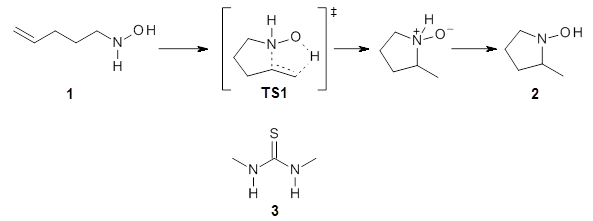
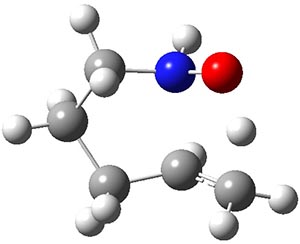
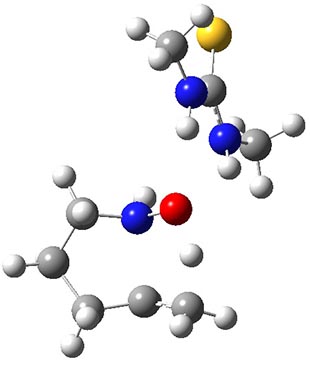
Jacobsen reports on another application of thiourea-based organocatalysts, this time for the catalysis of hydroamination.1 To support the synthetic effort, he examined the uncatalyzed intramolecular hydroamination that takes 1, through TS1 into product 2. The geometry of TS1 optimized at B3LYP/6-31+G(d,p) is shown in Figure 1. The computed barrier for this reaction is 22.2 kcal mol-1. Using a model thiourea as the catalyst (MeHN)2C=S, 3), Jacobsen locates a catalyzed transition state TS2 shown in Figure 1. The activation barrier for this catalyzed reaction is 19.1 kcal mol-1, suggesting that a thiourea can afford a real catalytic effect.

TS1

TS2
Figure 1. B3LYP/6-31+G(d,p) optimized geometries of TS1 and TS2(the catalyzed transition state).

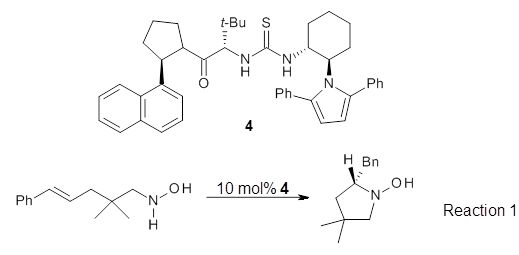
Jacobsen then goes on to show that 4 can act as both an excellent catalyst for the hydroamination reaction along with inducing significant enantioselectivity. An example is Reaction 1, where 10 mol% of catalyst 3 gives an overall yield of 83% and an ee of 91%, while in the absence of catalyst the yield is only 8%.

References

(1) Brown, A. R.; Uyeda, C.; Brotherton, C. A.; Jacobsen, E. N. "Enantioselective Thiourea-Catalyzed Intramolecular Cope-Type Hydroamination," J. Am. Chem. Soc. 2013, 135, 6747-6749, DOI:10.1021/ja402893z.

InChIs


1: InChI=1S/C5H11NO/c1-2-3-4-5-6-7/h2,6-7H,1,3-5H2
InChIKey=JUMXQRNWLGIKEI-UHFFFAOYSA-N

2: InChI=1S/C5H11NO/c1-5-3-2-4-6(5)7/h5,7H,2-4H2,1H3
InChIKey=YVBPNYXAQNAMLH-UHFFFAOYSA-N

3: InChI=1S/C3H8N2S/c1-4-3(6)5-2/h1-2H3,(H2,4,5,6)
InChIKey=VLCDUOXHFNUCKK-UHFFFAOYSA-N

4: InChI=1S/C44H49N3OS/c1-44(2,3)42(41(48)36-25-15-24-35(36)34-23-14-21-30-16-10-11-22-33(30)34)46-43(49)45-37-26-12-13-27-40(37)47-38(31-17-6-4-7-18-31)28-29-39(47)32-19-8-5-9-20-32/h4-11,14,16-23,28-29,35-37,40,42H,12-13,15,24-27H2,1-3H3,(H2,45,46,49)/t35-,36?,37-,40-,42-/m1/s1
InChIKey=OJMZMPGOFWBKAF-FDGFXIECSA-N

Thursday, July 4, 2013

Will molecular dynamics simulations of proteins ever reach equilibrium


Contributed by Gerald Monard


When one runs molecular dynamics simulations, one always wonders whether the trajectories are “long enough”. The ergodic hypothesis states that with an infinite trajectory (in time), all accessible states should be reached. However, one cannot wait an infinite amount of time. In practice, trajectories are finite. Thus the question: did my molecular dynamics simulation have reach equilibrium?

S. Genheden and U. Ryde have analyzed conformational entropies of five protein and protein-ligand complexes with different methods for simulations up to 500 ns. They show that, for all cases, conformational entropies have not converged and that, therefore, all available states have not been reached.

Conformational entropies have been evaluated from the distribution of the dihedral angles, using different models: dihedral-distribution histogramming (DDH), von Mises approach (VMA), quasi-harmonic analysis (QHA), and normal-mode analysis (NMA). The latter was used in the estimation of ligand-protein binding free energies with the MM/GBSA method.

What is interesting in this article is that, whatever the entropy model used, no simulation converged and that entropies are still increasing at the end of the simulations. To explain this, the authors used a very simple model of protein containing only dihedral angles. In this case, the entropy of the model protein increases logarithmically with the simulation time, and the conformational entropy does not converge until the simulation time is larger than all the normal mode mean lifetimes (from 0.2 ps for 1 kJ/mol barrier to 12 h for 100 kJ/mol barrier). Using such an approach, the authors state that after 500 ns of simulation, most of their systems have sampled less than 70% of the conformational spaces and that the entropy will continue to increase with simulation time. Moreover, in the case of BPTI, after 1 ms of simulation, entropy has still not converged!

So, does this mean that we are all wrong when performing MD simulations? Will MD simulations ever reach equilibrium? In the strict sense, the answer is no: MD simulations do not converge, at least when regarding the entropy term. But, do we really need full convergence? As the authors say, reaching all available states for a protein would mean to fold and unfold the protein several times during the MD simulation. Do we (always) need this? In most cases, no.

Another interesting point is the MM/GBSA calculations. Using the NMA model to compute the entropy, the ligand-protein binding free energies converge in the 500 ns simulation time, showing a variation of less than a few kJ/mol. However, this is mainly due to error cancellation in the sum that defines the binding free energy in the MM/GBSA approach. In addition, the NMA approach produces much more stable estimates of the entropy than the other three methods (DDH, VMA, and QHA). This is due to the NMA approach that assumes a single conformation for the protein and estimates the entropy form the vibrational spectrum in this conformation. As long as the protein does not drastically change its conformation and its vibrational spectrum, the NMA entropy does not vary much (but then one could argue that this means that the NMA approach may not be very accurate).

In conclusion, I would say that this article shows that it is hopeless to see MD simulations of proteins to ever reach equilibrium (at least using a single trajectory). But that does not mean we should stop running MD simulations. We have to be (very) careful about the quantities that we are looking at. Different properties show varying sensitivity to this lack of strict equilibration.

Wednesday, July 3, 2013

Atomic-level simulations of current-voltage relationships in single-file ion channels

M.Ø. Jensen; V. Jogini; M. P. Eastwood and D.E. Shaw. J.Gen. Physiol, 141: 619-632 (2013)

Contributed by Ben Corry

There has been much discussion in these pages about papers assessing the accuracy of classical molecular dynamics in reproducing structural aspects of proteins, but less about whether such simulations can be used to understand physiological processes. Many such processes take place over time scales of ms to s and simulating them directly has long been beyond the scope of atomistic methods. But, the situation is rapidly changing with advances in computer hardware and software. One example of an important physiological process close to my heart is the conduction of ions through trans-membrane channels which underlies electrical signalling in nerve cells and takes place on a ms time scale. I am sure that many of us working in the field have thought that direct atomistic simulations have the potential to elucidate the physical mechanisms underlying this process, and have wondered how accurately such simulations could reproduce this phenomena. Yet again, D.E. Shaw Research provide us with an answer.

Making use of extensive computational resources and more than 1ms of simulation time, Jensen et al1 measure the ionic current passing through a voltage gated potassium channel and the simpler gramicidin A channel under a range of voltages, allowing for a direct comparison to one of the most fundamental experimentally measureable properties. Sadly, the results are disappointing. Currents are about 40 times less and 300 times less than equivalent (highly accurate) experimental measurements in the potassium channel and gramicidin A respectively.

What are the reasons for this poor performance? Jensen et al point the finger at the most likely culprit, the accuracy of the non-polarisable biomolecular force field. Altering parameters such as the interaction strength between permeating ions and the protein has only a very small influence on the calculated current highlighting that simple modifications are unlikely to resolve the discrepancy between simulation and experiment. Deficiencies in the lipid model, such as the overestimation of the membrane dipolar potential, are also discussed; and while these are suggested to be a significant factor in the poor performance of the simulation they do not appear to be the major reason for the underestimation of ion currents. The final suggestion is that polarisable force fields may be required to accurately reproduce permeation rates under experimental conditions. Indeed, in the simple case of gA in which ions permeate one at a time, it would appear plausible that the inclusion of polarisability would improve the results by stabilising ions in the pore and reducing the barriers to permeation. It is not discussed is how much the structure of the proteins change during the simulations, especially under the influence of the electric field. If the structures of the proteins deviate from reality (again due to force field limitations) it is possible that this could also contribute to the poor performance of the simulations, in addition to problems with the ion-protein interactions and lack of polarisability. Given that it has only just become feasible to directly simulate ion currents with non polarisable force fields, it may be some time yet before we know if the use of polarisable ones will make the brute force simulation of physiological processes reliable.

References

1.       M.Ø. Jensen; V. Jogini; M. P. Eastwood and D.E. Shaw. J. Gen. Physiol, 141: 619-632


Sunday, June 30, 2013

Molecularspace.org

J. Hachmann, C. Román-Salgado, K. Trepte, A. Gold-Parker, M.A. Blood-Forsythe, L.R. Seress, R. Olivares-Amaya, A. Aspuru-Guzik, The Harvard Clean Energy Project Database
Contributed by +Jan Jensen

The Harvard Clean Energy project, lead by CCH editor Alán Aspuru-Guzik, has released the results of 150,000,000 DFT calculations on 2,300,000 compounds under the CC-BY license at www.molecularspace.org. The details of the calculations has been described in a 2011 Journal of Physical Chemistry Letters paper and will be described further in an upcoming paper.

The compounds in the database were selected as potential candidates for organic photovoltaics and the database contains HOMO and LUMO orbitals energies, and their difference, computed using various DFT functionals, which, in turn are used to estimate power conversion efficiency, the open circuit voltage, and the short-circuit current density using the standard Scharber model.

The HOMO and LUMO energies and gaps represent averages of several DFT methods and conformations and are calibrated against experimental data.  Details of this calibration are not given the 2011 JCP Letters paper, so they may appear in the forthcoming paper.

According to the website, molecularspace.org will soon be augmented by a designer module that "will allow you to help us design new materials. By following simple chemical rules and using our predictive model, you can help us develop new candidates for solar cell materials."

The calculations were made possible by using the World Community Grid managed by IBM.

Creative Commons License
This work is licensed under a Creative Commons Attribution 3.0 Unported License.

Friday, June 28, 2013

Three interesting recent Angew. Chem. papers

Contributed by Steven Bachrach.
Reposted from Computational Organic Chemistry with permission


A note here on a few recent Angew. Chem. articles of interest to readers of this blog. The first is a comment by Frenking1 concerning the “trilogue” by Shaik, Hoffmann and Rzepa2 which discusses the nature of C2, especially the notion that this molecules may possess a quadruple bond (see this post for a previous post on this article.) Frenking argues that the force constant associated with the C-C stretch in C2 is smaller than that in acetylene, so how can one argue that there is some quadruple bond character in C2? A reply from the original authors3 accompanies the comment by Frenking, and they respond by noting that the PES for bond stretching is unusually flat. I had the generally sense, though, that the authors of both articles were really talking past each other and that an opportunity for a more fruitful discussion has been missed.

The other article of note is an excellent review of de novo enzyme design as performed by the Baker and Houk labs.4 This review, authored by leaders of this effort, highlights their approach to this “holy grail” problem. The general notion is to use standard tools of computational chemistry to design a theozyme. Next, this theozyme is placed into known protein motifs with the attempt to have it fit without too much steric clash. The protein is then mutated one residue at a time to optimize the fit and binding of the theozyme to substrate. Lastly, the best targets are synthesized and tested. (The reader can see my post one of their projects: synthetic Diels-Alderase.)


References

(1) Frenking, G.; Hermann, M. "Critical Comments on “One Molecule, Two Atoms, Three
Views, Four Bonds?”," Angew. Chem. Int. Ed. 2013, 52, 5922-5925. DOI: 10.1002/anie.201301485.

(2) Shaik, S.; Rzepa, H. S.; Hoffmann, R. "One Molecule, Two Atoms, Three Views, Four
Bonds?," Angew. Chem. Int. Ed. 2013, 52, 3020-3033, DOI: 10.1002/anie.201208206.

(3) Danovich, D.; Shaik, S.; Rzepa, H. S.; Hoffmann, R. "A Response to the Critical Comments on “One Molecule, Two Atoms, Three Views, Four Bonds?”," Angew. Chem. Int. Ed. 2013, 52, 5926-5928, DOI:10.1002/anie.201302350.

(4) Kiss, G.; Çelebi-Ölçüm, N.; Moretti, R.; Baker, D.; Houk, K. N. "Computational Enzyme Design," Angew. Chem. Int. Ed. 2013, 52, 5700-5725, DOI: 10.1002/anie.201204077.


Thursday, June 13, 2013

Unraveling the Enigmatic Mechanism of L‐Asparaginase II with QM/ QM Calculations

Diana S. Gesto, Nuno M. F. S. A. Cerqueira, Pedro A. Fernandes, and Maria J. Ramos J. Am. Chem. Soc. 2013, 135, 7146
Contributed by Jonathan Goodman

This paper discusses the hydrolysis of asparagine


The transformation is simple, but the catalyst, L-Asparaginase II, is not. The active site of the enzyme contains a number of functional groups which work together to hydrolyse the enzyme. 


The currently accepted mechanism is that the process is related to that of a serine protease, with Thr12 attacking the amide to form an ester that is then hydrolysed. This mechanism looks reasonable. The three-dimensional structure shows that Thr12 is poised over the carbonyl of the amide, close to the π* orbital of the carbonyl and in about the right position to attack. However, studies of mutants of the enzyme do not provide unambiguous support for this proposal. 

This paper reports a computational study of the system using an ONIOM approach, with B3LYP/6-31G(d) for the high-level layer and AM1 for the low-level layer. This split approach made it possible to follow the reaction pathways for the system. Minima and transition states were recalculated using single point calculations at the M06-2X/6-311++G(2d,2p) level. This method showed that the currently accepted mechanism, summarized in the figure below showing the key Thr12-substrate interaction in cyan, was a high energy pathway, and an alternative mechanism involving the attack of a water molecule and stabilization of the intermediate oxyanion by Thr12 was more accessible. The new mechanism is surprising in that Thr12 is above the carbonyl group and so not in a good position to interact with the lone pair of the amide carbonyl. However, this configuration does fit the grand jeté orientation that we recently highlighted for mechanisms involving oxyanion holes (doi: 10.1039/C2OB06717J).


This paper demonstrates that the calculations can provide a sufficiently accurate analysis of the system to inspire an alternative to the currently accepted mechanism. The new mechanism fits all of the available experimental data; it was hard to see how some of the experimental data fitted the original mechanism. The new mechanism, therefore, is to be preferred. If both mechanisms had fitted the available experimental data, would these demanding calculations have been enough to change the currently accepted mechanism to the new process?