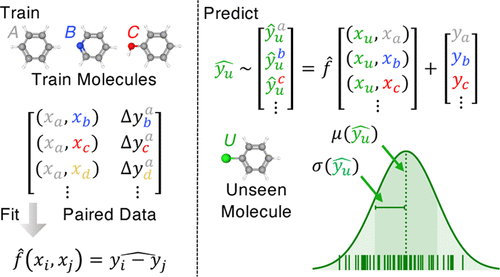
Frank Hu, Francis He, David J. Yaron (2022)
Highlighted by Jan Jensen

This work is licensed under a Creative Commons Attribution 4.0 International License.
Important recent papers in computational and theoretical chemistry
A free resource for scientists run by scientists
Frank Hu, Francis He, David J. Yaron (2022)
Highlighted by Jan Jensen

Paul G. Francoeur, Daniel Peñaherrera, and David R. Koes (2022)
Highlighted by Jan Jensen
Parts of Figures 5 and 6. (c) The authors 2022. Reproduced under the CC-BY licence
One approach to active learning is to grow the training set with molecules for which the current model has the highest uncertainties. However, according to this study, this approach does not seem to work for small-molecule pKa prediction where active learning and random selection give the same results (within the relatively high standard deviations) for three different uncertainty estimated.
The authors show that there are molecules in the pool that can increase the initial accuracy drastically, but that the uncertainties don't seem to help identify these molecules. The green curve above is obtained by exhaustively training a new model for every molecule in the pool during each step of the active learning loop and selecting the molecule that gives the largest increase in accuracy for the test set. Note that the accuracy decreases towards the end meaning that including some molecules in the training set diminishes the performance.
The authors offer the following explanation for their observations: "We propose that the reason active learning failed in this pKa prediction task is that all of the molecules are informative."
That's certainly not hard to imagine given the is the small size of the initial training set (50). It would have been very instructive to see the distribution of uncertainties for the initial models. Does every molecule have roughly the same (high) uncertainty? If so, the uncertainties would indeed not be informative.
Also, uncertainties only correlate with (random) errors on average. The authors did try adding molecules in batches, but the batch size was only 10.
It would have been interesting to see the performance if one used the actual error, rather than the uncertainties, to select molecules. That would test the case where uncertainties correlate perfectly with the errors.

This work is licensed under a Creative Commons Attribution 4.0 International License.
Seunghoon Lee, Joonho Lee, Huanchen Zhai, Yu Tong, Alexander M. Dalzell, Ashutosh Kumar, Phillip Helms, Johnnie Gray, Zhi-Hao Cui, Wenyuan Liu, Michael Kastoryano, Ryan Babbush, John Preskill, David R. Reichman, Earl T. Campbell, Edward F. Valeev, Lin Lin, Garnet Kin-Lic Chan (2022)
Highlighted by Jan Jensen
Figure 1 from the paper. (c) 2022 the authors. Reproduced under the CC-BY licence.
Quantum chemical calculations are widely seen as one of quantum computings killer app's. This paper examines the available evidence for this assertion and doesn't find any.
The potential of quantum computing rests on two assumptions: that the cost of quantum computer calculations on chemical systems scales polynomially with system size, while the corresponding calculations on classical computers scale exponentially.
The former assumption is true for the actual quantum "computation" and the latter assertion is true for the Full CI solution. However, this paper suggests that preparing the state for the quantum "computation" may scale exponentially with system size, and that we don't need Full CI accuracy and that chemically accurate methods such as coupled-cluster based method scale polynomially with system size for a given desired accuracy.
The argument for the potential exponential scaling for system preparation is as follows: If you want the energy of the ground state you have to provide a guess at the ground state wavefunction that resembles the exact wavefunction as much as possible. More precisely, the probability of obtaining the ground state energy scales as $S^{-2}$, where S is the overlap between the trial and exact wavefunction. The authors show that $S$ scales exponentially with system size for a series of Fe-S clusters, which suggests an overall exponential dependence for the quantum computations.
The argument for polynomial scaling of chemically accurate quantum chemistry calculations has two parts: "normal" organic molecules and strongly correlated systems.
The former is pretty straight-forward: no one knowledgeable is really arguing that CCSD(T)-level accuracy is insufficient for ligand-protein binding energies and CCSD(T) scales polynomially with system size. So the simple notion of accelerating drug discovery by computing this with quantum computers does not hold water.
However, CCSD(T) does not work for strongly correlated systems and we don't have any real practical alternative for which we can test the scaling. Instead the authors look at simpler model of strongly correlated systems and demonstrate polynomial scaling with system size.
As the authors are carefull to point out, none of this represents a rigorous proof of anything. But it is far from obvious that quantum chemistry is the killer app for quantum computing that most people seem to think it is.
In addition to the paper you can find a very clear lecture on the topic here.
This work is licensed under a Creative Commons Attribution 4.0 International License.
Wenhao Gao, Tianfan Fu, Jimeng Sun, Connor W. Coley (2022)
Highlighted by Jan Jensen
None of these methods find the optimum value given an "budget" of 10,000 oracle evaluations and for some tasks the best performance is not exactly impressive. This doesn't bode well for some real life applications where even a few hundred property evaluations are challenging.
Some methods are slower to converge than others, so you might draw completely different conclusions regarding efficiency if you 100,000 oracle evaluations. Similarly, some methods have high variability in performance so you might draw very different conclusions from 1 run compared to 10 runs. This is especially a consideration for problems when you can only afford one run. It might be better to choose a method that performs slightly worse on average but is less variable, rather than risk a bad run from a highly variable method that performs better on average.
The method that performed best overall is one of the oldest methods, published in 2017!
Food for thought

This work is licensed under a Creative Commons Attribution 4.0 International License.
Hannes Kneiding, Ruslan Lukin, David Balcells (2022)
Highlighted by Jan Jensen
This representation is combined with two graph-NN methods (MPNN and MXMNet) and trained against DFT properties such as the HOMO-LUMO gap. The results are quite good and generally better than radius graph methods such as SchNet. However, one should keep in mind that both the descriptors and properties are computed with DFT.
Given that the computational cost of the descriptors is basically the same as the property of interest, this is a proof-of-concept paper that shows the utility of the general idea. However, it remains to be seen whether cheaper descriptors (e.g. based on semi-empirical calculations) result in similar performance. However, given the current sparcity of ML tools for TMCs this is a very welcome advance.

This work is licensed under a Creative Commons Attribution 4.0 International License.
Agnieszka Wołos, Dominik Koszelewski, Rafał Roszak, Sara Szymkuć, Martyna Moskal, Ryszard Ostaszewski, Brenden T. Herrera, Josef M. Maier, Gordon Brezicki, Jonathon Samuel, Justin A. M. Lummiss, D. Tyler McQuade, Luke Rogers & Bartosz A. Grzybowski (2022)
Highlighted by Jan Jensen

Michael Tynes, Wenhao Gao, Daniel J. Burrill, Enrique R. Batista, Danny Perez, Ping Yang, and Nicholas Lubbers (2021)
Highlighted by Jan Jensen